Doctor Nguyen Ngoc Tiep, Specialist II, from the Orthopedic Trauma Department at Tam Anh General Hospital Hanoi, stated that Van's shoulder MRI results showed a partial infraspinatus tendon tear and a complete supraspinatus tendon rupture, with fatty atrophy and the tendon end retracted 4 cm from its attachment point. Other rotator cuff tendons were inflamed and edematous.
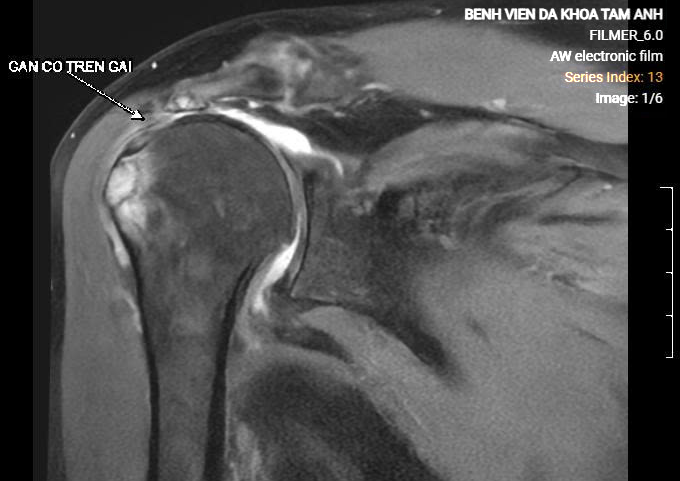 |
Van's MRI scan revealed a complete and retracted supraspinatus tendon rupture. Photo: Tam Anh General Hospital |
Van's MRI scan revealed a complete and retracted supraspinatus tendon rupture. Photo: Tam Anh General Hospital
The shoulder muscle system comprises four tendons: supraspinatus, infraspinatus, subscapularis, and teres minor. The supraspinatus muscle initiates arm elevation and abduction, while the infraspinatus muscle helps rotate the arm. Doctor Tiep explained that the long-standing supraspinatus tendon rupture caused Van's humeral head to lose its stable central position in the glenoid socket, gradually displacing upwards. This led to narrowing of the subacromial space, compressing surrounding soft tissue structures, causing pain and early joint degeneration. Patients primarily experience pain at night and in the morning because joint displacement and increased compression occur when they turn in their sleep.
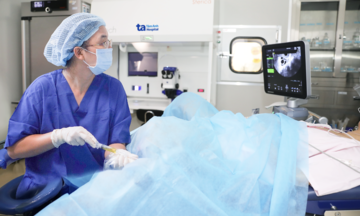
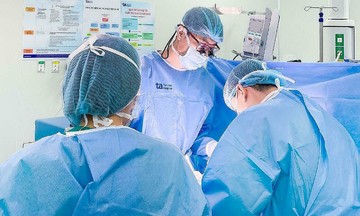
"In this case, repairing the ruptured tendon using conventional methods is not feasible due to a high failure rate," said Doctor Tiep, comparing reattaching a tendon ruptured for many years to patching a worn-out fabric, which easily re-tears with movement. The doctor performed an arthroscopic examination of the right shoulder, confirming the degree of supraspinatus tendon retraction and the low success rate of direct repair. He decided to debride the inflamed and fibrotic tissues and perform a superior capsular reconstruction combined with suturing the remaining part of the supraspinatus tendon.
The doctor made a small incision in the patient's thigh, harvesting a piece of fascia from the right iliotibial band to create a graft for the superior capsular reconstruction, matching the size of the defect. The chosen fascia is strong and durable, capable of healing quickly with minimal impact on motor function.
After reconstruction, the fascial graft was positioned between the humeral head and the acromion, replacing the superior capsule of the shoulder joint. It acts as a biological cushion covering the bone end, limiting displacement, friction that causes pain, and degeneration. The doctor secured the graft to the bone with anchor screws and sutured it to the remaining supraspinatus tendon end using ultra-strong sutures. The partial infraspinatus tendon tear did not require intervention.
Post-operatively, Van received multimodal pain management and wore an abduction brace for three weeks to protect the graft. Doctor Tiep guided the patient through elbow, wrist, and hand exercises. Physical therapy for the shoulder joint began three to four weeks later, with an expected recovery of arm range of motion and strength within three to six months.
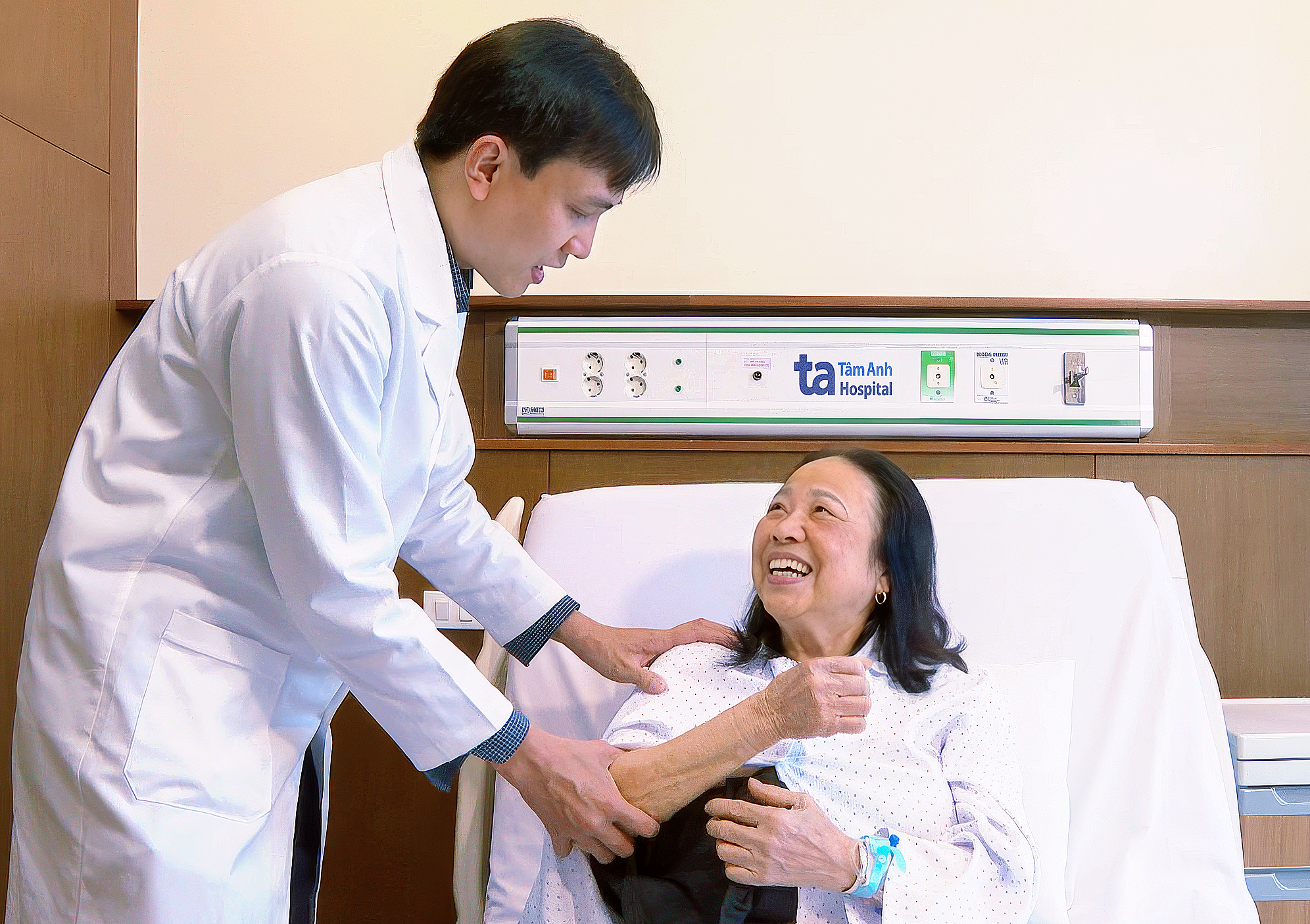 |
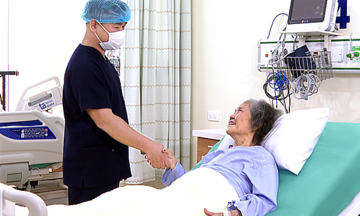
Doctor Tiep examining Van's arm after surgery. Photo: Tam Anh General Hospital |
Doctor Tiep examining Van's arm after surgery. Photo: Tam Anh General Hospital
Supraspinatus tendon ruptures are common in individuals over 60 due to degeneration, which weakens the tendon and makes it prone to tearing even with minor impacts. Younger individuals engaged in heavy shoulder work or sports involving extensive shoulder use, such as painting, plumbing, carpentry, tennis, pickleball, badminton, and weightlifting, also face a high risk. The condition typically affects the dominant shoulder.
Doctor Tiep advises individuals experiencing shoulder pain when raising or lowering their arm, night pain, muscle weakness, or restricted movement to seek early medical attention. For elderly patients with degeneration, conservative treatment with medication and physical therapy may be effective. Surgery is indicated if there is no improvement after three months. The optimal time for tendon repair is within six months, as longer delays lead to more complex surgeries and increase the risk of joint degeneration, potentially requiring shoulder replacement.
Thanh Long