Severe myopia is defined as over 6 diopters, with an eyeball axial length exceeding 26 mm (compared to a normal 23-24 mm in adults). This condition stretches the retina, making it thin and vulnerable to damage. Individuals with severe myopia not only rely on corrective lenses but also face a significantly higher risk of eye diseases compared to those with less than 4 diopters of myopia.
Dr. Le Thi Thanh Hai, a Second Degree Specialist at the High-Tech Eye Center, Tam Anh General Hospital, TP HCM, identifies common eye diseases in people with severe myopia.
Retinal tear
A retinal tear is a common complication in degenerated retinas of individuals with severe myopia. The primary cause is the vitreous humor pulling on thin, weakened retinal areas, creating a tear. Patients may suddenly see flashes of light, an increase in floaters, or dark areas in their vision. This condition requires early detection and treatment to prevent progression to retinal detachment and limit the risk of vision loss.
Retinal detachment
Retinal detachment occurs when the retinal layer separates from the underlying nourishing tissue, often after a tear. In people with severe myopia, the risk is higher due to thin and easily stretched retinas. Symptoms include a sensation of a curtain over the eye, expanding dark areas in the vision, or rapid or sudden vision loss. This is an ophthalmic emergency; without timely intervention, it can lead to blindness.
Vitreous degeneration
The vitreous humor is a clear gel that helps maintain the eyeball's structure. In people with severe myopia, the vitreous tends to liquefy and shrink earlier. This causes the vitreous fibers to pull away, separating the vitreous from the retina and optic nerve, leading to degeneration. Common symptoms include floaters and flashes of light. Early treatment is crucial to prevent complications such as posterior vitreous detachment, vitreous hemorrhage, retinal tear, or retinal detachment.
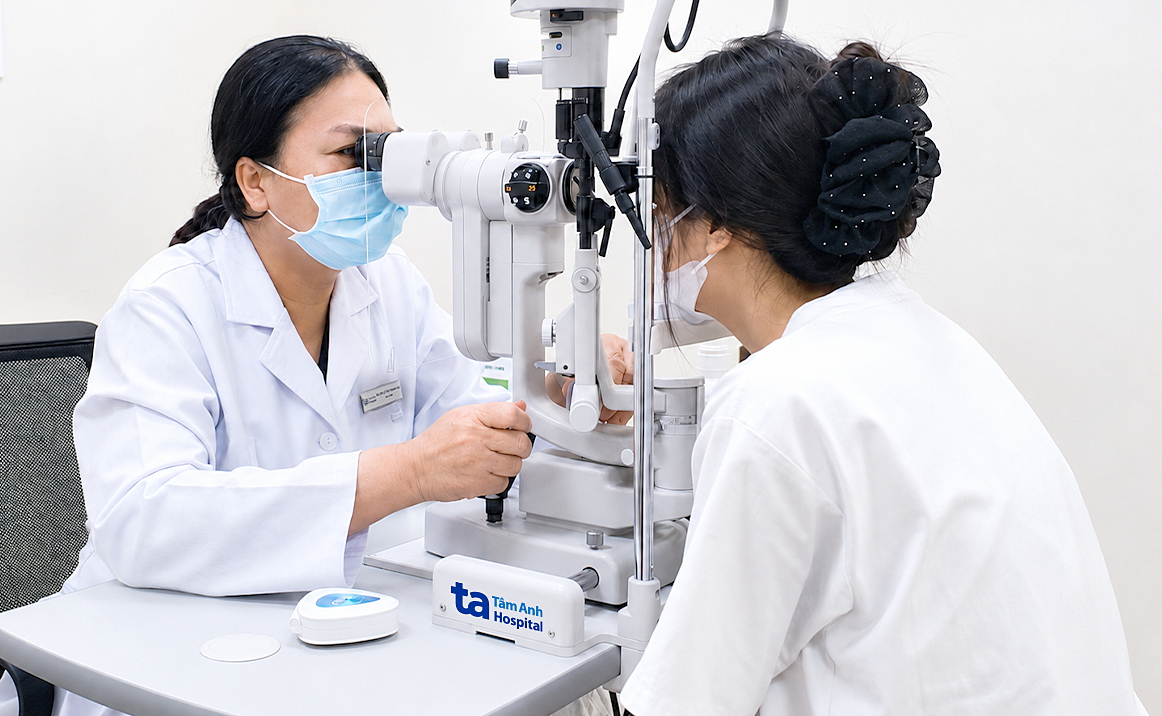 |
Dr. Hai examines a woman's eyes. Illustrative photo: Tam Anh General Hospital
Retinal degeneration
Retinal degeneration can occur in the central area (macula) - which determines the ability to see fine details - or in other retinal regions. Patients may experience blurred vision, distorted images, difficulty reading, floaters, or flashes of light. If not detected and treated promptly, the condition can cause irreversible vision loss or progress to retinal detachment.
Depending on the type and severity, doctors prescribe appropriate treatment methods such as eye drops, oral medication, laser therapy, or surgery. However, retinal diseases in myopic individuals often cannot be completely cured because there is no method to shorten the eyeball's axial length. Myopia correction procedures only improve vision; they do not alter the inherently elongated structure of the eyeball.
In Vietnam, young people in major cities are seeing an increasing trend in refractive errors. According to a report by the Ho Chi Minh City Department of Health, student health examination data for the 2025-2026 academic year recorded over 60% of children with refractive errors, mostly myopia, a twofold increase compared to six years ago.
Dr. Hai states that the main causes include genetics, insufficient lighting in living environments, prolonged exposure to blue light (from phone and computer screens), incorrect posture, or extended periods of near vision work.
In addition to retinal and vitreous diseases, people with severe myopia also face a high risk of developing glaucoma, cataracts, and macular degeneration. Dr. Hai recommends that myopic individuals have regular eye exams every six months to monitor the fundus (back of the eye) and ensure correct lens prescription. If there is a sudden increase in floaters, flashes of light, a curtain-like sensation over the eye, or rapid vision loss, prompt examination is necessary.
Ngoc Kim Tham
| Readers can submit questions about ophthalmic diseases here for doctors to answer. |