In the first three months of 2026 alone, Ho Chi Minh City recorded over 8,100 hand, foot, and mouth disease cases, more than double the number from the same period last year. Over 300 outbreaks have been identified, primarily in schools and the community. The week in mid-March saw nearly 900 new cases.
More concerning, severe cases exceeded 100, a five-fold increase compared to the same period, leading to four child deaths. Tests confirm that EV71, a virus strain responsible for several major past outbreaks, is now dominant and the primary reason for the sharp rise in severe cases.
Intensive care units are facing direct pressure. At Nhi Dong 1 Hospital, while the total number of patients currently receiving treatment is just over 30—significantly lower than the peak of 200 cases during previous outbreaks—the proportion of severe cases (from grade 2B upwards) has reached 20-30%, which is three to six times the usual rate.
In the first three months of the year, the hospital admitted approximately 80 severe cases, surpassing the total of 58 cases recorded in all of 2025. Dr. Cao Minh Hiep, Head of Planning and General Affairs, stated that the unit has increased its intensive care beds from 30 to 50 and is prepared to expand the infectious disease department to a maximum of 250 beds if needed.
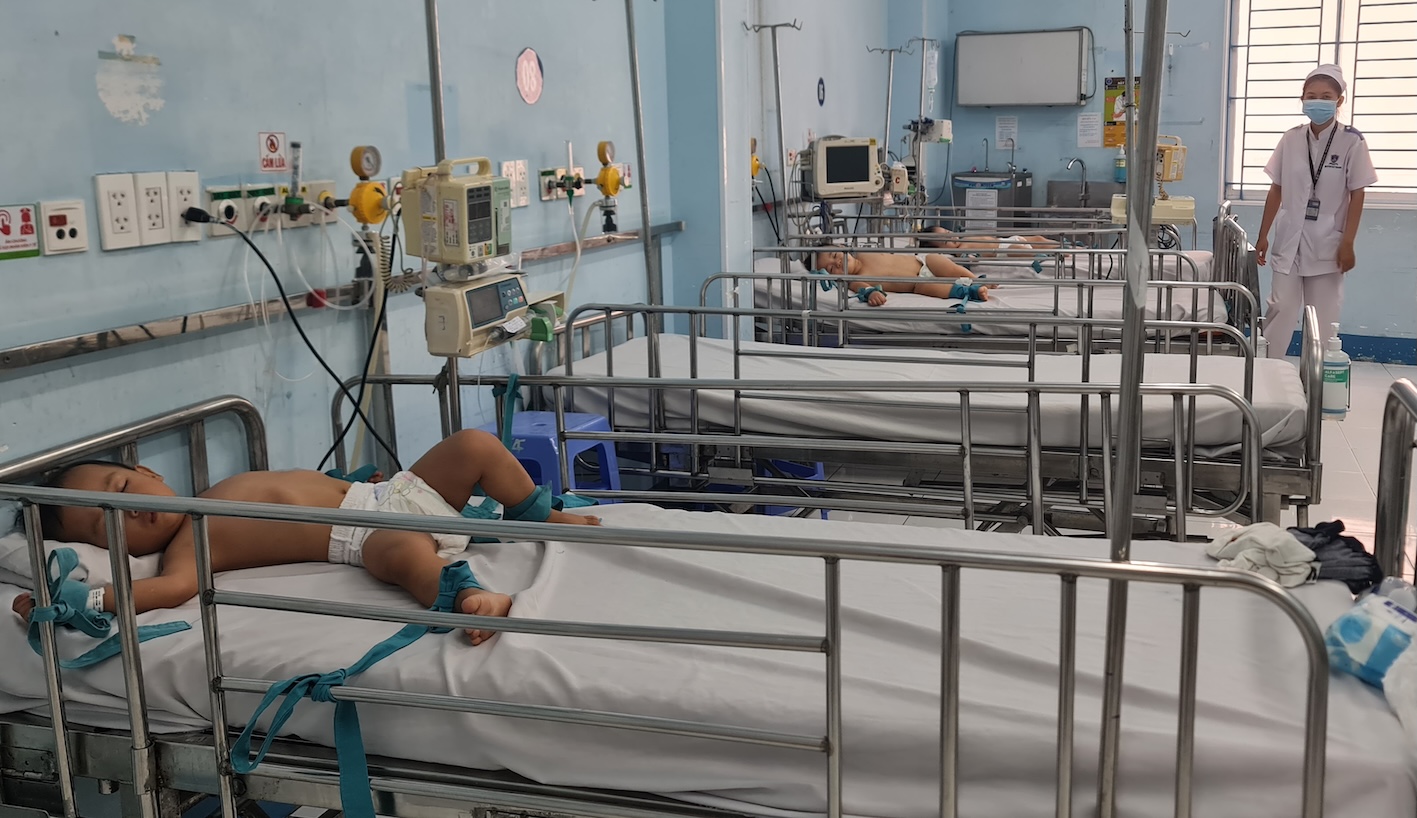 |
Children with severe hand, foot, and mouth disease are treated at Nhi Dong 1 Hospital, with their limbs secured to the bed to prevent agitation. *Photo: Le Phuong*
A similar situation is unfolding at Nhi Dong 2 Hospital. Dr. Nguyen Dinh Qui, Head of the Infectious Diseases Department, reported that the rate of severe cases in the first quarter was 15-16%, which he described as "a worrying figure." Almost every week, the hospital admits cases ranging from grade 2B to grade 4, with many deteriorating rapidly within 24 hours, requiring immediate emergency treatment and continuous dialysis.
The hospital has developed a tiered response plan. When inpatient cases increase from under 25 to between 25 and 50, the Infectious Diseases Department will reduce admissions for less contagious conditions to free up space. If cases exceed 50, the entire former Covid-19 treatment area will be reactivated, increasing the total capacity from 92 to 150 beds.
At Nhi Dong Thanh Pho Hospital, among over 300 admissions recently, 20% were very severe, and two-thirds of these patients were transferred from other provinces. Dr. Nguyen Minh Tien, Deputy Director of the hospital, warned that many cases present with atypical symptoms, such as skin lesions easily mistaken for atopic dermatitis or wheezing symptoms confused with bronchitis. This necessitates thorough training for doctors at lower-level facilities to avoid missed diagnoses.
The characteristic of EV71 is its extremely rapid attack on the central nervous system. Children can transition from mild symptoms to grade 2B or grade 3 within just 24-48 hours. If a child is already at grade 4, with heart and brain damage, and must travel for hours to Ho Chi Minh City, the risk of death or permanent brain damage is very high.
Therefore, the current core strategy is to treat children locally rather than transferring them to higher-level facilities. Nhi Dong Thanh Pho Hospital is ready to deploy teams with ECMO machines directly to provincial hospitals for on-site intervention. Nhi Dong 1 Hospital is leveraging its remote consultation network via telehealth, Zalo, and Viber, maintaining a mobile team ready to provide support, and integrating severe disease warning signs directly into electronic prescriptions for parents to monitor at home.
Regarding medication, hospital stockpiles currently include thousands of vials of Gamma Globulin (IVIG) and large quantities of the anticonvulsant Phenobarbital, ensuring sufficient supply even if the epidemic peaks.
Dr. Nguyen Van Vinh Chau, Deputy Director of the Ho Chi Minh City Department of Health, stated that directives have been issued to four leading hospitals (Nhi Dong 1, Nhi Dong 2, Nhi Dong Thanh Pho, and the Hospital for Tropical Diseases) to promptly reinforce treatment efforts, secure drug supplies, and continuously provide training and guidance to grassroots healthcare facilities. This aims to ensure early detection of severe cases and minimize the risk of death.
Meanwhile, Deputy Minister of Health Nguyen Thi Lien Huong assessed the risk of an outbreak in the southern region as high. She urged localities to remain vigilant, proactively review referral procedures, and consider expanding surveillance testing to close contacts, including child caregivers and preschool teachers, to halt transmission early.
Le Phuong