A solar eclipse occurs when the moon passes between the Earth and the sun, forming a straight line. During this event, the moon partially or completely blocks the sun's light as observed from Earth.
Master of Science, Doctor Duong Minh Phuc, from the High-Tech Eye Center at Tam Anh General Hospital, Ho Chi Minh City, states that eye damage from a solar eclipse falls under solar retinopathy. This is a common complication that can arise when eyes are directly exposed to high-intensity light.
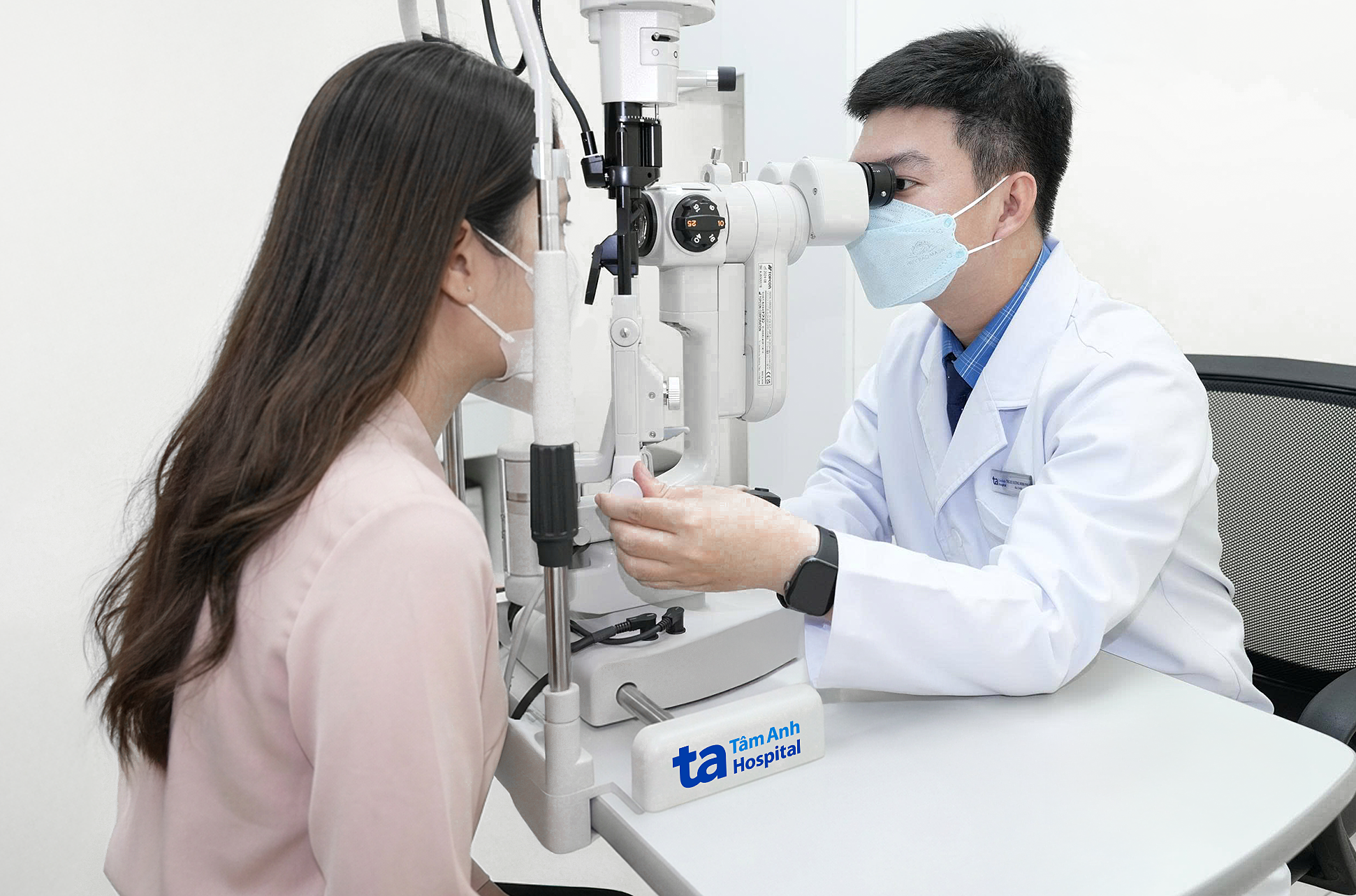 |
Doctor Phuc examines a woman's eyes. Illustration: Tam Anh General Hospital |
When observing a solar eclipse, even if the sun is partially obscured by the moon, the remaining light still has very high intensity. This light energy, along with ultraviolet (UV) rays, can damage photoreceptor cells and the retinal pigment epithelium, especially in the macula. The macula is located at the center of the retina and is crucial for central vision and color perception.
This damage does not cause immediate sensation but typically manifests as eye pain, grittiness, redness, distorted vision, and tearing several hours to several days later. In severe cases, individuals may experience impaired color discrimination and irreversible vision loss.
Solar retinopathy is difficult to detect with the naked eye. For accurate diagnosis, doctors use an optical coherence tomography (OCT) scan to evaluate the retinal layers in detail. According to Doctor Phuc, if anyone notices abnormal eye symptoms after viewing a solar eclipse or other astronomical phenomena, they should visit a hospital with an ophthalmology department for timely examination and treatment.
Currently, there is no method to restore retinal cells that have been damaged by light. Treatment focuses on monitoring and supportive care to preserve vision. In mild cases, vision may gradually improve over several weeks to several months. However, if the photoreceptor cells in the macula are severely damaged, individuals may suffer permanent vision loss.
Doctors advise against looking directly at strong light sources for extended periods. When observing astronomical phenomena or working in environments with high light sources or UV radiation, specialized protective eyewear should be used to safeguard the eyes.
Ngoc Kim Tham
| Readers can submit questions about ophthalmic diseases here for doctors to answer |