Concerns about food safety have arisen in Taiwan following reports that napa cabbage from Hebei province, China, was soaked in formaldehyde by traders to extend its shelf life.
To clarify the issue, nutritionist Kao Min-min, an advisor to major health portals in Taiwan, provided a detailed explanation of the chemical's nature in a personal post in late August.
Kao explained that formaldehyde acts as a preservative and inhibits microorganisms by forming cross-links with molecules like proteins, DNA, and RNA, thereby destroying cell structures. This property led to its common use in preserving medical specimens, and the familiar solution known as "formalin" is essentially an aqueous solution primarily composed of formaldehyde.
The freshness of vegetables is easily affected by time, temperature, and humidity during harvesting, transport, and storage. Consequently, some unscrupulous traders have illegally used this chemical to slow decomposition and maintain a fresh appearance. This issue is not limited to napa cabbage or bok choy; some seafood products have also faced food safety incidents involving the illicit use of formaldehyde.
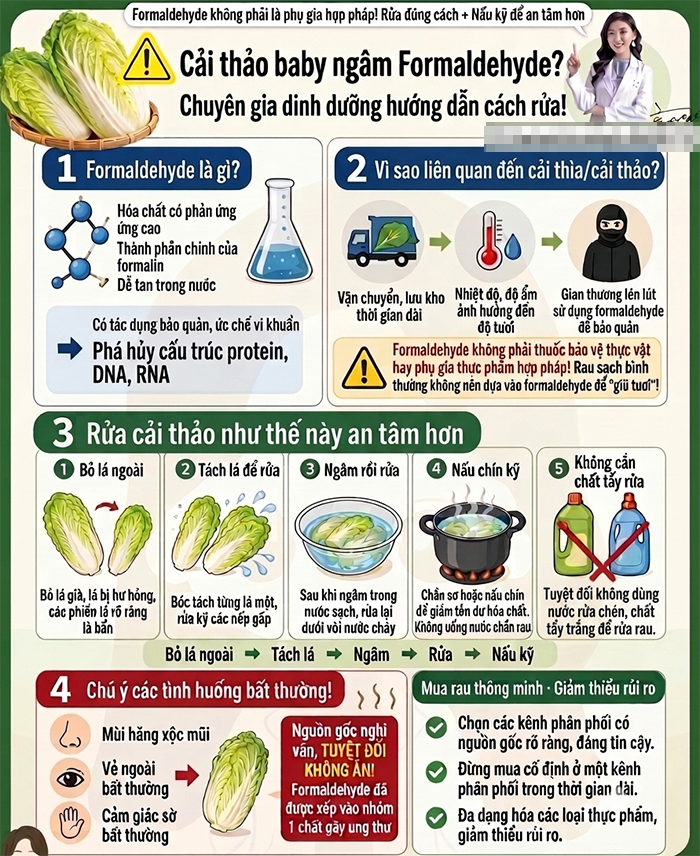 |
Nutritionist Kao Min-min demonstrates how to clean bok choy and napa cabbage. Graphic: AI |
The expert emphasized that formaldehyde is neither a legal pesticide nor an approved food additive for preservation. Common vegetables cannot and should not rely on this chemical to maintain freshness. However, given formaldehyde's high water solubility, consumers concerned about unusual chemical residues on vegetables can minimize risks through proper preparation and thorough cooking.
To safely clean bok choy and napa cabbage, home cooks must follow a sequential process instead of simply rinsing the whole vegetable before cooking.
First, remove the outermost old leaves, any damaged or visibly soiled leaves. Then, separate each leaf stalk to thoroughly clean the folds and the stem junction.
Next, soak the vegetables in clean water for a short period, then rinse them thoroughly under running water. There is no need to use additional detergents like dish soap or bleach.
Finally, cook the vegetables thoroughly. Studies indicate that blanching or boiling in hot water can reduce residual formaldehyde. For example, home cooks can blanch bok choy in boiling water for about 3 minutes or napa cabbage for about 60 seconds. Another method is to remove the outermost old leaves, soak the vegetables in water for about 30 minutes, and then cook them.
However, these timings are based on specific research conditions. The essential practice in daily cooking remains to follow all steps: removing outer leaves, separating stalks, soaking in water, rinsing under running water, and cooking thoroughly.
 |
Nutritionist Kao Min-min. Photo: Marketersgo |
The World Health Organization (WHO) classifies formaldehyde as a Group 1 carcinogen. Kao warned that if purchased bok choy has a pungent, unusual odor, or abnormal shape and texture, people should not assume that a few extra rinses will make it safe.
The expert recommended that the safest solution for health is to avoid consuming foods of questionable origin. Instead of completely boycotting bok choy and napa cabbage, consumers should prioritize purchasing food from reputable sources with clear origins, diversify their daily diet, and maintain the habit of thorough washing and cooking.
Binh Minh (Source: Mirror Daily)