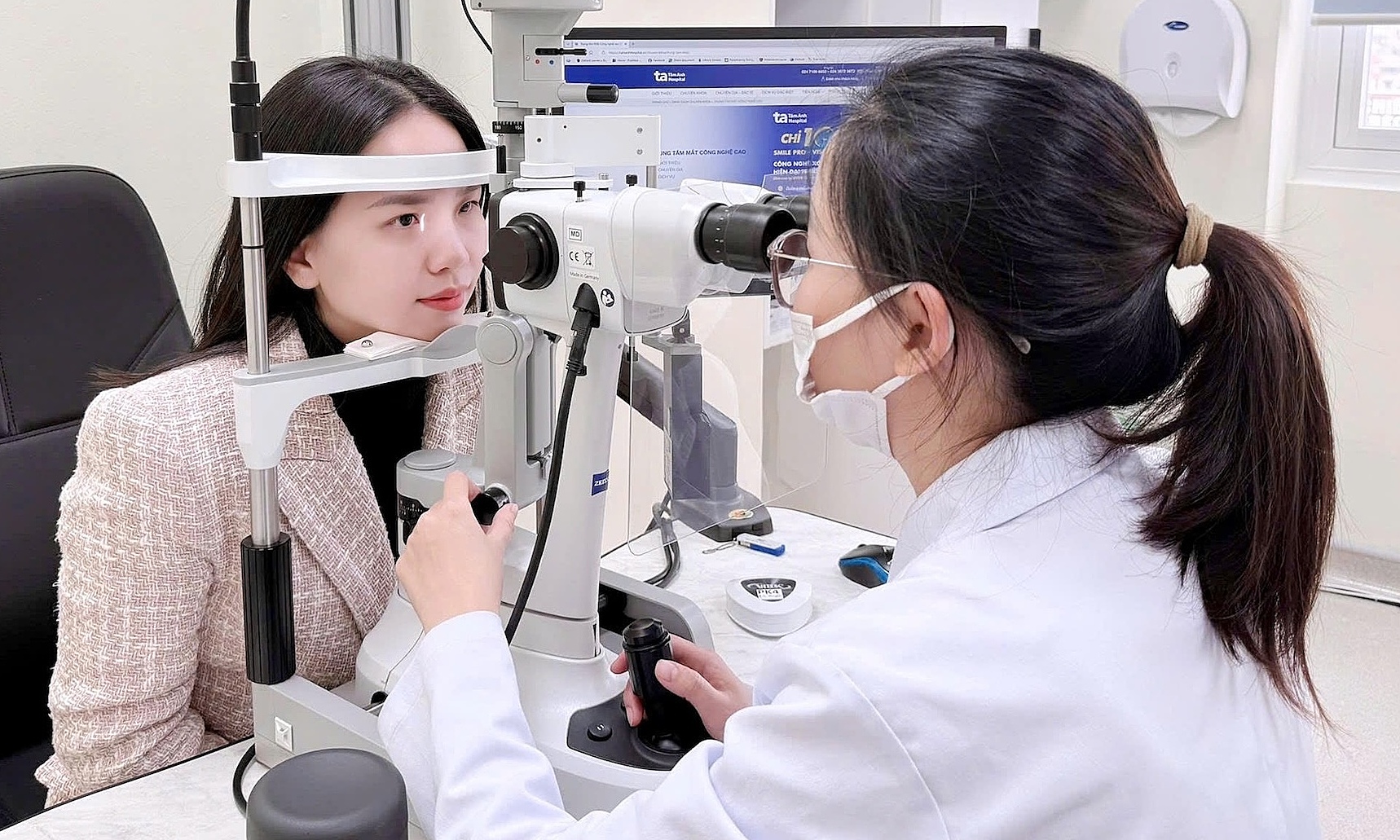
Ms. Thuy felt an itch in her ear after a mountain climbing trip. When she scratched, she found a dead insect, though she couldn't identify it. Three days later, her ear became uncomfortable, painful, and she experienced tinnitus. She sought examination at Tam Anh Cau Giay General Clinic.
Endoscopy revealed a perforated eardrum that could not heal naturally. The eardrum surface was fibrotic, thickened, and lacked its normal elasticity. Master, Doctor Nguyen Chi Trung, from the Ear, Nose, and Throat (ENT) Department, noted numerous small insect remains behind the eardrum during ear cleaning.
The doctor used a betadine-soaked dressing to eliminate any remaining insects in the ear, combined with daily ear drops for cleaning. During a follow-up visit, Ms. Thuy's tinnitus and ear itching had subsided. She was scheduled for tympanoplasty, an eardrum repair surgery, to close the perforation.
 |
Endoscopy revealed Ms. Thuy's perforated eardrum. *Photo: Tam Anh General Hospital* |
Ms. Thuy had undergone eardrum repair surgery six years prior due to complicated otitis media. After the first surgery, she resumed normal activities; the incision healed well, the graft integrated successfully, and her hearing was normal. This current tear was in the same location as her previous eardrum tear.
For individuals with a history of eardrum perforation and repair, the eardrum's structure may not fully recover. Weakened tissue and fibrotic areas are less durable than a normal eardrum. According to Doctor Trung, when an insect enters, even a minor impact can lead to a re-perforation.
A less durable eardrum also complicates a second repair surgery. The surgical team must harvest a tissue graft from the temporalis fascia muscle to cover the perforated eardrum.
Doctors advise that if an insect enters the ear, patients should not panic or try to remove it themselves. This can push the foreign object deeper and damage internal structures. One can try: shining a light to attract the insect out, or instilling a small amount of an appropriate solution, as directed, to suffocate or kill it. If symptoms do not improve, it is necessary to seek treatment at an ENT specialist clinic.
Individuals who have undergone eardrum repair surgery or have a history of otitis media, with weakened eardrum structures, should not attempt self-treatment. Doing so can increase the risk of re-perforation or widespread inflammation. If symptoms such as ear itching, ear pain, a sensation of a foreign object, or hearing loss appear, seek early medical attention for examination and timely treatment.
Thuy Hanh
| Readers can submit questions about ear, nose, and throat conditions here for doctors to answer. |