Eng English
China 中国人

Eng English
China 中国人
  • News
  • World
  • Business
  • Entertainment
  • Sports
  • Law
  • Education
  • Health
  • Lifestyle
  • Travel
  • Science
  • Digital
  • Automobiles
  • Trở lại Thể thao
  • Health
Friday, 28/8/2026 | 09:07 GMT+7

Is a second hand, foot, and mouth disease infection less severe than the first?

My child recovered from hand, foot, and mouth disease but was re-infected. Is the second infection less severe, and how should I monitor my child? (Anh Thu, 30, Bac Giang)

Answer:

The severity of a recurrent hand, foot, and mouth disease infection depends on the virus strain, the child's age, immune status, and the approach to detection and care.

The disease is caused by various enteroviruses, most commonly Coxsackie A16, A6, A10, and Enterovirus 71 (EV71). EV71 itself has multiple subgroups (B4, B5, C4, C1, etc.), meaning immunity after a first infection provides protection primarily against that specific subgroup, but not fully against others. Therefore, children can be re-infected if they contract a different subgroup.

Disease severity varies by pathogen: A16 typically causes mild illness; A6 leads to high fever and widespread rash; EV71 is often associated with severe cases and neurological or cardiopulmonary complications such as encephalitis, meningitis, pulmonary edema, and cardiopulmonary failure. A large study in China indicated that children re-infected with EV71 or other enteroviruses faced a much higher risk of severe illness compared to those re-infected with A16.

Young children, especially those under three, malnourished children, or those with underlying conditions or compromised immunity, are more susceptible to severe progression. Conversely, healthy children who are diagnosed early and receive proper care typically recover better, though parents still need to monitor them closely.
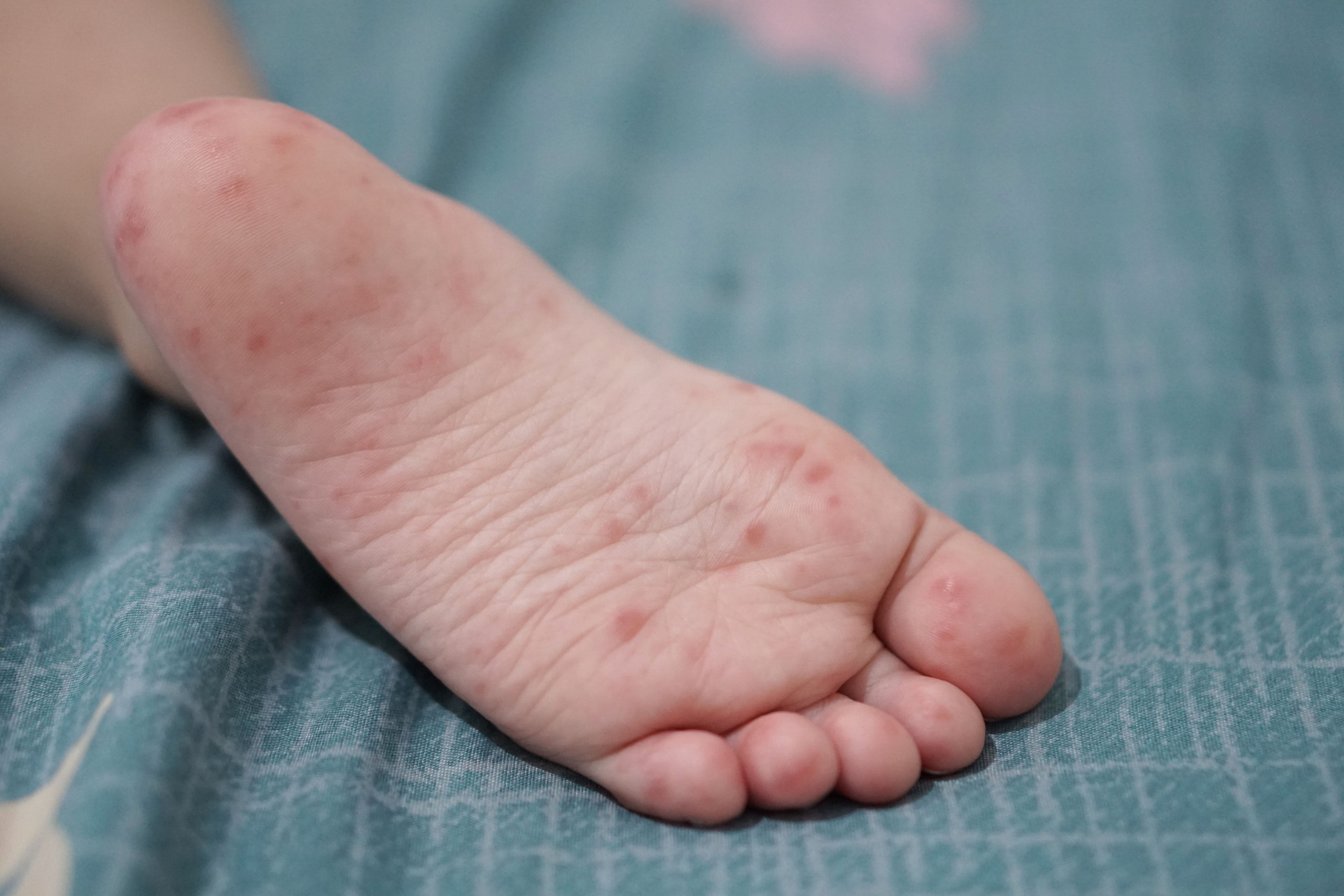
Children who have had hand, foot, and mouth disease can still be re-infected. *Vecteezy*

Improper care can worsen the disease: this includes self-administering antibiotics, incorrect antipyretic dosing, avoiding bathing, overtight swaddling, applying unknown herbal remedies or solutions, or allowing the child to become dehydrated due to painful mouth sores. More dangerously, assuming "it's already been contracted, so this time it will be mild" and overlooking warning signs can lead to delayed hospitalization when neurological or cardiopulmonary complications have already developed.

When a child contracts hand, foot, and mouth disease for a second time, parents should seek medical attention and monitor them closely during the initial days, even if the rash is minimal. Children need rest, sufficient hydration, soft and cool foods, and antipyretics administered as directed. Do not puncture blisters or apply medication indiscriminately. Seek immediate medical care if the child experiences: prolonged high fever, sudden startling, trembling limbs, drowsiness, excessive vomiting, limb weakness, rapid or unusual breathing, or cold hands and feet.

Currently, there is no specific treatment for the disease, but an EV71 vaccine was approved in 3/2026. The vaccine is for children from two months to under six years old. VNVC Immunization System, a comprehensive strategic partner with Swiss pharmaceutical group Biologics Substipharm, the vaccine distributor in Vietnam, is coordinating efforts to make the vaccine available soon.

Dr. Nguyen Tien Dao

Medical Manager, VNVC Immunization System

Readers can submit vaccine-related questions for the doctor to answer here.
By VnExpress: https://vnexpress.net/mac-tay-chan-mieng-lan-hai-co-nhe-hon-lan-dau-5114227.html
Tags: re-infection vaccination vaccine hand foot and mouth disease children

News in the same category

Should pregnant women with gestational diabetes only eat brown rice?

Should pregnant women with gestational diabetes only eat brown rice?

I have gestational diabetes and was advised to eat brown rice, but I don't like the taste. Am I required to eat only brown rice and completely avoid white rice and sticky rice? (Thu, Hanoi)

Men learn to prioritize reproductive health

Men learn to prioritize reproductive health

Nam, a 29-year-old office worker in Hanoi, considered reproductive health a distant concern until he contracted genital warts.

Thalassemia gene discovered at age 30

Thalassemia gene discovered at age 30

Hung, 30, discovered he carries the Thalassemia gene during a general health check-up after tests revealed small, hypochromic red blood cells.

Tips for natural morning alertness without coffee

Tips for natural morning alertness without coffee

Eating a protein-rich breakfast, staying hydrated, and getting early sun exposure help the body naturally awaken without relying on coffee.

Umbilical cord blood sampling in fetuses helps early detection of Thalassemia

Umbilical cord blood sampling in fetuses helps early detection of Thalassemia

Umbilical cord blood sampling is a prenatal diagnostic technique that can help identify fetuses with severe Thalassemia, providing rapid results through direct analysis of the fetal blood sample.

Taiyo family medicine clinic launches in Hanoi

Taiyo family medicine clinic launches in Hanoi

Taiyo Ba Dinh family medicine and home care clinic brings medical services directly to patients, especially the elderly and those with chronic diseases.

Distinguishing transient ischemic attack from hypoglycemia

Distinguishing transient ischemic attack from hypoglycemia

Hypoglycemia and transient ischemic attacks (TIAs) can cause similar symptoms such as hand tremors, dizziness, and fatigue, leading to easy confusion and delayed treatment.

Stent placement to restore bile flow for pancreatic cancer patient

Stent placement to restore bile flow for pancreatic cancer patient

Mr. Nghi, 75, with pancreatic head cancer metastasized to the liver and a tumor compressing and obstructing the bile duct, received a biliary drainage stent.

Fined 200 squats for not meeting sales targets, woman almost suffers kidney failure

Fined 200 squats for not meeting sales targets, woman almost suffers kidney failure

Failing to meet work targets, a woman in Hangzhou, Zhejiang province, had to perform 200 squats, leading to acute rhabdomyolysis, with toxins flooding her bloodstream and posing a risk of dangerous kidney failure.

Optimal coffee drinking times for heart and gut health

Optimal coffee drinking times for heart and gut health

Drinking coffee in the morning can both support cardiovascular health and stimulate bowel movements, but those sensitive to caffeine should consume it after a meal.

Eng English
China 中国人
  • News
  • World
  • Business
  • Entertainment
  • Sports
  • Law
  • Education
  • Health
  • Lifestyle
  • Travel
  • Science
  • Digital
  • Automobiles
FPT Tower, 10 Pham Van Bach Street, Dich Vong Ward,
Cau Giay District, Hanoi, Vietnam
Email: contacts@vnportal.net
Tel: 028 7300 9999 - Ext 8556
Advertise with us: 090 293 9644
Register
© Copyright 2026 vnnow.net. All rights reserved.
Terms of use Privacy policy Cookies