On 7/6, Doctor Nguyen Luong Vu, from the Department of Urology at Nguyen Trai Hospital, reported that the patient was admitted with gross hematuria and blood clots, leading to acute urinary retention. The patient had a history of hypertension and type 2 diabetes. A contrast-enhanced abdominal CT scan revealed a tumor nearly 5 cm in size on the lower pole of the right kidney's anterior surface, suspected to be renal cell carcinoma (RCC).
According to Doctor Vu, for kidney cancer cases, patients' primary concern is often the complete removal of a kidney, which can severely impact their future quality of life. However, due to early detection at a localized stage, the medical team chose laparoscopic kidney-sparing tumor resection instead of removing the entire organ.
The surgery lasted over 5 hours due to the large tumor's proximity to the renal pelvis, an area rich in major blood vessels supplying the kidney. Doctors meticulously dissected to remove the entire tumor while preserving as much healthy kidney tissue as possible. The warm ischemia time was only 30 minutes, and the kidney showed good perfusion immediately after the operation.
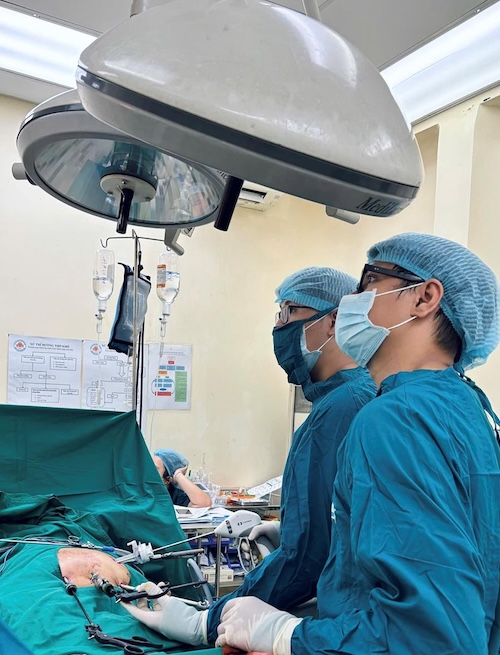 |
Doctors perform laparoscopic surgery on the patient. *Photo: Hospital provided*
Post-surgery, pathology results confirmed the patient had early-stage clear cell renal cell carcinoma. The patient did not require chemotherapy or radiation therapy, only regular follow-up. One week after the operation, the patient's health was stable, kidney function showed almost no decline compared to before the intervention, and they were discharged.
Early-stage kidney cancer often progresses silently, with few obvious symptoms. By the time hematuria or flank pain appear, the disease has often advanced. Some cases are only discovered incidentally during routine health check-ups or abdominal ultrasounds. Symptoms such as hematuria, flank pain, or unexplained weight loss warrant early medical examination.
Doctors recommend regular health check-ups, especially general abdominal ultrasounds, to detect kidney abnormalities early. Earlier detection increases the chances of laparoscopic and kidney-sparing tumor resection, allowing patients to overcome cancer while preserving the body's valuable "filter".
Le Phuong