Specialist doctor level one Ho Thi Mai, medical director of VISI High-Tech Eye Center, stated at the center's opening on 9/1 that the number of children diagnosed with myopia at the elementary school level is increasing. Many cases show rapid progression in their prescription within one to two years. Some children as young as 7-8 years old already have two to three diopters of myopia; if uncontrolled, and their prescription increases by at least one diopter annually, they could have over 10 diopters by age 18.
Last year, data from student health screenings conducted by the TP HCM Department of Health across numerous schools revealed that over 58% of students suffered from refractive errors. In preschool children, this rate was over 24%, rising to nearly 48% at the elementary level. For middle school students, the prevalence of refractive errors reached almost 72%, with nearly 29% detected for the first time during these health check-ups.
According to doctor Mai, a significant reason for the increase in childhood myopia is insufficient outdoor activity. Children today primarily spend time in enclosed spaces, with limited exposure to sunlight—a factor that numerous studies have shown to inhibit the progression of myopia.
Additionally, prolonged near-vision activities such as online learning, using phones, tablets, and watching tivi, force the eyes to constantly adjust, increasing the risk of early-onset myopia. Genetic factors also contribute to this risk, but doctor Mai notes that current living environments and lifestyle habits are the primary drivers behind the rapid surge in myopia among urban children.
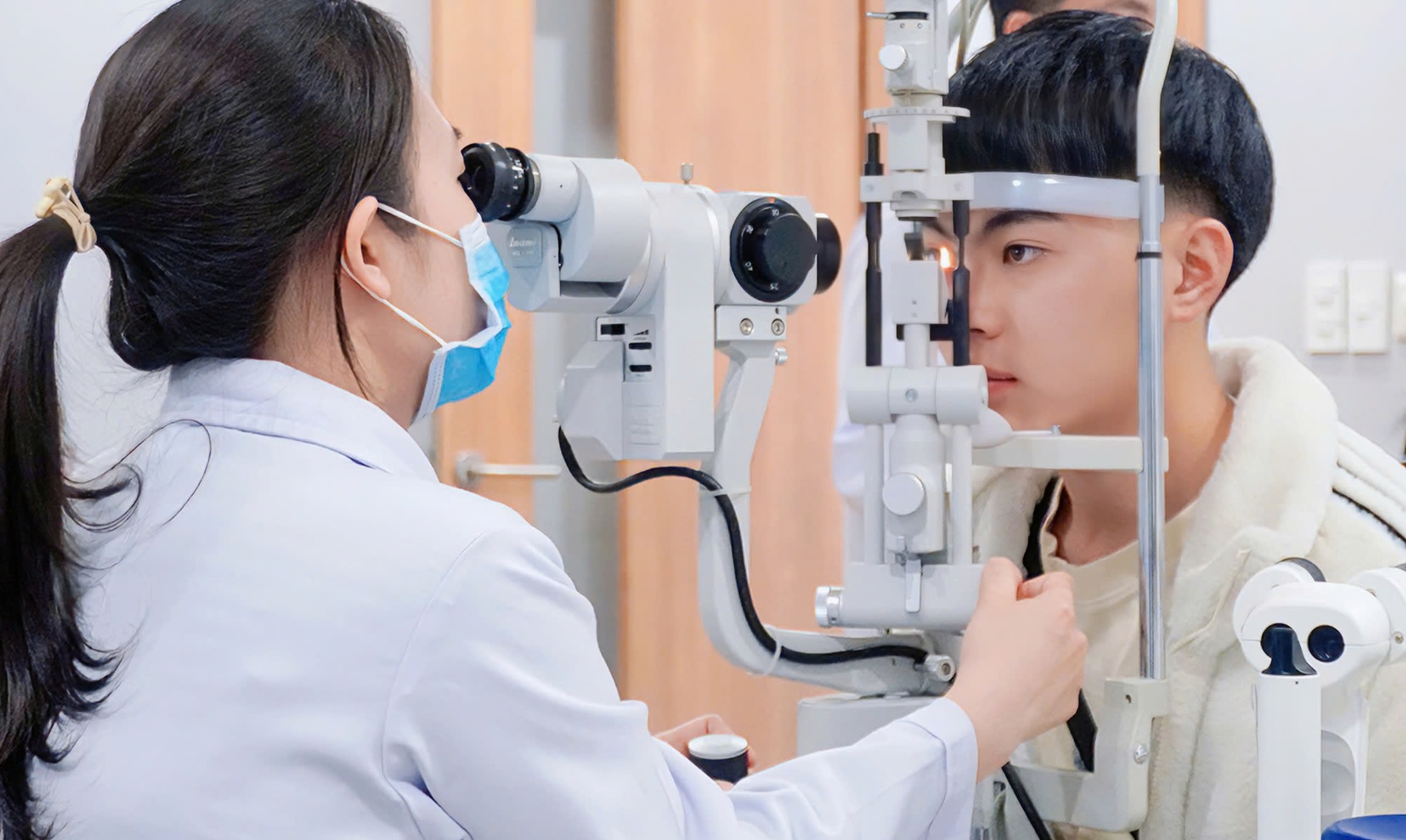 |
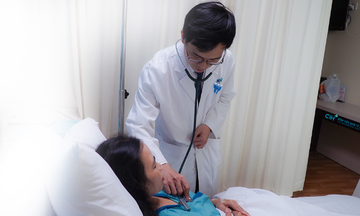
A doctor examining a child patient. *Photo: Tien Duc* |
Severe myopia is more than just wearing thick glasses. When the degree of myopia is high, the eyeball's axis lengthens, stretching and thinning the retina, which increases the risk of retinal tears or detachment. Children with 6 diopters or more of myopia, especially those with 10 diopters, face a higher risk of complications such as retinal degeneration, macular degeneration, glaucoma, and cataracts. During puberty, myopia often progresses faster, significantly increasing the risk of complications if not closely monitored.
Doctor Mai once treated a patient who sought myopia surgery to qualify as a flight attendant. However, it was discovered that the patient had retinal detachment in one eye, despite having only 6-7 diopters of myopia. This case required retinal surgery first, with a limited prognosis for future vision.
"Even after myopia correction surgery, the inherent risk of retinal pathology in severely myopic eyes persists throughout life," the doctor emphasized.
Refractive surgery is merely a method to "correct the prescription" so patients do not need to wear glasses; it is not a complete cure for myopia. Therefore, early intervention to control myopia in children is crucial. If controlled effectively, keeping the myopia level at just 3-4 diopters by adulthood, children will have more safe treatment options compared to allowing it to progress severely to 9-10 diopters.
For individuals who meet the age requirements and have stable myopia, various refractive surgery methods are available, chosen based on the eye's condition. Current refractive surgery technologies include PRK, LASIK, SMILE, Phakic ICL, or new generation laser techniques like SILK, which minimize corneal invasion with very small incisions. These are prescribed according to the degree of myopia, corneal thickness, and the individual's eye structure.
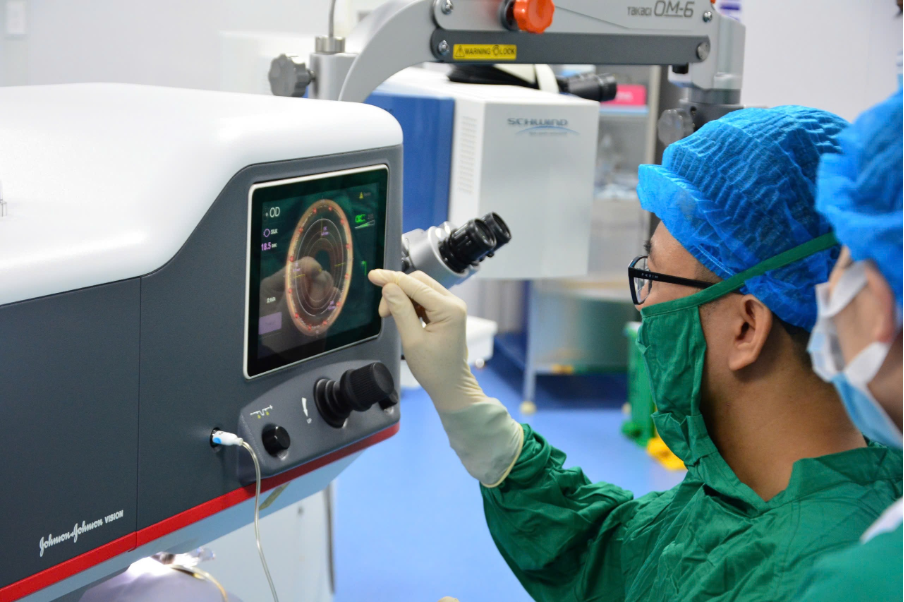 |
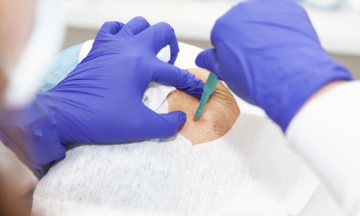
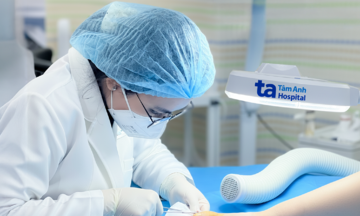
A doctor performing myopia correction surgery on a patient. *Photo: Tien Duc* |
Experts advise parents to encourage children to spend at least one to two hours outdoors daily, limit screen time, and ensure proper distance and lighting when studying. Children need regular eye examinations for early detection and timely intervention if signs of myopia appear. Furthermore, a balanced rotation between near-vision and far-vision activities is essential. The 20-20-20 method is recommended: for every 20 minutes of close-up work, look at something 6 meters away for 20 seconds; in confined spaces, one can close their eyes to relax for 20 seconds.
"Outdoor time is beneficial not only for the eyes but also for children's physical and mental health, serving as a simple yet effective measure to slow the progression of myopia," the doctor said.
Le Phuong