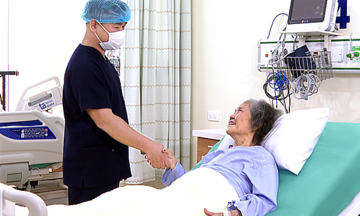
At the Department of Traditional Medicine and Rehabilitation, doctors recently treated an 11-year-old child from Hanoi who was admitted with a stiff face, a crooked smile, and an inability to close their left eye. The family reported that the child had removed their jacket and worn only a thin shirt all day at school in the cold. After one week of combined medication and physical therapy, the child's facial motor function showed marked improvement. Similarly, an 83-year-old woman experienced a crooked mouth to the left and right facial paralysis immediately after returning from breakfast in the biting cold.
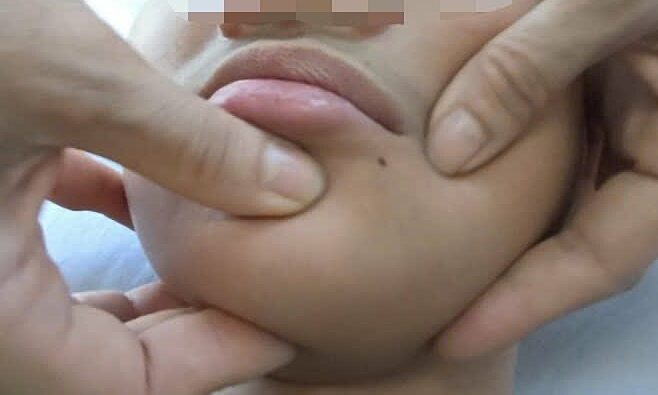 |
A young patient with facial nerve palsy due to cold. Photo: Hospital provided |
Beyond direct cold exposure, complications from winter ear, nose, and throat illnesses also cause facial paralysis, often mistaken for a stroke. A typical case is a 58-year-old man who initially suffered from a sore throat and swollen left ear, and whose otitis media did not improve after three days of treatment. When he noticed his mouth was crooked and he had difficulty speaking, he rushed to the hospital. A cranial computed tomography scan ruled out cerebrovascular damage, and doctors diagnosed him with peripheral facial nerve palsy due to acute otitis media complications, exacerbated by weakened health and a history of hypertension.
Doctor, First Degree Specialist Le Nguyen Long, head of the department, explained that the facial nerve passes through a narrow bone canal in the temporal bone, making it highly sensitive. When the head, face, and neck area are suddenly exposed to cold, blood vessels constrict, causing localized ischemia. This triggers an inflammatory response, leading to nerve swelling and compression, which disrupts nerve impulses. Furthermore, low temperatures can facilitate the reactivation of latent viruses, such as Herpes Simplex type 1, exacerbating inflammation and causing rapid onset paralysis.
Patients typically notice abnormalities immediately upon waking, such as a crooked smile, drooling, pain behind the ear, and an inability to close the eye completely, yet they remain fully conscious. The specialist noted that this condition differs from a brain stroke as it does not cause limb weakness or paralysis, nor central language disorders. Nevertheless, people should seek specialized medical care within the first 72 hours – the "golden hour" – to reduce swelling, protect the myelin sheath, and increase the chance of full functional and aesthetic recovery.
For prevention, doctors advise people to keep their head and face thoroughly warm when outdoors, and to absolutely avoid late-night bathing or sudden changes between hot and cold water. When sleeping, it is important to avoid air conditioner drafts or fans blowing directly onto the face. For those already affected, protecting the eyes with artificial tears and an eye patch is mandatory to prevent corneal damage. Additionally, patients should adhere to a combined modern and traditional medicine regimen rather than self-treating with unverified folk remedies.
Le Nga