According to the draft resolution recently finalized by the Department of Health and submitted to the Ho Chi Minh City People's Committee, public healthcare staff assigned to temporary rotations at grassroots facilities will receive special support, which will not be included in their salaries or existing allowances.
The highest support level, 20 million VND per month, is designated for professors, associate professors, doctors (PhDs), or specialists (level 2). Resident doctors and specialists (level 1) are proposed to receive 17 million VND, while doctors without a specialization will receive 12 million VND. For nurses, midwives, medical technicians, and pharmacists, the support is 10 million VND per month for those with a university degree or higher, and 8 million VND for those with a college degree.
Healthcare staff rotating to specific areas will receive higher amounts. In Thanh An island commune, the support will be multiplied by 1,2 times, ranging from 9,6-24 million VND per month. In the Con Dao special zone, the multiplier is 1,5, meaning the highest possible amount could reach 30 million VND per month.
To be eligible for this policy, healthcare staff must complete a continuous rotation of at least two months and receive confirmation of task completion from the receiving facility. If the working period is less than a full month, the support will be calculated based on the actual number of days.
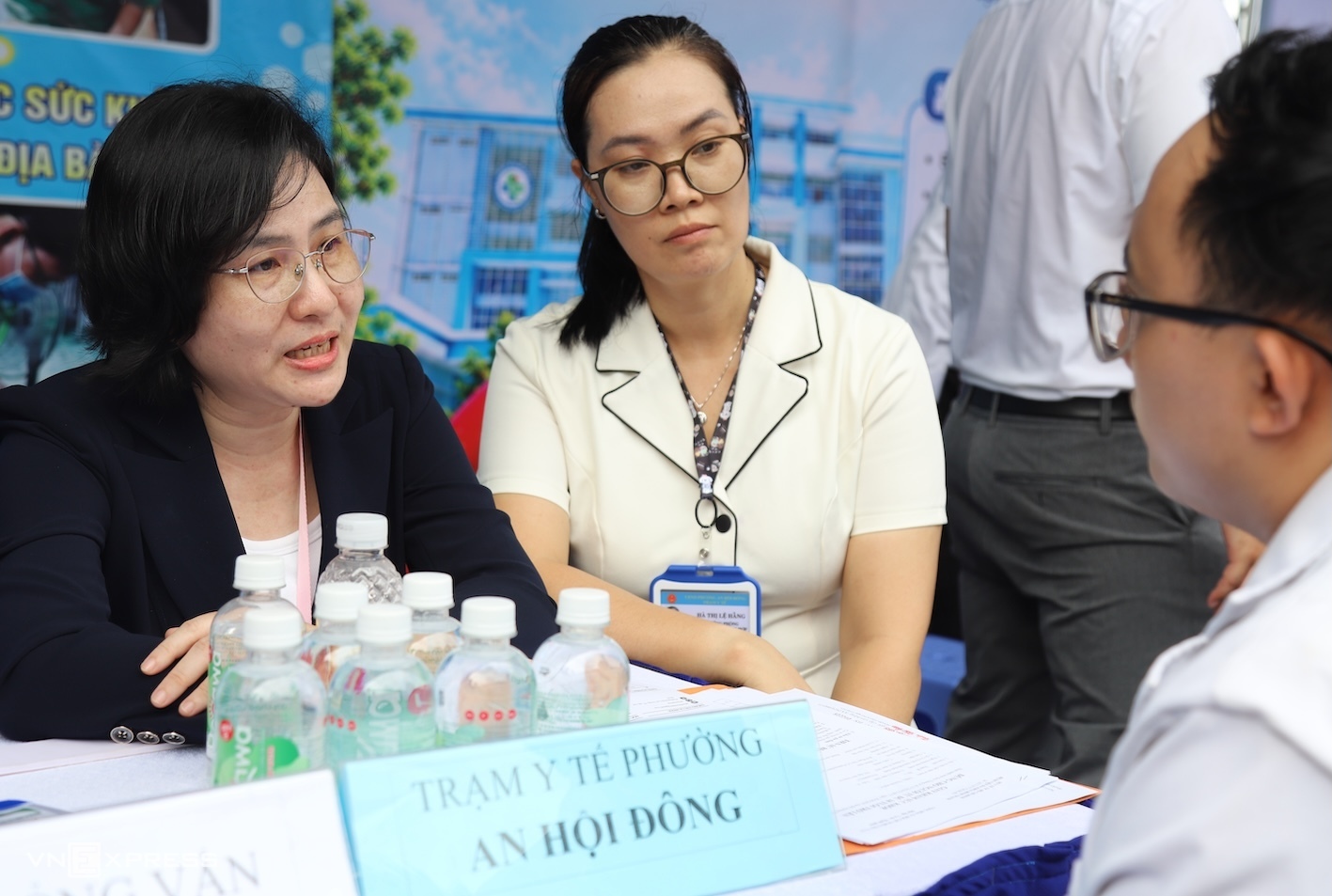 |
Young doctors participate in recruitment at An Hoi Dong Ward Health Station during a job fair on the morning of 10/9. Photo: Song Khue |
Young doctors participate in recruitment at An Hoi Dong Ward Health Station during a job fair on the morning of 10/9. Photo: Song Khue
Explaining the proposal, the Ho Chi Minh City Department of Health stated that the grassroots healthcare network is under immense pressure. The city currently has 168 commune health stations responsible for providing healthcare to approximately 14,5 million residents. These stations not only conduct health insurance examinations and treatments but also establish electronic health records and manage non-communicable diseases.
Meanwhile, staffing at these stations remains thin, with a particular shortage of specialist doctors across many fields. The city currently needs to recruit approximately 1.046 doctors in specialties such as internal medicine, surgery, obstetrics, pediatrics, and dentistry.
The Department of Health believes that increased support can incentivize healthcare staff, particularly highly skilled professionals, to participate in grassroots rotations. This will help residents access medical examination and treatment services locally and reduce the need for transfers to higher-level hospitals.
The city's budget is projected to allocate a maximum of approximately 108 billion VND annually for this policy, covering about 1.300 healthcare staff rotations. If approved by the Ho Chi Minh City People's Council during its September session, the resolution is expected to take effect from 1/10/2026 and remain valid until the end of 2030.
Previously, Ho Chi Minh City concluded a four-year pilot program that placed young doctors in commune health stations for practical training. Following this phase, the city is developing new policies to ensure a long-term supply of skilled personnel for grassroots healthcare. The Department of Health also plans to second doctors from higher-level hospitals to serve as directors of commune health stations for 3-5 years.
Le Phuong