As a mosquito lands on their skin, they immediately use a specialized suction tube to capture it, place it in a jar, and note the time, location, and species. This is part of the daily routine for "mosquito hunters"—individuals who silently track dangerous diseases like malaria and dengue fever.
At the mosquito rearing facility of the National Institute of Malariology, Parasitology and Entomology, researchers meticulously examine each water tray and mosquito cage. This work requires meticulous care, akin to tending to young children, observing their life cycle, hourly activity, and feeding them.
"This is a particularly arduous and risky job, but it plays a decisive role in disease control," said Associate Professor Hoang Dinh Canh, Director of the National Institute of Malariology, Parasitology and Entomology, at the 12th national Entomology Conference on 21/5 in Hanoi. Research aims to understand disease transmission mechanisms, and the biological and ecological characteristics of mosquitoes, to develop appropriate disease prevention measures.
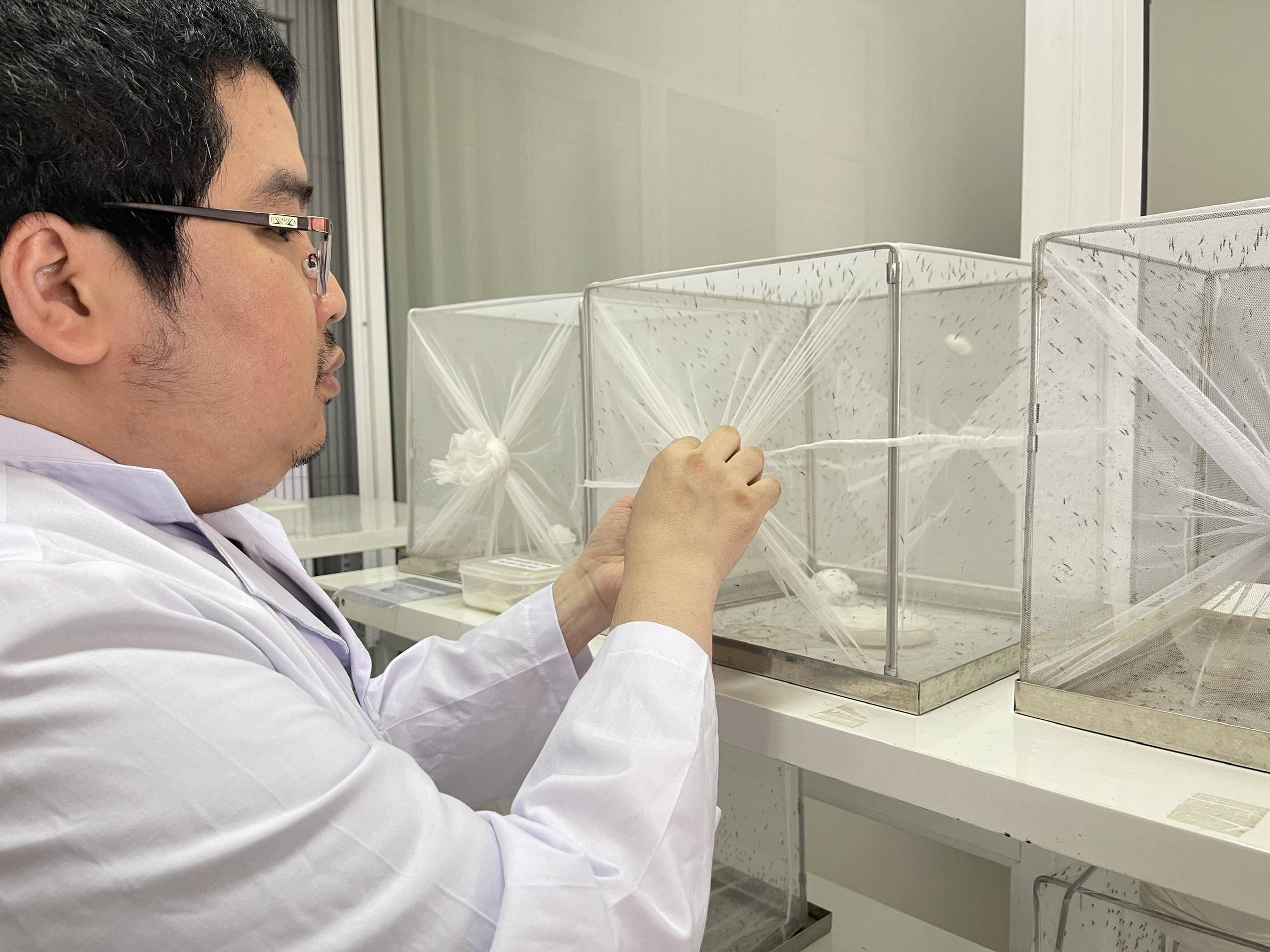 |
Mosquito rearing facility at the National Institute of Malariology, Parasitology and Entomology. Photo: Thanh Loan
Associate Professor Canh explained that many studies require using real people as bait because human body temperature and scent are essential to attract mosquitoes. To understand mosquito biological behavior, researchers travel to remote areas, setting traps at forest edges, under stilt houses, and in livestock pens—places where mosquitoes are most prevalent. Some studies last for days and nights to identify active mosquito species, their biting times, and their disease transmission capabilities.
Doctor Nguyen Van Dung, Head of the Entomology Department, stated that rearing mosquitoes in the laboratory helps scientists understand the biological characteristics and behavior of the dengue-transmitting species, enabling the development of effective prevention measures. Through research, experts have observed that Aedes mosquitoes typically lay eggs in clean water sources such as plant pots, flower vases, buckets, or discarded items that collect rainwater. This mosquito species rarely breeds in sewers or dirty water.
Furthermore, Aedes mosquitoes tend to rest indoors, particularly in dark corners, areas where clothes are hung, or poorly lit spaces, rather than clinging to walls as many believe. According to Doctor Dung, understanding mosquito behavior helps the health sector implement appropriate interventions like removing clean water containers, cleaning household items, and treating common mosquito resting spots.
Mosquitoes are not merely nuisance insects; they are intermediate links in the transmission of many dangerous diseases. Anopheles mosquitoes transmit malaria, while Aedes mosquitoes are the primary vectors for dengue fever. Additionally, ticks, lice, and fleas can also carry pathogens to humans.
 |
Associate Professor Hoang Dinh Canh, Director of the National Institute of Malariology, Parasitology and Entomology, speaks at the conference. Photo: Minh Nhat
Vietnam was once a nation with a very high number of malaria cases, especially in mountainous and remote areas. At one point, millions of cases were recorded annually, with many deaths due to severe malaria. However, thanks to decades of persistent disease control efforts, from case surveillance and mosquito behavior research to chemical spraying and protecting forest-goers, the number of malaria cases has now decreased to a few hundred cases annually. Vietnam aims to eliminate malaria completely by 2030.
Meanwhile, dengue fever is becoming increasingly unpredictable. Previously, outbreaks occurred cyclically; now, the disease appears almost year-round and is widespread in many localities. Vietnamese scientists are collaborating with international research institutes from Japan, Australia, Belgium, and other countries to conduct in-depth studies on mosquito life cycles and the disease transmission capabilities of each species.
"Only by clearly understanding disease vectors can we effectively control and prevent epidemics," Canh stated.
By Le Nga