The woman had known since 2008 that she had only a congenital left kidney, which had grown larger than usual to compensate for function. At that time, her reproductive organs showed no abnormalities.
After marriage, she experienced recurrent miscarriages despite treatment to maintain pregnancy. Through examination, doctors diagnosed a uterine septum, a congenital defect that increases the risk of miscarriage. Following surgical removal of the uterine septum, she became pregnant again in 2013. After a high-risk pregnancy and continuous monitoring in the hospital, she gave birth to a healthy baby in 2014.
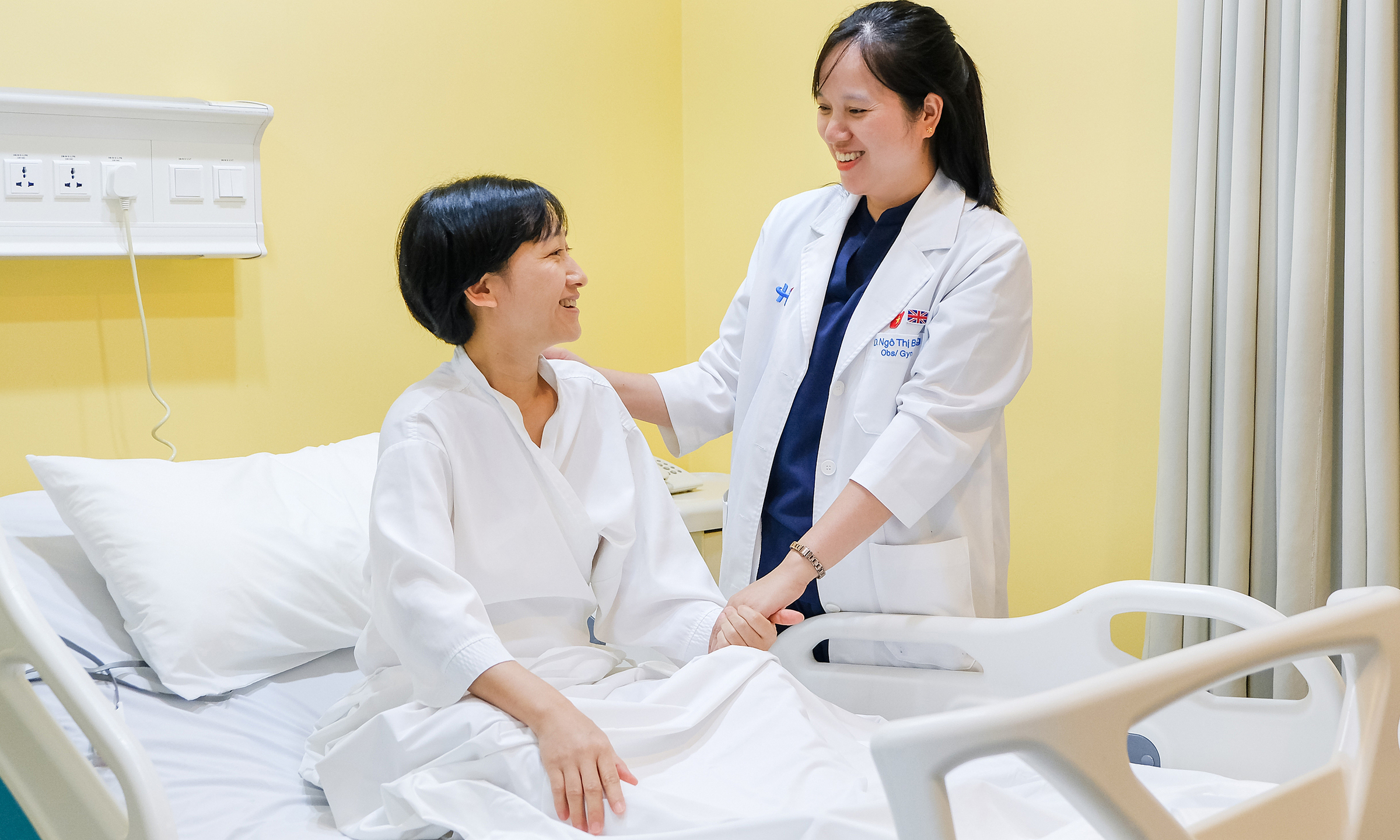 |
Patient stable after surgery. Photo: Hospital provided
In 2020, she was diagnosed with small uterine fibroids and monitored regularly. By 2026, the fibroids grew rapidly, causing abdominal pain due to compression on the colon, necessitating surgery at Viet Phap Hanoi Hospital. During the operation, the surgical team discovered a series of additional rare abnormalities, including the absence of a right ovary, right fallopian tube, and right round ligament.
"The combination of right renal agenesis, right adnexal agenesis, and uterine malformation is a very rare complex of congenital defects in obstetrics and gynecology", stated Master of Science, Specialist Doctor II Ngo Thi Bang, the surgeon who performed the operation.
Typically, for large uterine fibroids, doctors prioritize a total hysterectomy. However, in this case, the team chose a different approach based on the patient's unique anatomy. Since she had only one functional kidney and ureter, deep dissection around the cervix could damage this sole ureter.
Pre-operative tests showed no cervical lesions, so doctors decided on a subtotal hysterectomy. This approach ensured safety while providing effective treatment. They also preserved her left ovary and fallopian tube to maintain her endocrine function.
Dr. Bang explained that the reproductive and urinary systems share a common developmental origin during the embryonic stage. Therefore, abnormalities in one system often lead to defects in the other. However, the absence of an ovary, fallopian tube, and round ligament on the same side, combined with renal agenesis, is a rare occurrence in medical literature.
From this case, Dr. Bang emphasized that congenital reproductive abnormalities do not necessarily mean infertility. If diagnosed and intervened upon correctly and timely, many women with similar defects can still conceive and give birth to healthy children, as demonstrated by this patient's experience.
Le Nga