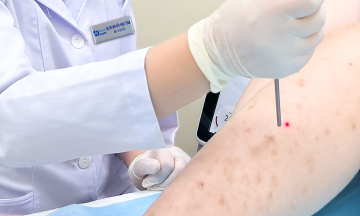
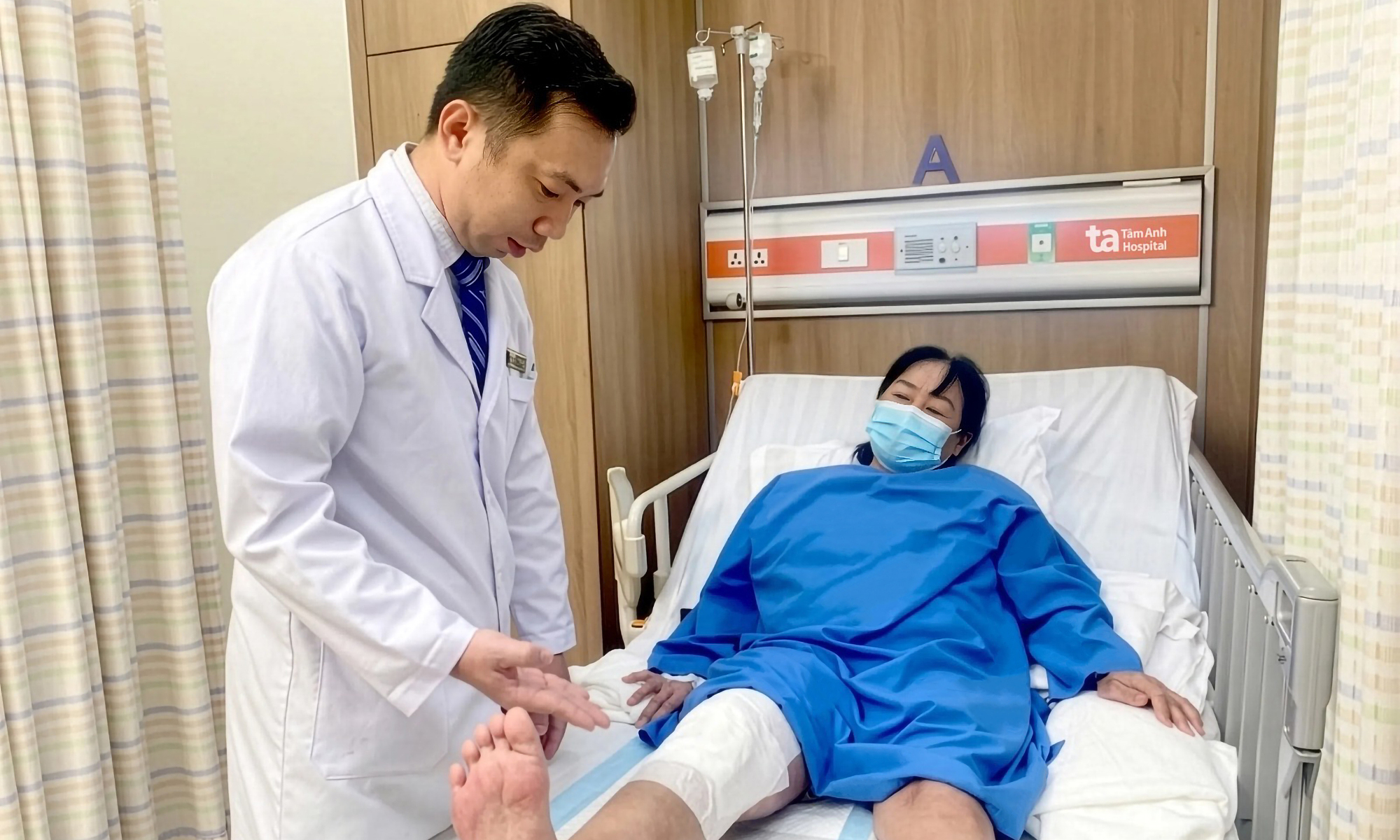
The patient developed scoliosis in adolescence but was not diagnosed early. Over time, her spine curved into a C-shape with a Cobb angle of 41 degrees, classified as severe. The cause was her right leg being 8 mm shorter than her left, leading to pelvic tilt.
This discrepancy forced her body to self-adjust, causing the spine to curve left to maintain balance. After 30 treatment sessions combining various methods, her posture significantly improved. She also developed discipline, regained self-confidence, and adopted a more positive outlook on life.
Doctor Calvin Q. Trinh, Director of HMR Physical and Rehabilitation Center, stated that scoliosis caused by leg length discrepancy and pelvic tilt is increasingly common in adolescents. The causes can include differences in bone length or functional imbalances such as flat feet, genu valgum, or genu recurvatum.
According to Doctor Trinh, the pelvis is the "foundation" of the spine; if the foundation is tilted, the "walls will crack, and pillars will break." When the body's foundation is unbalanced, the spine must curve to maintain its center of gravity. Therefore, simply realigning the back is not enough, as the body will eventually re-curve the spine over time. The key is to bring both legs into balance for long-term body stability.
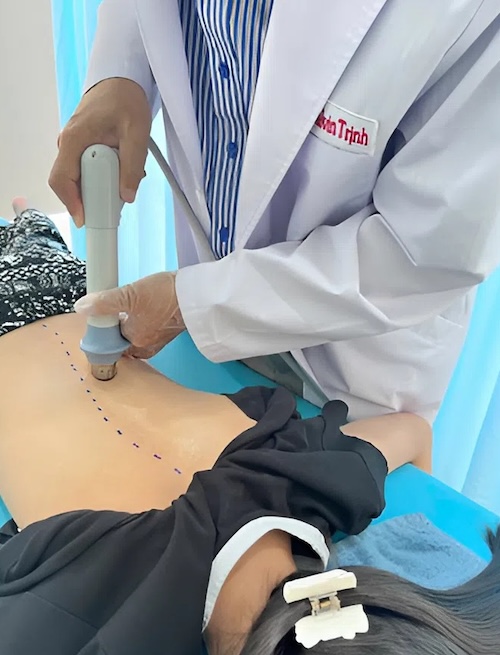 |
Doctor Calvin Q. Trinh treating a patient. *Photo: Courtesy of the doctor* |
Previously, scoliosis treatment primarily involved exercises and bracing to limit progression. Currently, many new techniques such as shockwave therapy, electrical stimulation, and botox injections help improve muscle stiffness more effectively. Notably, modern methods can directly correct leg length discrepancy at its root, rather than just using temporary solutions like shoe inserts or unilateral orthopedic shoes.
Thanks to appropriate treatment, many children show significant improvement. For example, a 12-year-old girl with S-shaped scoliosis had a thoracic curve of 56 degrees and a lumbar curve of 32 degrees. After 50 treatment sessions, her Cobb angle decreased by more than 8 degrees, resulting in a more balanced posture and increased confidence. Another example is a boy with scoliosis caused by flat feet and genu valgum, leading to leg length discrepancy. After 30 days of treatment, his thoracic curvature decreased by 12 degrees, and his cervical curvature decreased by 8 degrees.
According to Doctor Calvin, scoliosis should be treated before adolescence to prevent accelerated progression during a child's rapid growth phase. In cases of early detection without bone deformation, improvement of 10-20 degrees is possible within 6 months, sometimes even returning to normal. For severe cases where vertebrae are already deformed, treatment can last many years and typically only achieves a maximum improvement of 15-20 degrees. In such instances, the goal is to re-establish body balance and reduce deformity so children can participate in daily activities with confidence.
The doctor also warned that while scoliosis is not life-threatening, it severely impacts mental health. Children are prone to self-consciousness, depression, and sometimes negative thoughts. Parents should watch for signs of body asymmetry, abnormal gait, or unusual posture. The later it is detected, the more difficult and costly treatment becomes.
Le Phuong