Associate Professor Doctor Nguyen Thi Thu Hien, head of the refraction department at the High-Tech Eye Center, Tam Anh General Hospital, reported that An's eyes exhibited alternating exotropia. Measurements with a specialized prism showed severe misalignment, approximately 80 prism diopters base-in, equivalent to 45 degrees of exotropia.
Strabismus is an ocular misalignment that can involve binocular vision disorders. Each eye contains 6 extraocular muscles: 4 rectus muscles (medial, lateral, superior, inferior) and two oblique muscles (superior, inferior). These muscles coordinate to ensure both eyes look in the same direction. Improper coordination of any of these muscles leads to strabismus, often causing one eye to deviate inward, outward, upward, or downward relative to the other. Strabismus can affect one or both eyes.
 |
Doctors measuring An's eyes to accurately determine the extent of her strabismus. *Photo: Tam Anh General Hospital* |
Strabismus affects not only appearance but also causes binocular vision disorders, potentially leading to amblyopia (lazy eye). Treatment involves correcting the gaze to align both eyes and addressing any binocular vision disorders or amblyopia.
Doctors recommended early surgery for both of An's eyes. For exotropia, surgeons operate on the lateral and medial rectus muscles to properly align the eye. However, given An's severe deviation, a single surgery might not fully correct the strabismus. Post-surgery, doctors will evaluate the outcome and, if needed, prescribe supplementary surgery for complete treatment.
Under general anesthesia, Associate Professor Hien recessed the lateral rectus muscles in both eyes, reducing their outward pull. Concurrently, she shortened the medial rectus muscle in the right eye to increase its inward pull. The surgery lasted 45 minutes, with close monitoring by the anesthesiologist.
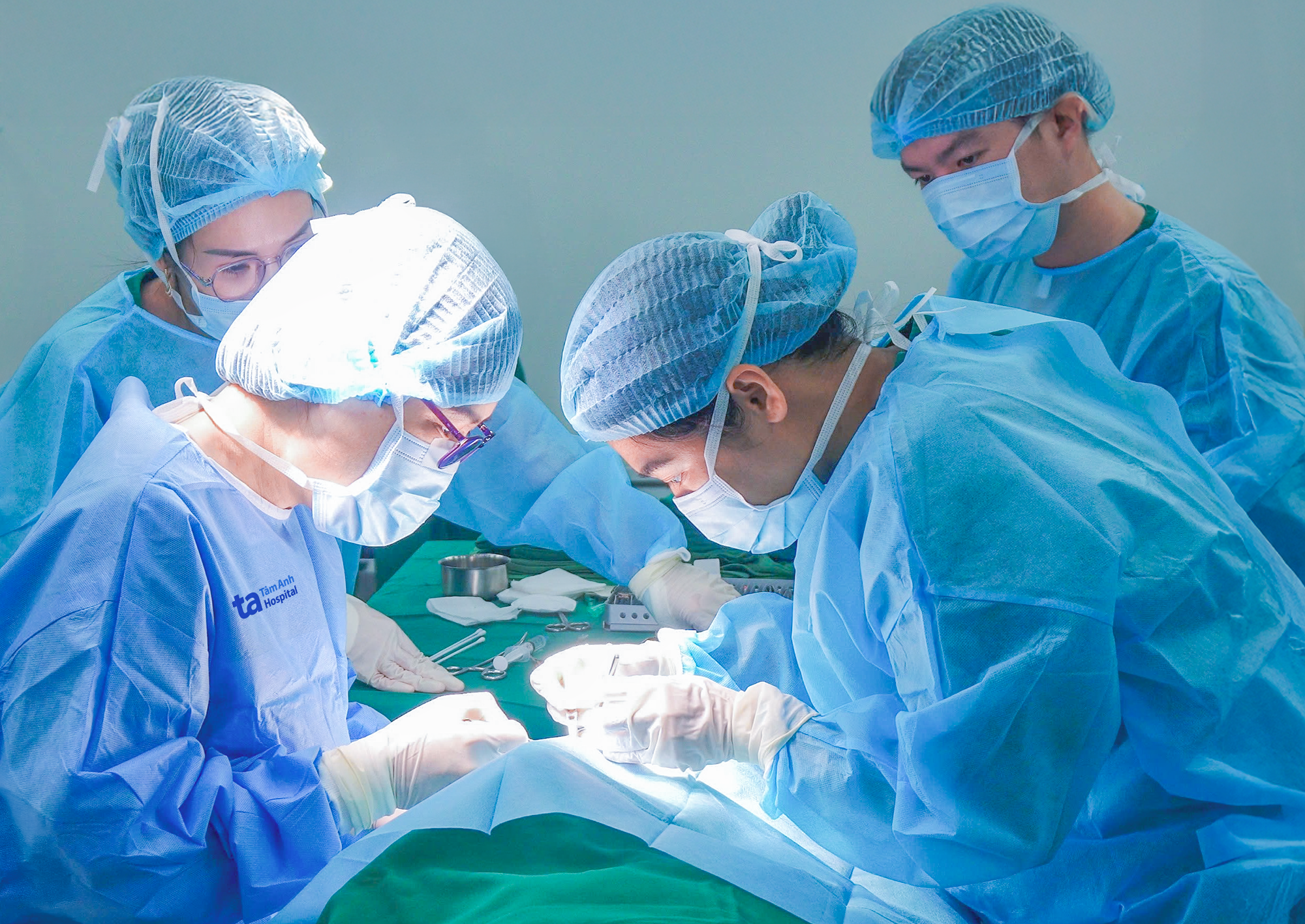 |
Surgeons performing strabismus correction on An. *Photo: Tam Anh General Hospital* |
Post-surgery, An's condition stabilized. Doctors removed her eye patch, and she wore protective glasses to prevent dust before discharge. Nurses instructed her parents on administering prescribed eye drops. At her two-week follow-up appointment, An's eyes were balanced and free of strabismus. She could resume normal activities, and her vision reached 10/10. Children may experience temporary double vision shortly after surgery, but this typically resolves quickly.
Associate Professor Hien recommends that children exhibiting any form of strabismus – inward, outward, upward, or downward deviation – seek immediate examination at specialized eye care facilities. The appropriate treatment plan, whether optical correction, vision therapy, or surgery, depends on the child's specific condition, including the type and degree of strabismus, associated refractive errors, and optimal post-correction vision.
Nhat Minh
*Patient's name has been changed
| Readers can submit questions about ophthalmological diseases here for doctors to answer |