A patient from Hoai Nhon, Gia Lai, was admitted to the hospital experiencing difficulty swallowing. Doctors in Internal Medicine Department 4 identified a tumor in the head of the pancreas and ordered a biopsy for pathological analysis. This procedure is essential for determining an accurate treatment plan.
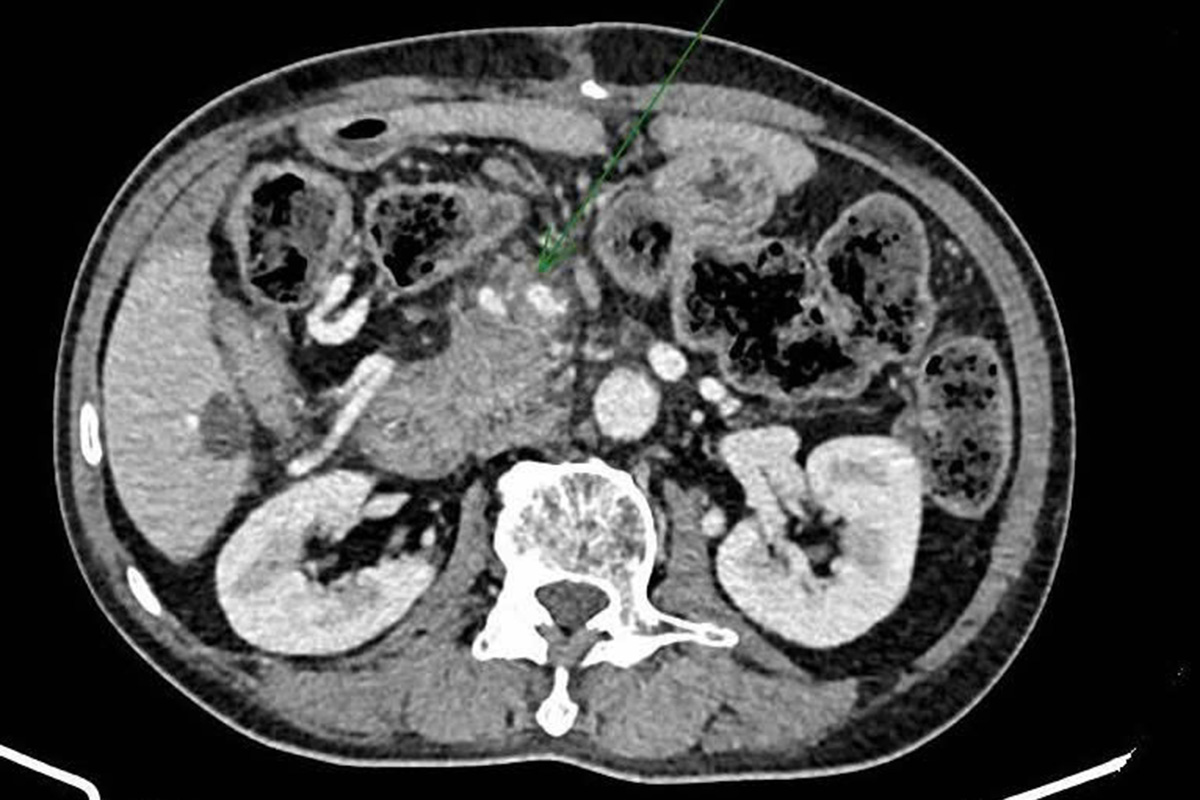
The intervention faced several challenges. The patient’s advanced age and old surgical scars on the abdominal wall reduced visibility during ultrasound. The tumor was located in the head of the pancreas, a challenging position within the abdomen, surrounded by visceral blood vessels, mesentery, and tightly adhered to the duodenum. Computed tomography (CT) scans revealed no clear access route, as the tumor was obscured by the digestive tract and major blood vessels.
To prepare for the procedure, the medical team created a 3D reconstruction based on abdominal CT scans. They also applied a technique to compress the digestive tract, aiming to create a safe pathway for the biopsy needle.
During the procedure, significant gas in the patient’s digestive tract continued to limit the doctors’ visibility. The first needle insertion yielded two samples, but these were insufficient for a definitive diagnosis due to the fibrous nature of the pancreatic tumor. Undeterred, the team adjusted their strategy, inserting the needle deeper into the tumor’s center for a second attempt to obtain a longer core sample.
After 35 tense minutes, the biopsy was successfully completed. The team obtained sufficient quality samples without causing complications such as duodenal perforation or damage to major blood vessels. Subsequent pathological analysis confirmed nerve invasion by the tumor, consistent with the patient’s pain experienced during the procedure.
 |
The team of doctors from the Department of Diagnostic Imaging worked intensely to obtain the pancreatic biopsy sample for the patient. *Photo: Hospital provided*
"Obtaining a biopsy sample for pathological analysis is essential", said Doctor Nguyen Cong Tam, from Internal Medicine Department 4 at Da Nang Oncology Hospital. "Once we have these results, doctors can quickly implement an appropriate treatment plan to prolong the patient’s life."
According to Doctor Pham Nguyen Huy Tung, from the Department of Diagnostic Imaging, pancreatic biopsy is considered one of the most challenging deep organ biopsy techniques. The procedure demands strong professional expertise and situational flexibility from doctors, as even a minor deviation can lead to dangerous complications.
This technique is now routinely performed at Da Nang Oncology Hospital through multidisciplinary coordination. This enhances diagnostic capabilities and provides opportunities for early treatment for cancer patients.
By Nguyen Dong