Mr. Dai, who had been managing gastroesophageal reflux disease for 25 years with medication, saw his condition worsen over the past two to three years. Prolonged episodes of swallowing difficulty led to vomiting and significant challenges with eating and drinking.
Endoscopy of the esophagus, stomach, and duodenum at Tam Anh General Hospital, TP HCM, revealed mild dilation in the lower third of the patient's esophagus and some fluid retention. The cardia was constricted, impeding the passage of the endoscope.
Doctor Do Minh Hung, Director of the Center for Endoscopy and Endoscopic Digestive Surgery, diagnosed the patient with reflux esophagitis, gastric mucosal hyperemia, and gastric mucosal atrophy, with a strong suspicion of achalasia. High-resolution esophageal manometry (HRM) results confirmed type one achalasia, indicating an almost complete loss of esophageal peristalsis and insufficient relaxation of the lower esophageal sphincter during swallowing.
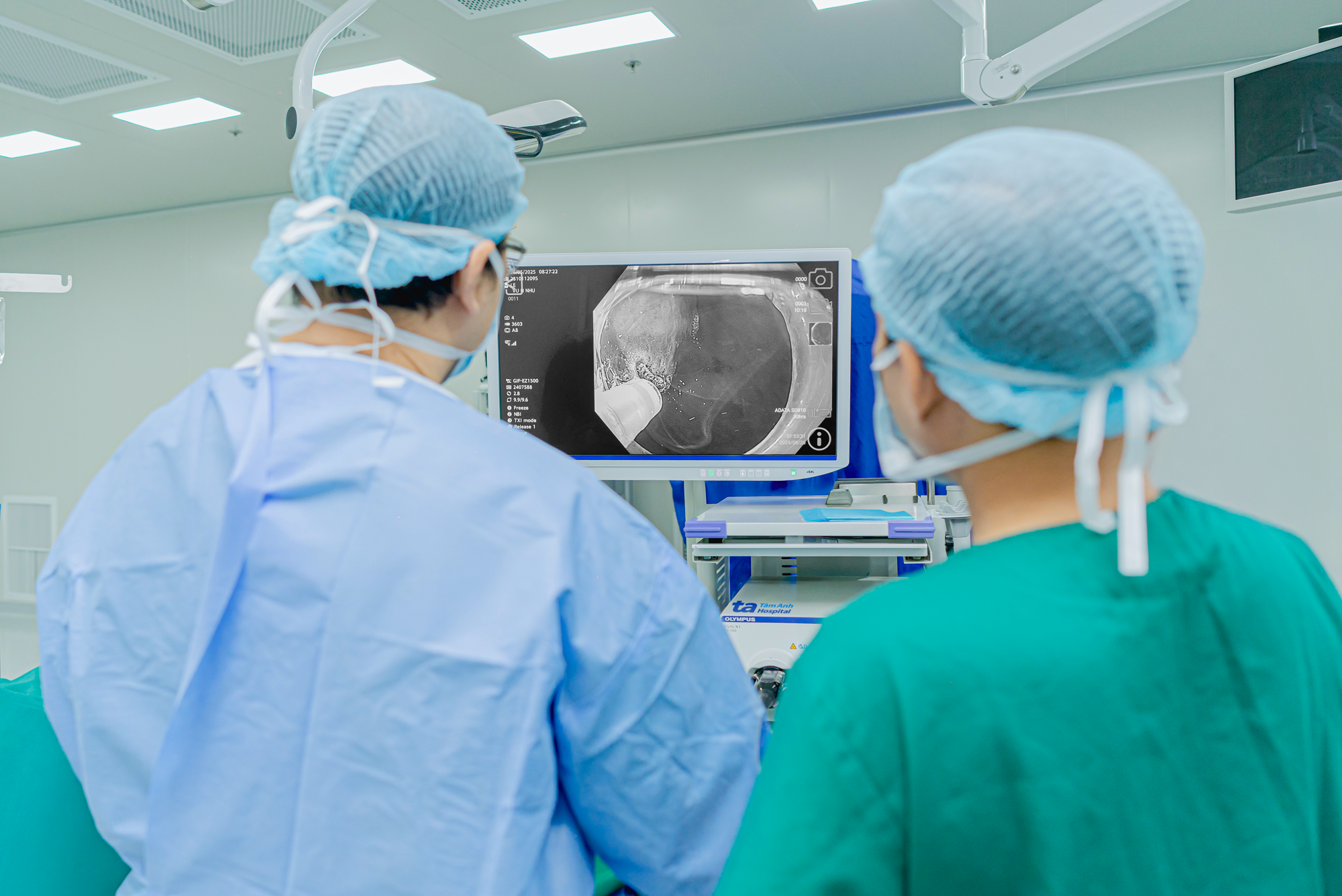 |
Doctor Minh Hung (left) performs endoscopic myotomy on Mr. Dai's esophageal sphincter. *Photo: Tam Anh General Hospital* |
Following a consultation, doctors recommended peroral endoscopic myotomy (U-POEM). This procedure aims to reduce the obstruction at the lower esophageal sphincter, thereby allowing food to pass more easily into the stomach.
During the procedure, the doctor inserted an endoscope orally and injected a lifting solution into the mucosa. This created a submucosal tunnel that extended through the esophagogastric junction to the cardiac portion of the stomach.
After identifying the muscle layers, the doctor performed a myotomy of the lower esophageal sphincter. Once completed, the mucosal entry point was closed with clips.
Following the intervention, Mr. Dai experienced minimal pain and was able to walk. He was discharged after one day, with a significant improvement in his swallowing difficulty, allowing him to eat and drink comfortably.
 |
Doctor Minh Hung consults with Mr. Dai during a follow-up appointment. *Photo: Provided by the hospital* |
Achalasia is an esophageal motility disorder where the lower esophageal sphincter fails to relax adequately during swallowing, and esophageal contractions are disrupted. This condition prevents food and liquids from easily passing into the stomach, causing them to accumulate in the esophagus. Common symptoms include: swallowing difficulty, food regurgitation, chest pain, coughing, or vomiting.
Achalasia is classified into three types. Type one is characterized by a complete loss of esophageal peristalsis, meaning sequential contractions that propel food into the stomach are absent. Type 2 involves increased pressure within the esophagus during swallowing. Type 3 manifests as abnormal, spastic contractions.
Initial symptoms of achalasia are often non-specific, leading to confusion and misdiagnosis with conditions like gastroesophageal reflux disease, esophageal stricture, or other swallowing disorders. Without timely treatment, the esophagus can gradually dilate, resulting in inflammation, ulcers, malnutrition, weight loss, and other complications.
Doctor Hung states that current treatment methods primarily focus on reducing obstruction at the lower esophageal sphincter. These include: U-POEM surgery, Heller myotomy, and pneumatic dilation. The selection of a specific method depends on the achalasia type, extent of esophageal damage, patient's age, underlying medical conditions, surgical risks, and individual circumstances.
Individuals experiencing persistent swallowing difficulty, a sensation of food stuck behind the breastbone, frequent regurgitation of undigested food, chest pain, coughing, or choking during sleep should consult a gastroenterologist for accurate diagnosis and appropriate treatment.
Quyen Phan
| Readers can ask questions about digestive diseases here for doctors to answer. |