Master, Doctor Nguyen Thanh Ha, from the Department of Radiation Oncology at Tam Anh General Hospital Hanoi, stated that the patient had a subsolid nodule measuring 20x11x15 mm in the upper lobe of the right lung, with irregular borders. Classified as Lung-RADS 4X, it indicated suspected malignancy. Doctors prescribed a transthoracic biopsy for the patient, and pathology results confirmed invasive adenocarcinoma, the most common subtype of non-small cell lung cancer, accounting for 80-85% of all cases.
Disease staging with PET/CT revealed a tumor measuring 25x15 mm in the upper lobe of the right lung, showing increased FDG uptake—a suspicious sign for malignancy. There was no metastasis to hilar lymph nodes or other organs. The disease was classified as stage one, as the tumor was entirely localized within the lung.
Doctor Ha assessed that lobectomy with lymph node dissection was the standard curative treatment for this case if the patient's condition allowed. However, Mr. Vuong suffered from severe chronic obstructive pulmonary disease (COPD), sleep apnea, and an aortic arch aneurysm with a thrombus, leading to a high risk of surgical complications. Losing additional healthy lung tissue could also further burden his already weakened respiratory system.
Following a multidisciplinary consultation, doctors chose stereotactic body radiation therapy (SBRT/SABR) as an alternative to surgery. The patient's tumor met the criteria for this method: it was small, confined to one lobe, and had not metastasized to regional lymph nodes or distant sites.
Doctor Ha explained that unlike conventional radiation therapy, which typically covers a wide field with small doses over many weeks, SBRT focuses very high-dose radiation beams from multiple directions, precisely converging on the tumor in just a few sessions. This method effectively destroys tumor cells locally, maximally preserves healthy lung tissue, and is suitable for COPD patients with reduced respiratory reserve.
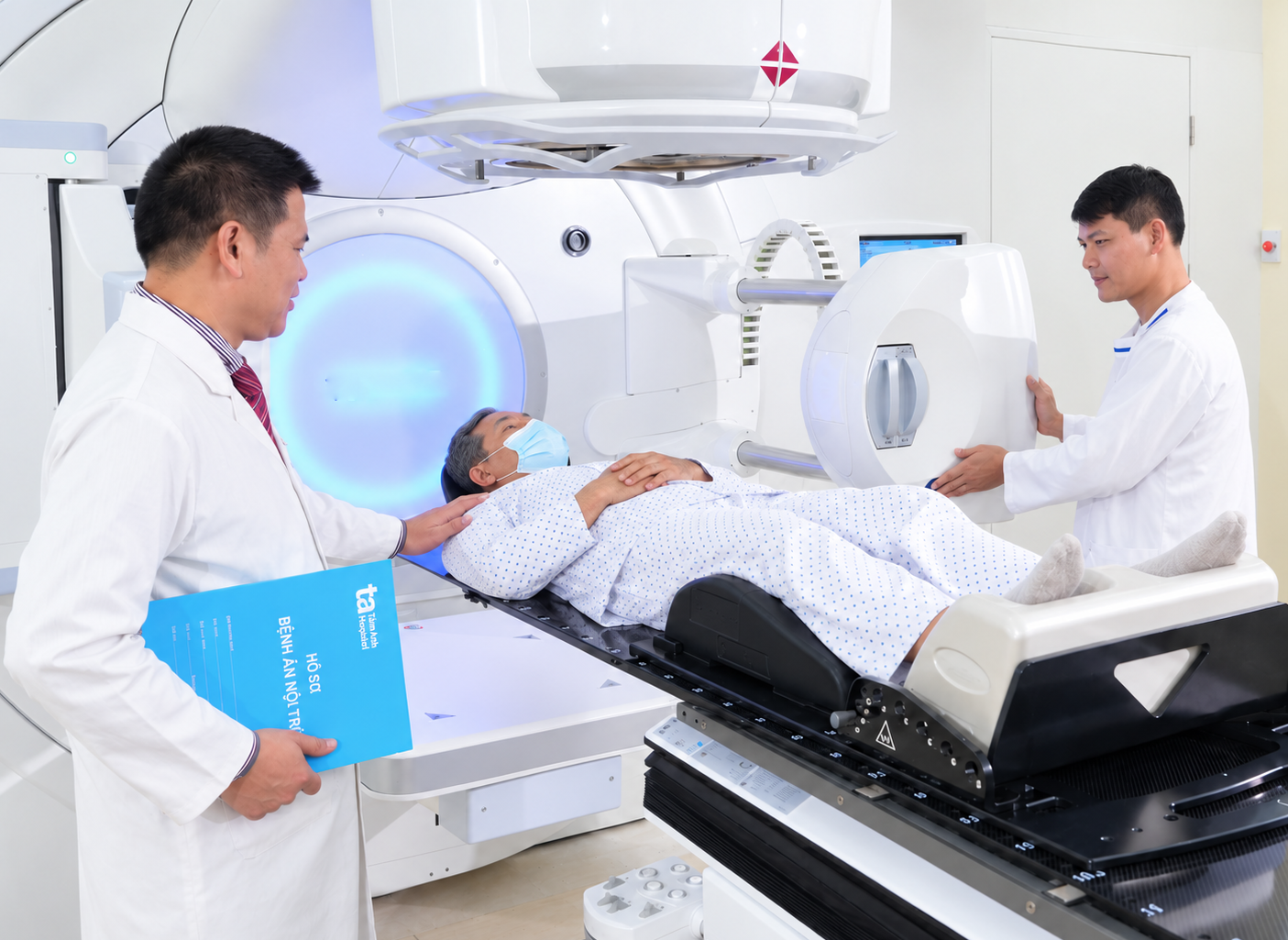 |
A doctor reminds the patient of important considerations before stereotactic body radiation therapy. Photo: Tam Anh General Hospital |
A doctor reminds the patient of important considerations before stereotactic body radiation therapy. Photo: Tam Anh General Hospital
Before treatment, the patient underwent a simulation CT scan to precisely determine the tumor's location with each breath. Doctors calculated and programmed the optimal radiation delivery. During each session, specialized equipment immobilized the patient, and an image-guided system re-checked the lesion's position before radiation delivery, ensuring the radiation beam converged accurately to the millimeter on the tumor, minimizing harm to healthy tissue.
The entire treatment process was completed in one day. After the single SBRT dose was administered, the patient was able to return home.
At a follow-up appointment one month later, a chest CT scan showed Mr. Vuong's tumor had significantly regressed, with its diameter reduced to about 1,5 cm. He no longer experienced coughing, chest pain, or shortness of breath, and resumed normal activities, continuing with regular monitoring.
Doctor Ha recommended that high-risk individuals, especially long-term smokers or those with chronic lung disease, undergo regular low-dose CT screening. Surgery remains the primary option for early-stage lung cancer in patients who are medically fit. However, for elderly patients, those with poor respiratory function, or multiple underlying conditions, SBRT offers an optimal alternative.
Hoang Duong
*Patient's name has been changed
| Readers can submit questions about respiratory diseases here for doctors to answer. |