The 2 cm tumor was deep within the parenchyma of the upper left lung lobe, close to the pulmonary artery and vein. Associate Professor, Doctor Vu Huu Vinh, Director of the Thoracic - Vascular Surgery Center at Tam Anh General Hospital Ho Chi Minh City, explained that a needle biopsy through the chest wall often struggles to reach the precise location, failing to collect enough tissue for an accurate diagnosis of the tumor's nature.
Following consultation, the surgical team opted for Da Vinci Xi robotic endoscopic surgery, employing a conservative approach. Instead of initially removing the entire lung lobe, doctors resected only the segment containing the tumor and collected a sample for an intraoperative frozen section biopsy. The extent of further surgery would be determined by these results.
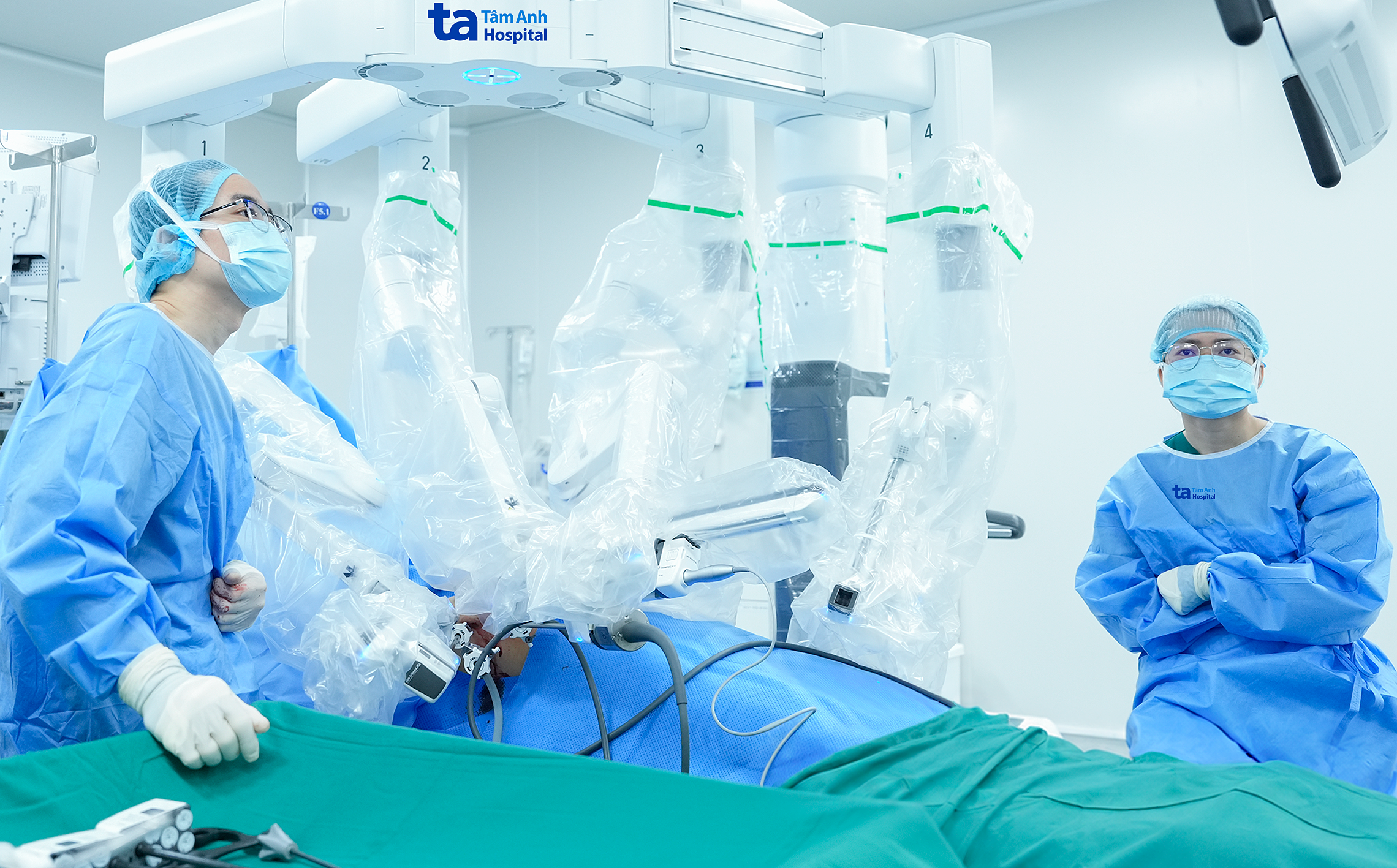 |
The surgical team performing a lung segmentectomy for the patient using the Da Vinci Xi robot. *Photo: Tam Anh General Hospital* |
Aided by the Da Vinci Xi robot's (US) camera system, which magnifies images 10-15 times, the team clearly visualized individual blood vessels. This allowed for precise dissection of the tumor-bearing lung segment, preventing damage to adjacent organs and ensuring a complete sample was collected for frozen section biopsy.
After 40 minutes, pathology results confirmed the tumor was a lesion caused by pulmonary tuberculosis, not cancer. Mr. Vo did not require a complete lung lobe resection, and his incision was closed with dissolvable sutures.
Post-surgery, the patient recovered quickly, experiencing minimal pain. He was able to walk and eat normally, and was discharged after three days. He received instructions for breathing exercises to restore respiratory function and, if indicated, would undergo tuberculosis treatment according to the prescribed regimen. The patient did not require supplementary chemotherapy or radiation therapy after the operation.
Many lung lesions, including those from early-stage cancer, are often asymptomatic and are mostly discovered incidentally during routine health check-ups. Associate Professor Vinh recommends that everyone maintain regular health screenings. Individuals over 50 years old, current or former smokers, those working in dusty environments, or with a family history of lung cancer should undergo periodic health screenings as advised by a doctor. Early detection not only enhances the chances of successful treatment but also helps preserve lung parenchyma and maintain quality of life after treatment.
By Bao Anh
*Patient's name has been changed
| Readers can submit questions about cancer here for doctors to answer |