In recent years, healthy eating trends have become popular. Dr. Tieu Tiep Kien, a weight loss expert, notes that with countless daily consumer choices, most people often rely on packaging labels like "high fiber," "plant-based milk," or "no added sugar" to quickly assess a product's health benefits. However, the true factors influencing blood sugar response often lie in the food's processing method and its inherent state.
Dr. Tieu recently shared on social media that many foods labeled "healthy" do not actually help stabilize blood sugar as commonly believed, specifically:
Oat Milk
For example, oat milk is essentially made from finely ground oats mixed with water, a production principle very similar to traditional roasted rice drinks. The difference sometimes only lies in brand image and packaging marketing strategies. Because the ingredients are finely processed, the body's absorption rate is faster, which can also lead to a quicker increase in blood sugar.
Whole Wheat Bread
Regarding whole wheat bread, which many consider a healthy food, Dr. Tieu Tiep Kien warns that some products on the market actually use white flour as the main ingredient, only adding a small amount of wheat bran or adjusting the color. Consequently, their rate of increasing blood sugar is not significantly different from white bread.
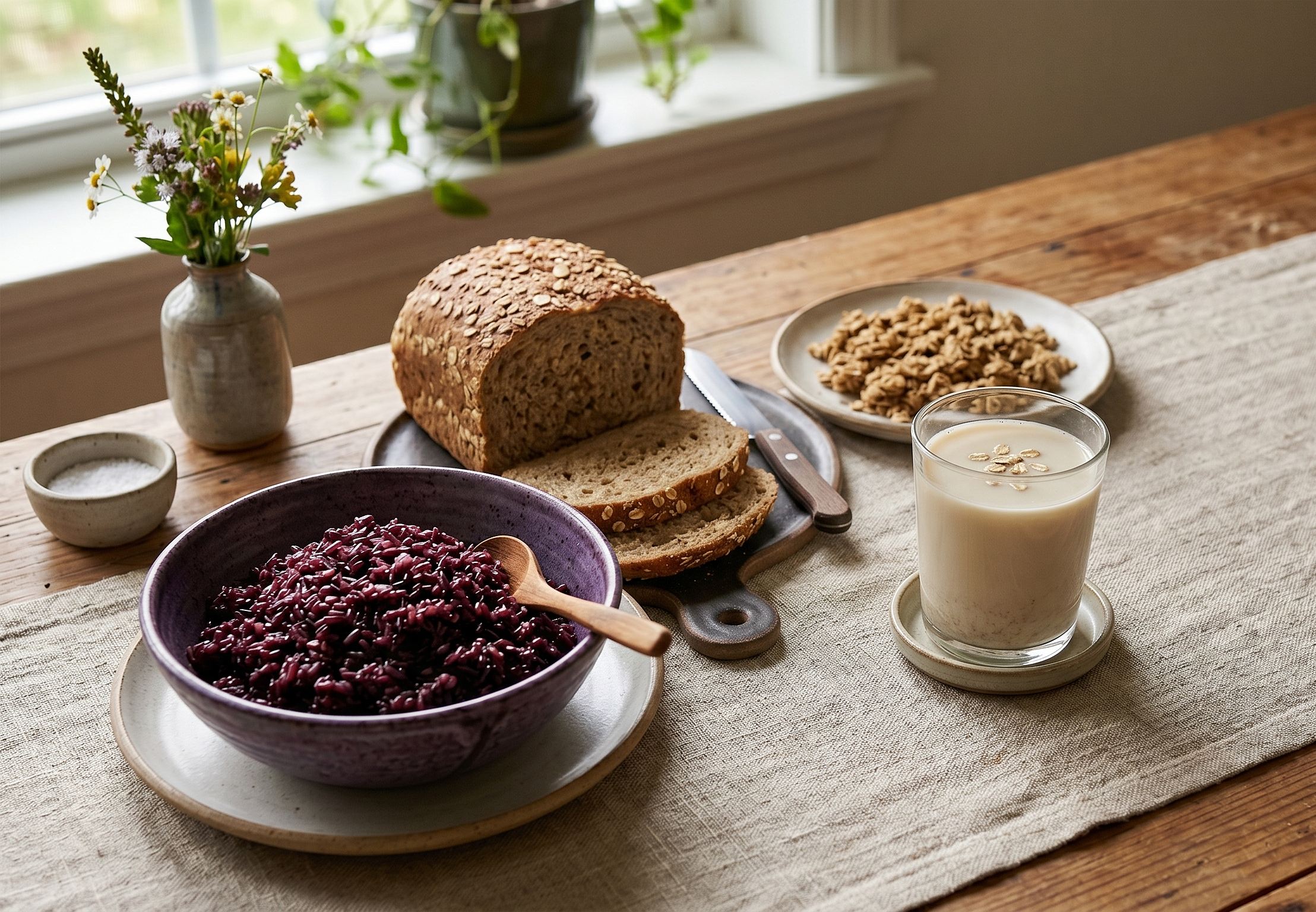 |
Oat milk, whole wheat bread, and purple sticky rice are often considered healthy foods, yet they can cause blood sugar to spike. Image created by AI
Purple Sticky Rice
Additionally, purple sticky rice (also known as black glutinous rice), often regarded as a staple health-promoting food, may not be the optimal choice for blood sugar stabilization. Dr. Tieu points out that purple sticky rice belongs to the glutinous rice family; its resistant starch content is even lower than some types of white rice, and its glycemic index (GI) can be higher. Therefore, individuals who are losing weight or need to control blood sugar still need to pay attention to their intake.
Explaining why foods affect blood sugar changes, Dr. Tieu Tiep Kien outlines two major principles:
"The more refined, the faster": Sophisticated processing is equivalent to "pre-digesting" a portion of the food, making it easier for the human body to absorb.
"The higher the temperature, the faster": Cooking at high temperatures converts starch into more easily absorbed sugar. For example, roasted sweet potatoes tend to raise blood sugar more quickly than boiled sweet potatoes.
However, Dr. Tieu Tiep Kien also emphasizes that people do not need to be overly anxious or completely avoid specific foods due to this; instead, they should adjust their selection principles.
Dr. Tieu provides a "three-phrase mantra" for identifying foods that rapidly raise blood sugar: "The whiter, the faster; the softer, the faster; the more liquid, the faster."
Conversely, foods closer to their original state (whole foods), requiring more chewing, and minimally processed, generally have a gentler impact on blood sugar fluctuations.
My Y (According to SETN)