According to pharmacist Do Xuan Hoa from the Medical Information Center, Tam Anh General Hospital, TP HCM, many people often consider melanin the "culprit" behind skin pigmentation disorders, leading to hyperpigmentation and aging. A proper and complete understanding of melanin can help protect the skin better, especially during periods of extreme heat and consistently high UV index.
Melanin has only one type
Unlike the term "dark pigment" commonly known, melanin actually has two main types: bright melanin (pheomelanin) and dark melanin (eumelanin). Beyond quantity, the distribution ratio of dark and bright melanin also affects skin color. Individuals with more bright melanin have lighter skin, while those with high levels of dark melanin develop darker skin areas, appearing as dark spots, melasma, and freckles.
Vietnam is located near the equator, a region with high UV intensity, leading to a greater likelihood of forming dark melanin than bright melanin. Consequently, Vietnamese people generally have darker skin and are more prone to hyperpigmentation than Europeans. In younger individuals, skin structure is often healthier, and the content of endogenous antioxidants like glutathione is higher, helping to limit the formation of dark melanin. As people age, the amount of these substances gradually decreases, making the skin more susceptible to hyperpigmentation and more sensitive to sun exposure, according to pharmacist Hoa.
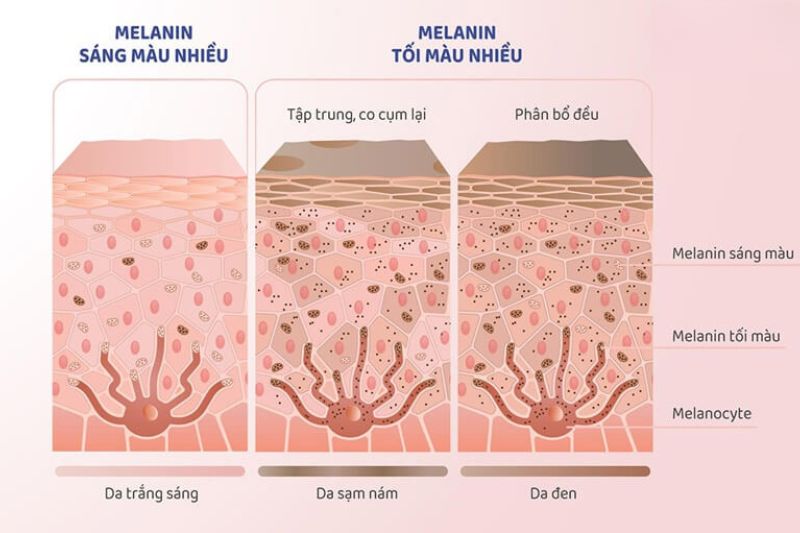 |
The ratio and distribution of bright or dark melanin determine skin color. Photo: Eco Pharmaceutical Joint Stock Company
Melanin protects the skin and body from the damaging effects of ultraviolet rays. Skin whitening methods, such as using quick-whitening creams, exfoliating creams containing harmful substances, or direct injections of whitening agents to completely eliminate this pigment, often result in lighter skin and rapid improvement of dark spots. However, they compromise the skin's protective capabilities.
Therefore, pharmacist Hoa emphasizes that the principle for preventing hyperpigmentation and freckles, and for nourishing healthy skin, is not to eliminate melanin entirely. Instead, it involves inhibiting abnormal melanin overproduction, while safely reducing dark melanin and increasing bright melanin.
Only UV rays produce melanin
Melanin is formed daily through the action of the tyrosinase enzyme (found in melanocytes) and environmental factors. UV radiation from sunlight is the primary cause of melasma patches and dark spots appearing in the epidermis. However, this is not the only cause. Factors such as hormonal imbalance and nervous stress also stimulate increased melanin production.
In women's bodies, the two sex hormones, estrogen and progesterone, regulate bodily functions. When these hormones become imbalanced, such as during pregnancy, pre-menopause, or menopause, they stimulate melanocytes to accelerate melanin production. This hormonal imbalance generates free radicals (ROS), which activate pigment formation, often dark melanin, leading to mixed melasma in the dermis.
Therefore, treating melasma with external interventions, including laser therapy, chemical peels, and topical products, may not be effective without addressing internal factors.
Darker skin has more pigment-producing cells
The truth is that the number of melanocytes is the same in all individuals. However, depending on race, living environment, and individual skin care and protection habits, each melanocyte can produce varying amounts of melanin, generating more bright or dark melanin.
According to pharmacist Hoa, the most crucial principle for skin protection involves external sun protection combined with internal body support. Avoid sun exposure, especially between 10 a.m. and 5 p.m., and use sunscreen with an SPF 30 or higher. Reapply every 2-4 hours if swimming or sweating.
During summer, increase consumption of fruits and vegetables like grapefruit, watermelon, and tomatoes to boost antioxidants. To reduce dark melanin, consider supplementing with natural L-Glutathione, Pomegranate extract, and Sakura extract. L-Glutathione has the ability to increase bright melanin, which helps brighten skin and fade melasma from within, without compromising the skin's protective capacity against UV radiation.
Thai Thanh