After having her first child, Hong experienced two ectopic pregnancies, necessitating the removal of both fallopian tubes. She and her husband pursued in vitro fertilization (IVF) at the Center for Reproductive Assistance, Tam Anh General Hospital Hanoi (IVF Tam Anh). They successfully obtained 6 frozen day-5 embryos, but the embryo transfer was postponed for three cycles while Hong received treatment for a thin uterine lining and gynecological inflammation.
Ha, 30, experienced three consecutive miscarriages over five years. Doctors at IVF Tam Anh diagnosed her miscarriages as being caused by Anti-phospholipid Syndrome (APS) of unknown origin. This autoimmune disease involves the body producing anti-phospholipid antibodies, which interfere with fetal development and nourishment. Additionally, Ha had uterine adhesions, causing the uterine fundus to be pulled inward. This condition might be a consequence of her previous miscarriages or prior abortion procedures.
Ha and her husband also decided to pursue IVF to have a child. The two sisters frequently shared experiences regarding diet and rest, and reminded each other to adhere strictly to their medication regimens, which helped facilitate their IVF journeys.
On the day Hong underwent embryo transfer, Ha had her oocyte retrieval. Doctor of First Degree Specialist Le Duc Thang's ultrasound examination revealed Ha's eggs were underdeveloped and matured unevenly. Only two eggs were immediately suitable for fertilization after retrieval. Immature eggs were categorized by maturity level and further cultured in a hormonal environment. This process allowed embryologists to retrieve three additional mature eggs, significantly improving the chances of pregnancy.
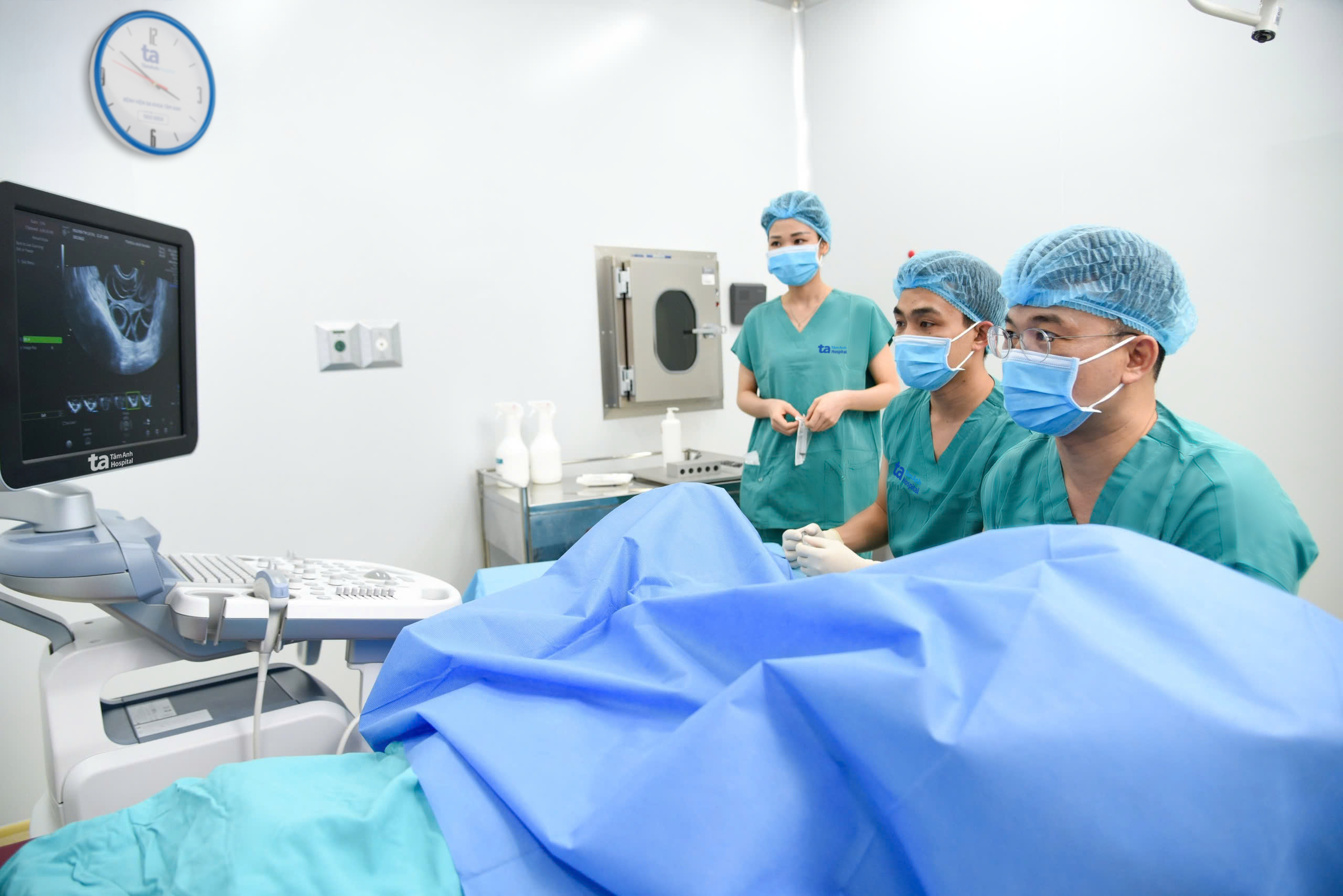 |
An IVF Tam Anh doctor performs oocyte retrieval for a patient. Illustration photo: Provided by the hospital. |
The husband's sperm sample was washed, then fertilized with the eggs in vitro and cultured in an artificial intelligence-integrated time-lapse incubator, resulting in three day-5 embryos. All embryos were cryopreserved while doctors performed laparoscopic surgery on Ha to remove adhesions and reconstruct her uterine cavity to a normal shape suitable for embryo transfer.
Hong conceived successfully on her first embryo transfer. Ha's uterine cavity also recovered, and her lining became suitable. She received one day-5 embryo transfer into her uterus and daily anticoagulant injections. Upon receiving her positive pregnancy test result, Ha calculated, "If the pregnancy progresses smoothly, our children will be born in the same year."
According to Doctor Thang, the infertility experienced by sisters Hong and Ha is not linked to genetic factors or family history. Primary infertility in women often stems from ovulation disorders, such as: polycystic ovary syndrome, diminished ovarian reserve, or congenital abnormalities of the reproductive organs. In contrast, secondary infertility frequently occurs after obstetric complications like: infections, ectopic pregnancies, recurrent miscarriages, or uterine interventions that lead to endometrial damage. Furthermore, lifestyle and environmental factors also contribute to an increased risk of infertility in women.
Currently, numerous modern assisted reproductive techniques, such as: in vitro maturation of immature eggs, blastocyst culture, embryo cryopreservation, embryo screening, and the endometrial receptivity array (ERA) test, are expanding the opportunities for conception in many challenging cases of infertility.
At IVF Tam Anh, from 2021-2025, the cumulative pregnancy rate across all patient groups averaged 82,8%. For the group who had experienced multiple failed treatments, the rate was 72,3%.
Trinh Mai
| Readers can submit questions about infertility here for doctors to answer |