On 14/9, the UK House of Commons rejected the End-of-Life Bill for the Terminally Ill, with 286 members of parliament voting against and 270 in favor. This decision followed four hours of intense discussion, according to The Guardian. The bill aimed to permit adults in England and Wales diagnosed with less than 6 months to live to request medical assistance to end their lives, provided two independent doctors and an expert panel assessed and approved the request.
Introduced by MP Kim Leadbeater on 29/11/2024, the bill sought to address the issue of terminally ill British citizens traveling to other countries, such as Switzerland, to seek a humane death. The proposal had previously cleared a preliminary vote in the House of Commons with 330 votes in favor and 275 against, even gaining support from former Prime Minister Keir Starmer before detailed debates began. Proponents had hoped the bill would mark the largest social transformation in the UK since 1967, when the country partially legalized abortion rights.
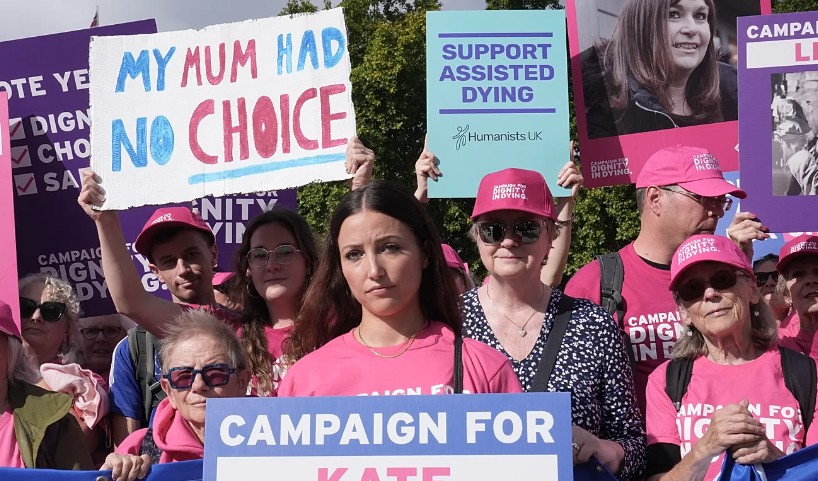 |
Activists gathered to protest in support of assisted dying rights at Parliament Square, central London, on 11/9. *Photo: Stefan Rousseau* |
Under current law in England and Wales, assisting suicide is a criminal offense, carrying penalties of up to 14 years in prison. However, the Prosecution Authority states that assistance motivated by humanitarian reasons, where the helper gains no financial benefit, reduces the risk of prosecution.
Opponents argued that the bill lacked feasibility and posed a risk of pressuring vulnerable or disabled individuals to end their lives. Cancer surgeon and MP Zubir Ahmed highlighted significant errors in predicting patients' remaining life expectancy, a key medical prerequisite in the bill. He noted that the probability of doctors correctly predicting a patient would live less than 6 months was equivalent to the probability of being wrong.
Doctor Kevin De Sabbata from Keele University further warned that the healthcare system struggled to accurately prognosticate remaining life expectancy and could not fully assess the mental capacity of individuals experiencing fear or depression. The bill's omission of a mandatory psychological expert intervention mechanism could lead treating doctors to overlook negative psychological factors. Researchers Abigail Pearson and Dunja Begović also stressed that the waiting period between steps was too short, insufficient to help patients overcome feelings of being a burden to their families, potentially leading to the abuse of assisted dying procedures instead of prioritizing palliative care.
Religious officials and medical organizations also vehemently rejected the proposal. Archbishop Richard Moth, Catholic leader in England and Wales, declared the bill wrong in principle. The head of the Church of England, Archbishop of Canterbury Sarah Mullally, along with the Royal College of Psychiatrists, collectively expressed concerns about gaps in protecting individuals with mental disorders.
The UK government maintained a neutral stance during the session, allowing MPs to vote according to their individual conscience rather than party discipline. Prime Minister Andy Burnham abstained from voting to avoid influencing the debate. Some MPs changed their stance just before the decision; for example, Janet Daby switched to the opposition due to personal anxieties about death.
Despite the outcome, MP Lauren Edwards, who directly introduced the draft, expressed disappointment but believed Parliament would pass this issue in the future to replace harsh current regulations. Internationally, countries such as Australia, Belgium, and Spain currently permit assisted dying under their own distinct sets of criteria.
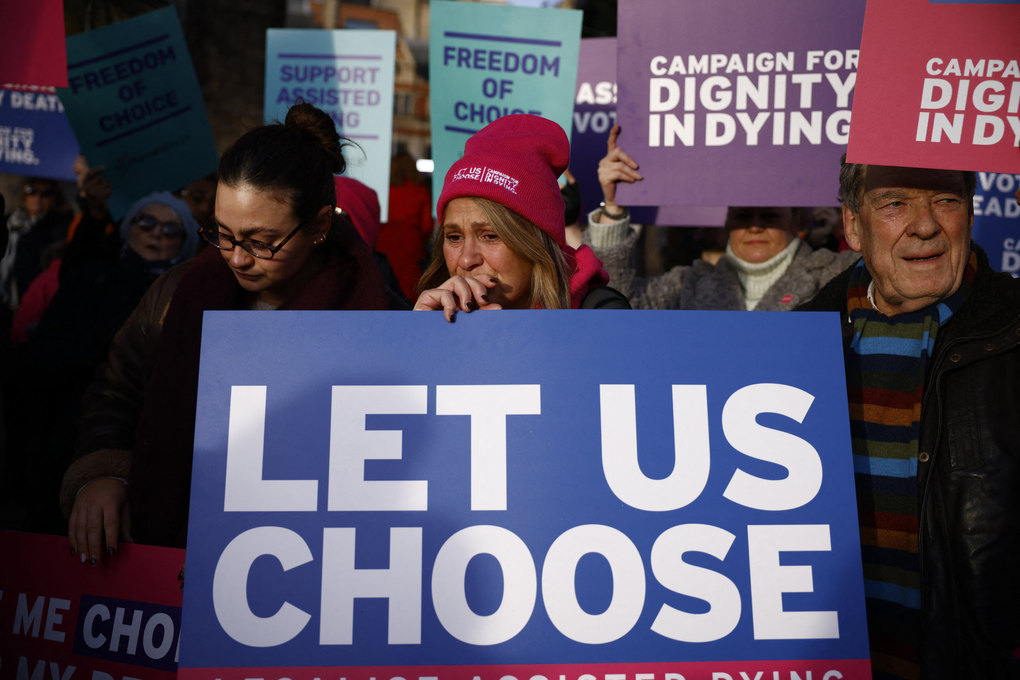 |
Supporters of the assisted dying bill protested outside Westminster Palace in central London on 29/11. *Photo: AFP* |
Binh Minh (According to The Guardian, ABC News, Euro News)