Director-General of the World Health Organization (WHO), Tedros Adhanom Ghebreyesus, reiterated on February 12 that several countries, especially the United States, had publicly claimed to possess intelligence regarding the matter. He stated that a few months prior, WHO had sent written requests urging senior US officials to share all available information.
"We hope they will share it because WHO has not yet concluded on the origin of Covid-19. Understanding what happened will help us prevent the next pandemic," Tedros emphasized at a press conference.
The Covid-19 pandemic claimed the lives of approximately 20 million people, devastated the global economy, crippled healthcare systems, and disrupted the lives of billions worldwide. Since the first cases were identified in Wuhan, China, in late 2019, deciphering the virus's origin has been considered key to preventing future pandemics.
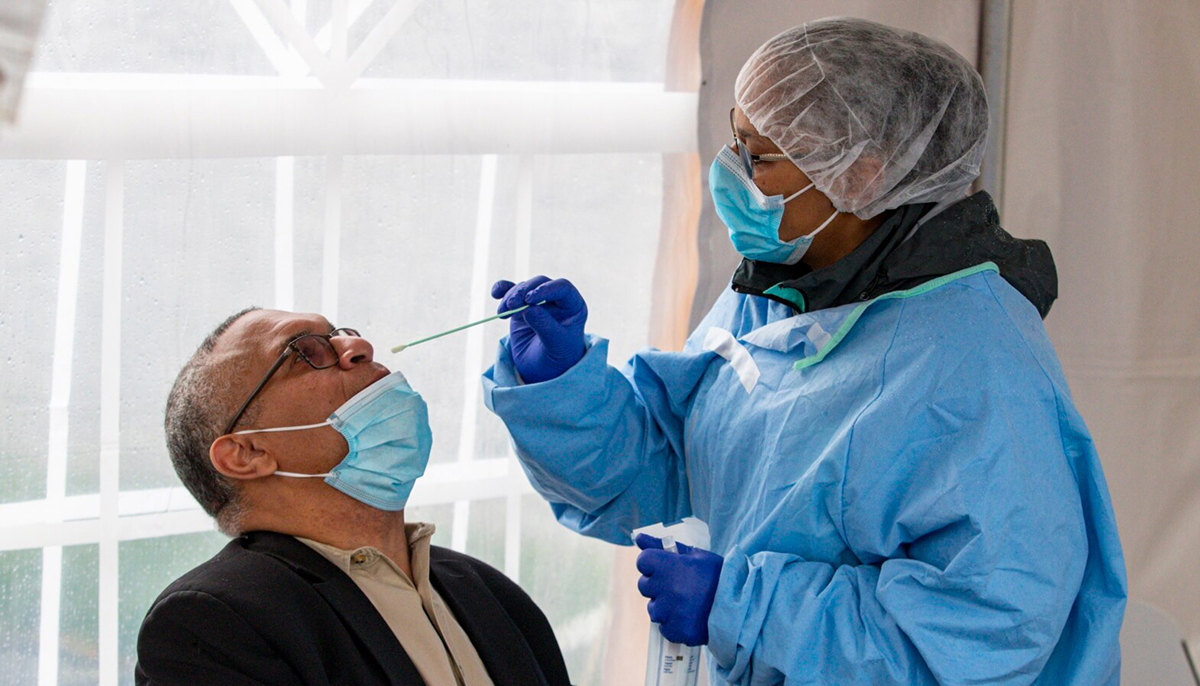 |
Democratic gubernatorial candidate Woody Myers undergoes a Covid-19 test in Indianapolis, Indiana, on 23/4/2020. Photo: AP
WHO's investigations have so far yielded no definitive conclusions due to a lack of evidence, and all hypotheses remain under consideration. Maria Van Kerkhove, WHO's Head of Epidemic and Pandemic Preparedness and Prevention, affirmed: "We continue to follow up with all governments that have reported intelligence, including the United States. However, beyond publicly available information, we currently do not have those reports."
Nearly six years after the pandemic began, the search for the origin of the SARS-CoV-2 virus remains one of the greatest global scientific and political challenges. It continues to be a source of tension between major powers. The two main hypotheses are that the virus transmitted naturally from animals to humans, or that it leaked from a laboratory in Wuhan, China. No conclusive evidence has been published to definitively refute either scenario.
The natural origin hypothesis, initially supported by the World Health Organization (WHO) and much of the scientific community, draws on experience from previous coronavirus outbreaks like SARS and MERS. A joint WHO - China report in 2021 concluded that transmission from bats via an intermediate host was "very likely" and a laboratory leak was "extremely unlikely". However, this report faced criticism for a lack of transparency and raw data from China. Genetic studies indicate the virus's similarity to bat strains, but the specific intermediate host has not been identified.
The laboratory leak hypothesis has garnered significant attention and support from Washington, particularly during the administrations of Joe Biden and Trump. Media reports, such as one by the Wall Street Journal in May 2021, cited US intelligence indicating that three researchers at the Wuhan Institute of Virology were hospitalized in November 2019 with Covid-like symptoms, raising new suspicions.
For its part, Beijing firmly rejects the laboratory leak hypothesis, viewing it as a politicization of the issue and accusing the United States. China insists the virus has a natural origin and has consistently denied requests for full access to raw data or sensitive research facilities, severely hindering international investigations.
Meanwhile, WHO has repeatedly called for transparency and full cooperation from China, establishing expert groups to continue research. However, the ability to conduct a comprehensive and unimpeded investigation remains limited due to a lack of consensus and information from all parties. To date, despite numerous investigations and declassified information from US intelligence agencies, no "silver bullet" has been published to end the debate.
Binh Minh (According to AFP, NY Times, Hill)