On 8/9, a World Health Organization (WHO) representative warned that the Ebola response in the Democratic Republic of Congo (DRC) faces a critical "bottleneck." This is due to a lack of skilled personnel, insufficient coordinating partners, and funding shortages, even as the disease continues to spread. The epidemic has expanded beyond its initial epicenter in Bunia, now affecting 6 provinces. This forced authorities to adapt their strategy, establishing treatment centers near new outbreak zones to ensure swift patient access.
The current outbreak of the Ebola Bundibugyo virus strain in the DRC has resulted in over 3,000 deaths and more than 6,000 infections, according to WHO. This makes it the country's worst epidemic in history, with continued spread across the northeast.
Luca Fontana, a WHO technical expert, noted that nearly 1,400 beds were rapidly established across 59 treatment centers. He described this as one of the fastest scale-up operations he has witnessed, even surpassing the Ebola pandemic response in West Africa from 2014-2016.
"Despite these extraordinary efforts, we estimate an additional 1,600 beds are still needed to meet demand", Fontana stated.
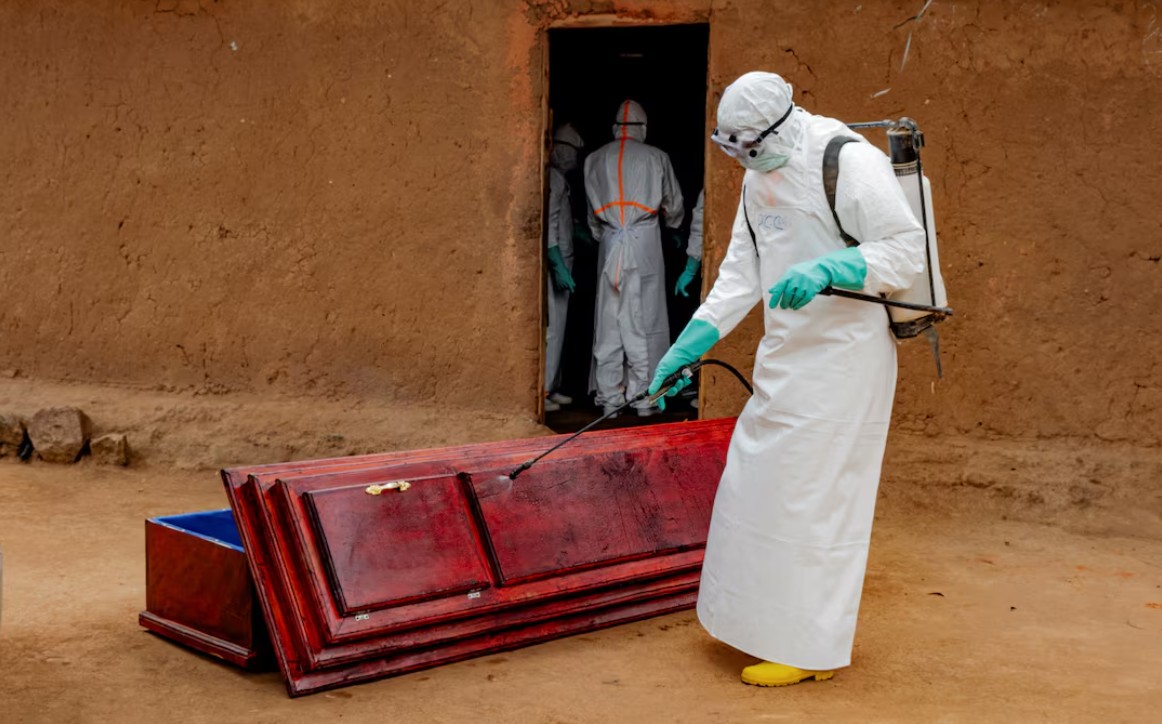 |
Members of the Civil Protection force, local community teams dedicated to preventing Ebola virus spread and ensuring safe, rapid burials, wear protective gear and spray disinfectant on a wooden coffin before moving the body of a man who died from Ebola from his home in Bunia, Ituri province, Democratic Republic of Congo, on 10/7. *Reuters* |
The agency estimates that each Ebola treatment bed requires an average of three healthcare workers. This translates to a need for approximately 9,000 personnel to manage the projected 3,000 beds, requiring the recruitment and training of an additional 5,000 new healthcare workers.
"Each time a healthcare worker dons full protective gear to enter the patient area, the cost is about 25 USD", Fontana explained. "We have hundreds of staff entering and exiting these areas daily".
Challenges are compounded by a severe scarcity of international organizations capable of operating Ebola treatment centers. This shortage is partly due to global aid funding cuts.
"Where are the organizations that operated treatment centers during the 2014-2016 West Africa epidemic?" he questioned. "Their inability to be present on the ground to support this outbreak response is likely due to a lack of resources. This represents one of the biggest 'bottlenecks' that could slow the scaling-up process".
Operating a 50-bed treatment center costs approximately 500,000 USD, according to WHO. The agency notes that only about 5-6 large organizations currently possess the expertise to establish and operate an Ebola treatment center. These organizations risk becoming overwhelmed managing existing facilities unless other partners assume control of stable, operational centers.
In some areas, the DRC Ministry of Health has taken over treatment centers established at the outbreak's onset. However, Fontana warned that the ministry's capacity would eventually reach its limit.
"Therefore, we need more organizations to join the effort on the ground", he stated, "to free up the most experienced partners so they can continue to the front lines".
Given this urgent situation, WHO is urging donors to increase funding and accelerate contributions to the 1.3 billion USD Ebola response plan, which the DRC government will lead for the next six months.
*Binh Minh (According to Reuters)*