Eng English
China 中国人

Eng English
China 中国人
  • News
  • World
  • Business
  • Entertainment
  • Sports
  • Law
  • Education
  • Health
  • Lifestyle
  • Travel
  • Science
  • Digital
  • Automobiles
  • Trở lại Thể thao
  • Health
Saturday, 3/10/2026 | 09:04 GMT+7

Why WHO recommends front-of-pack nutrition warnings on product packaging?

The World Health Organization (WHO) states that placing information about sugar, salt, and fat content on the front of packaging helps consumers quickly identify foods to limit.

WHO recently proposed front-of-pack nutrition labeling for food, in a context where Vietnam only requires businesses to print ingredient tables on the back of product packaging. This placement, with its small, hard-to-read font, makes it difficult for consumers to find information on unhealthy levels of salt, sugar, or fat when shopping.

A WHO Vietnam representative notes that shoppers often have only a few seconds to compare products in a supermarket. However, nutrition information is primarily on the back of packaging, presented as data tables with various texts and units.

To determine if a product is high in sugar, sodium (salt), or fat, consumers must locate the correct information, read the content, and sometimes convert it to serving sizes. This process is not simple for those without nutritional knowledge or who are shopping in a hurry.

Therefore, WHO recommends front-of-pack labeling (FOPL) for pre-packaged foods. FOPL involves placing important nutrition information in the most visible position on the packaging. Depending on the model, labels can use colors, symbols, or text warnings.

In a warning model, products with high levels of nutrients to limit can be identified by phrases such as "high in sugar", "high in sodium", "high in saturated fat", "high in total fat", or "high in trans fat". This labeling method prevents shoppers from having to calculate values from a long data table. Additionally, this information provides a visual cue, allowing them to quickly understand the product's nutritional profile and make informed decisions before purchasing.

According to WHO, this labeling serves as a tool to support consumer choice, not to dictate which products should be bought or consumed.

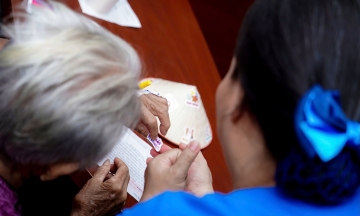
Consumers read product labels while shopping at a supermarket in TP HCM. *Photo: Thanh Tung*

Vietnam faces a significant burden from non-communicable diseases. WHO and the Ministry of Health report that approximately 80% of deaths in Vietnam are linked to non-communicable diseases, with about 44% occurring before age 70. These diseases have various causes, including several diet-related risk factors that can be prevented or managed.

Associate Professor, Doctor Truong Tuyet Mai, Deputy Director of the National Institute of Nutrition (Ministry of Health), states that excessive consumption of salt, free sugars, saturated fats, and trans fats is linked to overweight, obesity, high blood pressure, metabolic disorders, cardiovascular diseases, and diabetes. Therefore, helping people quickly identify products high in these ingredients is a solution to reduce non-communicable disease risk factors.

A WHO representative noted that FOPL not only targets consumer behavior during shopping but also prompts businesses to adjust their formulations to reduce ingredients that would trigger a warning label.

In Chile, after implementing a black symbol warning system, studies observed reduced sales of product categories high in sugar, sodium, or saturated fat. Peru's warning system was introduced in 2019. Assessments there indicate a trend of businesses improving formulations and a decrease in the proportion of products requiring warning labels in subsequent years.

WHO recommends that countries establish unified, mandatory FOPL systems, supervised by state regulatory bodies.

Master Le Thi Thu Ha, from the University of Public Health, suggests that warning labels are not intended to "ban" any food type. The goal is to bring crucial information closer to the shopper's attention. At the market level, this policy incentivizes businesses to reduce sugar, salt, or fat in their products.

Le Nga

By VnExpress: https://vnexpress.net/vi-sao-who-khuyen-nghi-dan-canh-bao-dinh-duong-o-mat-truoc-bao-bi-san-pham-5127620.html
Tags: nutrition label WHO

News in the same category

Radiation therapy for pain relief in terminal cancer patients

Radiation therapy for pain relief in terminal cancer patients

Radiation therapy can destroy cancer cells and shrink metastatic tumors, reducing compression and contributing to pain relief for cancer patients.

Can cupping and bloodletting cure stroke?

Can cupping and bloodletting cure stroke?

Recent reports and shared experiences promoting finger-pricking bloodletting and cupping techniques on the neck to 'remove blood clots' for stroke treatment or prevention have raised questions. Is there any truth to these claims? (Lien, 30, Hanoi)

Forgetting the way home, mistaken payments: easily overlooked signs of dementia

Forgetting the way home, mistaken payments: easily overlooked signs of dementia

Forgetting the way home, taking the wrong medication, or confused payments can be early signs of dementia, but are often dismissed as normal manifestations of aging.

Recognizing eye diseases through blurry vision symptoms

Recognizing eye diseases through blurry vision symptoms

Blurry vision is a common symptom that can be caused by various eye conditions such as nearsightedness, cataracts, or retinal detachment.

Why arm swelling occurs after breast cancer surgery

Why arm swelling occurs after breast cancer surgery

"My arm is swollen after breast cancer surgery. Why does this happen and how can I improve it?" asks Ngoc Ha, 34.

Should disc herniation be treated with radiofrequency ablation?

Should disc herniation be treated with radiofrequency ablation?

I have an L5/S1 disc herniation, which is compressing a nerve root, and medication has not helped. Can I be treated with radiofrequency ablation? (Ngoc An, Ha Noi)

Why eating three meals supports weight loss

Why eating three meals supports weight loss

I want to diet for weight loss by eating two meals a day and skipping dinner, but you advise that eating three full meals is better for weight loss. Why? (Ngoc Anh, Ho Chi Minh City)

Is it better to exercise during the day or at night?

Is it better to exercise during the day or at night?

The time of day you exercise does not determine muscle gain effectiveness; the crucial factor is choosing a suitable time to maintain regular, long-term physical activity.

The coffee drinking mistake that raises cancer risk

The coffee drinking mistake that raises cancer risk

Many people enjoy sipping steaming hot coffee, but experts warn that drinking it too hot can increase the risk of esophageal cancer.

First laparoscopic surgeries performed on Phu Quy island

First laparoscopic surgeries performed on Phu Quy island

The Phu Quy military-civilian medical center performed its first laparoscopic surgeries on four patients, enabling residents to receive treatment directly on the island instead of traveling to the mainland.

Eng English
China 中国人
  • News
  • World
  • Business
  • Entertainment
  • Sports
  • Law
  • Education
  • Health
  • Lifestyle
  • Travel
  • Science
  • Digital
  • Automobiles
FPT Tower, 10 Pham Van Bach Street, Dich Vong Ward,
Cau Giay District, Hanoi, Vietnam
Email: contacts@vnportal.net
Tel: 028 7300 9999 - Ext 8556
Advertise with us: 090 293 9644
Register
© Copyright 2026 vnnow.net. All rights reserved.
Terms of use Privacy policy Cookies