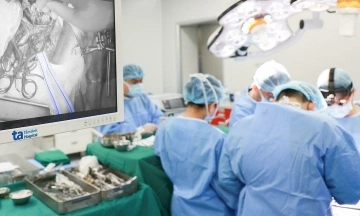
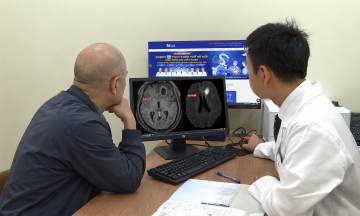
Endoscopic findings at Tam Anh General Hospital TP HCM revealed inflammation and narrowing of Ms. Huong's external ear canal. A biopsy confirmed stage III, highly differentiated, invasive squamous cell carcinoma.
Doctor Nguyen The Hien, Head of the Radiation Therapy Department at the Oncology Center, prescribed radiation therapy to eliminate the tumor, opting against surgery. This decision was due to Ms. Huong's age and the high risk of surgery causing deafness in her right ear or one-sided facial paralysis from potential damage to the 7th cranial nerve. The external ear canal's proximity to critical structures like the mastoid bone, middle ear, parotid gland, cranial nerves, and spinal cord necessitated precise calculations by the medical team. Their goal was to deliver sufficient radiation to destroy malignant cells without harming surrounding healthy tissues.
According to Doctor Hien, the external ear and head-neck region's uneven contours and numerous folds pose challenges for close contact during radiation therapy. Traditional methods, using an immobilization mask, often result in gaps between the mask and skin surface. This can lead to uneven radiation dose distribution, potentially leaving superficial cancerous tissue undertreated. Historically, patients received flexible plastic sheets shaped like the earlobe, secured by a mask. However, this material often failed to conform to the irregular areas around the earlobe and mastoid bone, creating air pockets.
To address these issues, the medical team designed a custom 3D bolus based on CT data. This bolus precisely contoured Ms. Huong's external ear, acting like an "artificial skin layer". This innovation ensured accurate radiation dose delivery to the tumor-bearing tissue and cervical lymph node region. The team also optimized the radiation therapy plan to maximize the dose to the tumor while minimizing impact on surrounding healthy structures.
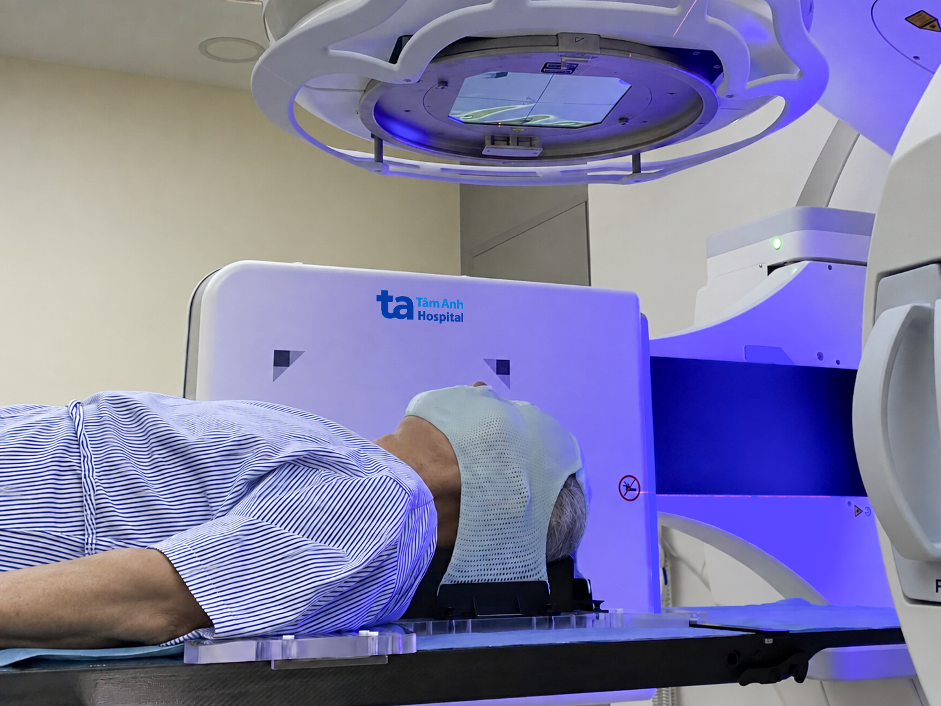 |
Ms. Huong undergoes radiation therapy using a linear accelerator system combined with a personalized 3D bolus based on CT data. *Photo: Tam Anh General Hospital* |
Throughout her radiation therapy, Ms. Huong maintained normal daily activities and experienced reduced pain. She has now completed treatment and is undergoing regular follow-up appointments.
External ear canal cancer is rare, affecting approximately one in one million people, and is typically observed in adults over 65, according to Doctor Hien. The disease often originates as skin cancer in the ear region, presenting as nodules or small ulcers. Without timely detection and treatment, cancer cells can invade the ear canal, eardrum, and metastasize to surrounding bones, impairing hearing and balance, and becoming challenging to treat. In contrast, early-stage skin cancer, when treated promptly, boasts a cure rate of up to 99%.
While the exact cause of external ear canal cancer remains unclear, several factors may increase risk. These include prolonged sun exposure to the outer ear and chronic irritation from frequent ear picking. Over time, such benign lesions can potentially transform into cancerous ones.
Ear cancer is often overlooked because its initial symptoms mimic common benign ear infections. Doctors advise individuals to seek examination and appropriate treatment for any nodules on the ear or temple. Furthermore, anyone experiencing sudden hearing loss, tinnitus, impaired hearing, swollen and painful lymph nodes in the jaw area, or a sensation of narrowing and inflammation within the ear canal should consult a doctor to determine the underlying cause.
Khai Minh
*Patient's name has been changed
| Readers can submit questions about cancer here for doctors to answer. |