During a conference on medical examination and treatment deployment for 2026 on 2/2, numerous hospitals reported that the Social Insurance (SI) agency denied payment for imaging diagnosis costs because the "actual performance time was faster than the specified norm". Ha Anh Duc, Director of the Department of Medical Examination and Treatment Management, acknowledged that his department developed this process previously, but its practical application has created problems.
"An X-ray scan must take a full 6 minutes, and an ultrasound 30 minutes. If it's faster than this, health insurance will not pay. The department 'created' this process, now what's the best way to handle it?", Duc questioned.
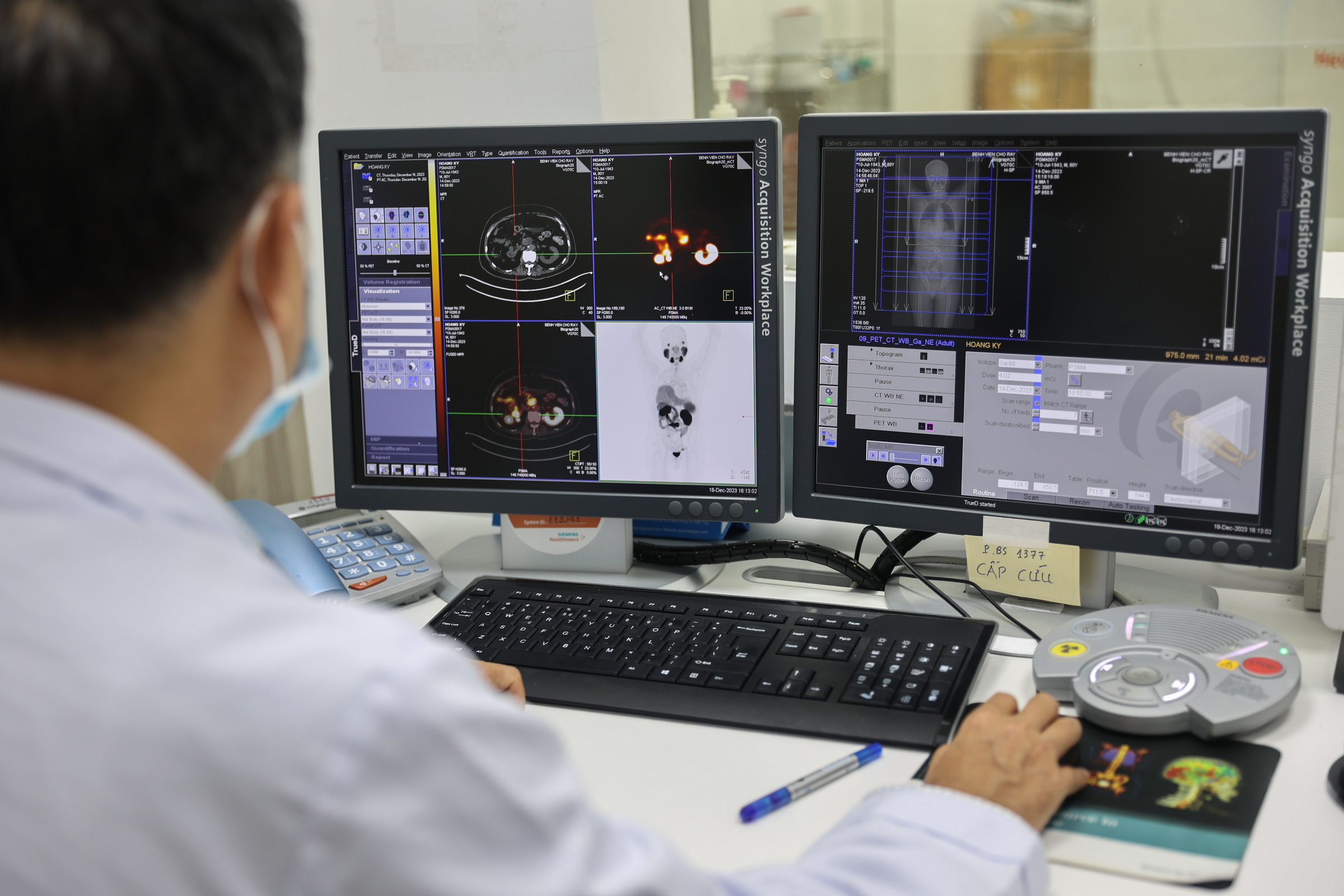 |
Doctor at Cho Ray Hospital performing a PET/CT scan for a patient. Photo: Quynh Tran
To clarify the cause of the dispute, Nguyen Trong Khoa, Deputy Director of the Department of Medical Examination and Treatment Management, explained that the 6-minute or 30-minute timeframe is an economic-technical norm used to set the price of medical services, based on older technology. However, issues arose when the insurance agency used this average norm as a rigid benchmark for auditing. Specifically, if a hospital performs a scan faster than 6 minutes – which is normal with modern digital machines – the system flags it as an incorrect procedure and denies payment.
"There's no reason why an X-ray scan, which is supposed to take 6 minutes, should only account for the time the machine is active", Khoa argued. In reality, the process of an X-ray scan involves more than just a few seconds of radiation emission. It includes a sequence of actions, from patient reception and positioning to performing the technique, processing images, reading, and returning results.
The leader of the Department of Medical Examination and Treatment Management emphasized that applying this auditing rule contradicts professional medical practice. The actual performance time depends on the doctor's skill and the complexity of each case. A straightforward case might be identified in one minute, but a difficult ultrasound case could take 15-20 minutes. Therefore, "it's impossible to rigidly force everyone to be the same".
To resolve the situation of "doctors waiting for the clock to run out", the Ministry of Health has met with the Association of Radiology and Nuclear Medicine and conducted nationwide surveys. The Department of Medical Examination and Treatment Management is drafting a document to send to the Ministry of Finance and Vietnam Social Security, proposing a review of this auditing rule.
The professional agencies believe that the standard time should only serve as a basis for calculating prices (economic norms), not as a condition for payment. The Ministry of Health proposes an adjustment to include an average time range with a broader margin of fluctuation to suit practical realities. Auditing should focus on the rationality of the indications and treatment effectiveness, rather than nitpicking about technical time.
"Auditing should focus on whether the indications are correct and if there is waste, rather than nitpicking about technical time", Khoa stated.
Also at the conference, the issue of outstanding health insurance payments garnered significant attention from many units. Hoang Trung Tuan, Deputy Director of the Health Insurance Department, reported that the total amount of unresolved outstanding payments between medical facilities and the insurance agency currently stands at nearly 23,000 billion VND. Of this, over 10,000 billion VND are accumulated amounts from 2023 and earlier, which the Ministry of Health is presenting to the Government for resolution. For 2024 alone, the projected expenditure overrun is about 8,000 billion VND. The Ministry of Health urged localities to promptly review and resolve these issues definitively during this period.
Le Phuong