Just before sunset on 25/5/2003, an old Boeing 727 carrying two men, Ben Charles Padilla and John Mikel Mutantu, took off from Quatro de Fevereiro Airport in Luanda, Angola. Ben, an American aviation engineer and private pilot, was one of them.
The aircraft ascended into the sky with no external lights, no flight plan, and no response to air traffic control signals. Its transponder was off, and within minutes, it disappeared from radar screens as it flew southwest over the Atlantic Ocean.
Neither the aircraft, tail number N844AA, nor the two men on board were ever seen again.
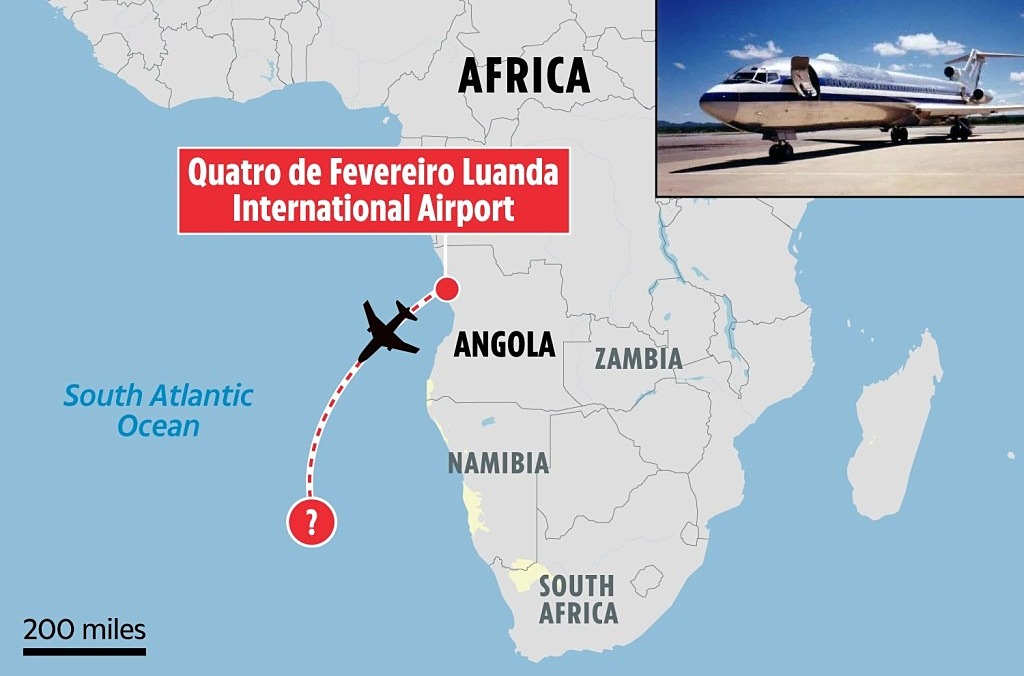 |
The Boeing 727 took off from Quatro de Fevereiro International Airport in Angola, vanishing as it headed out over the Atlantic Ocean. Photo: The Sun
Over 20 years later, this disappearance remains one of modern aviation's most baffling mysteries, fueling numerous theories ranging from organized crime and insurance fraud to terrorism and hostage-taking.
Ben's brother, Joseph B. Padilla Sr, refutes the idea that Ben stole the plane. Instead, he believes the aircraft was hijacked. Joseph stated, "I truly believe Ben was taken hostage and held against his will, possibly killed."
The Boeing 727, manufactured in 1975, served 25 years with American Airlines before being converted into a cargo plane. By 2003, it was considered outdated for passenger transport but remained fully airworthy.
Following a failed resale, the aircraft was grounded in Angola. Having sat on the tarmac for over one year, it accrued millions of USD in parking and service fees amid ownership disputes. Reports detailed a series of companies vying for ownership of the Boeing, complicating debt recovery efforts.
Despite this situation, aviation expert Julian Bray indicated the Boeing had clearly been maintained for flight readiness, adding that an aircraft cannot take off without thorough preparation.
Bray explained that under normal conditions, airports prevent disputed aircraft from taking off by immobilizing them, including blocking or locking the nose wheel to prevent runway movement. However, this did not occur in Luanda, allowing the plane to taxi onto the runway unhindered and without authorization.
On the evening of the incident, witnesses reported the aircraft moving unusually as it approached the runway, then lining up and taking off without permission.
One reason the aircraft might have evaded scrutiny was its cargo role. Converted from a passenger plane, it featured a large cargo loading door on its side, and frequent access by personnel appeared normal.
"If people are working on the plane, you wouldn't see anything out of the ordinary. In fact, nobody would look inside the plane because they wouldn't care," Bray clarified.
This raised suspicions that the aircraft might have been used to transport illegal cargo, such as drugs.
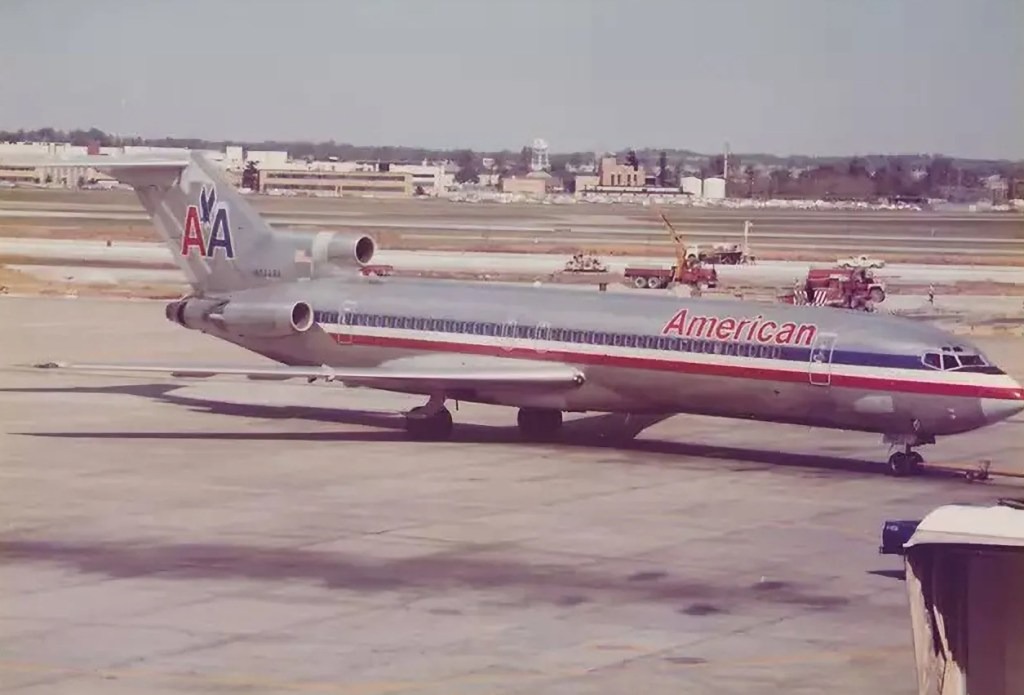 |
The American Airlines Boeing 727 that disappeared in 2003. Photo: The Sun
The Boeing was believed to have been loaded with approximately 14,000 gallons of fuel at the time of takeoff, enough for a flight of about 1,500 miles (over 2,400 km). "You wouldn't take off if the fuel tank wasn't full," Bray noted, suggesting a deliberate plan rather than an impulsive escape.
By disabling its transponder and radio system, the aircraft effectively erased itself from tracking networks. Without an air traffic flight plan or handover information to air traffic control, the plane became invisible.
The Boeing headed southwest, towards vast oceans or remote African regions with abandoned wartime runways.
Speculation about the reason for the plane's disappearance began almost immediately after it left the runway. Some believed the Boeing was stolen for use in organized criminal activities, potentially transporting high-value contraband like drugs. Others pointed to the tense climate following the 11/9/2001 terrorist attacks in America, which occurred less than two years prior, raising concerns that the aircraft could be used as a weapon.
The missing plane quickly drew the attention of American military and intelligence officials, prompting an intensive search as they believed it could be a "flying bomb."
Mastin Robeson, a former American Marine Corps general who commanded American military operations in the Horn of Africa at the time, stated that news of the missing Boeing "came through the intelligence network."
Robeson noted that the uncertainty surrounding the aircraft's purpose was so severe that the American Central Command considered deploying fighter jets to Djibouti, where American forces operated alongside French troops.
He added, "It was unclear whether it was stolen for insurance purposes by the owners themselves, or stolen with the intention of selling it to bad actors, or if it was a deliberate terrorist plot. There was speculation about all three possibilities."
No explosion or attack was ever recorded.
Ben, the American aviation engineer and private pilot, and John, a mechanic reportedly from the Democratic Republic of Congo, were both authorized to work on the aircraft. However, neither held a pilot's certification for a Boeing 727, a type of aircraft that typically requires a three-person crew.
Expert Bray noted that, despite the inherent risks, flying the aircraft was feasible. "If he had a pilot's license, he knew the principles of flight," Bray explained, comparing it to operating a vehicle without specific type certification. He also added that a pilot and a mechanic on board constituted a "viable flight crew."
One of the most unsettling theories suggests the two men did not act voluntarily.
Proponents of the hostage theory suggest someone might have been on board to ambush them, threatening them into taking off. According to Bray, there have been past instances where criminals kidnapped family members to exert pressure.
The family stated Ben had spent weeks in Angola overseeing the aircraft's overhaul and preparing for a recovery flight – returning the plane to its lessor.
According to Ben's brother, the Boeing had undergone a thorough inspection and was declared airworthy – contrary to initial reports that it had been abandoned or unmaintained.
Joseph mentioned his brother did not have a Boeing 727 license and never intended to fly this type of aircraft. Ben worked as an aviation engineer and mechanic, responsible for recruiting qualified pilots and co-pilots for the scheduled flight.
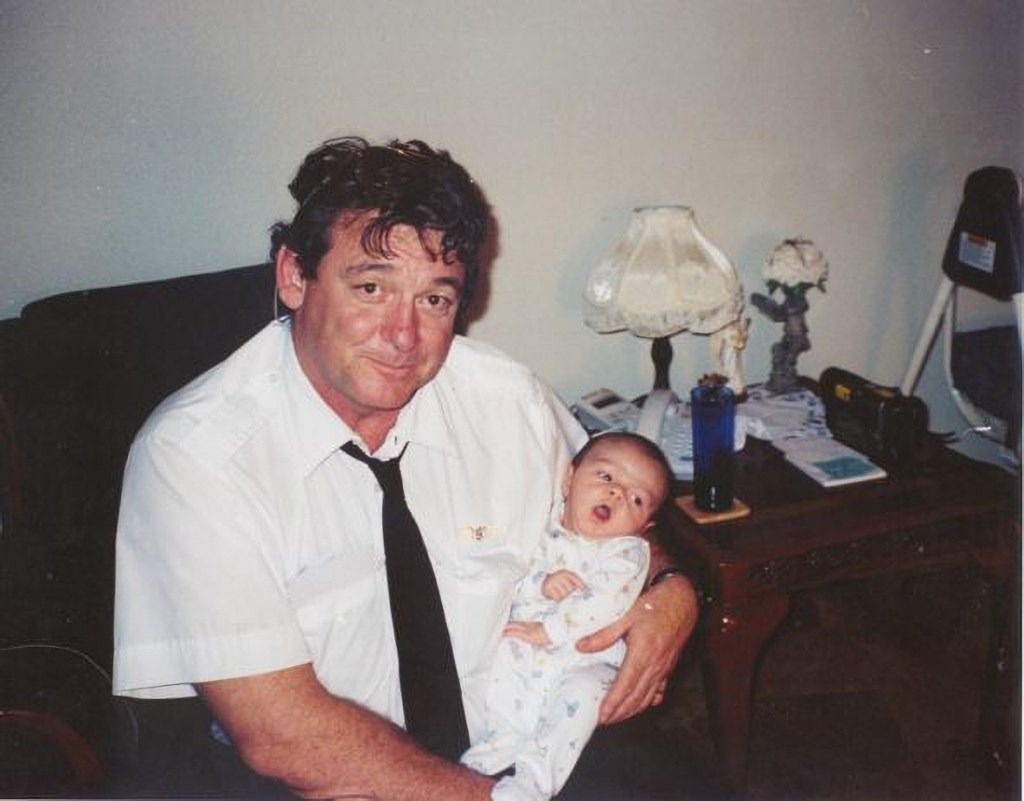 |
Ben Charles Padilla, an American aviation engineer and private pilot, was one of the two men who disappeared with the aircraft. Photo: The Sun
Joseph believes the aircraft was taken over while Ben was inspecting the engines near the runway, meaning someone could have been on board prior to the incident.
Joseph also recalled Ben telling family members that if he ever found himself in a 9/11-style hijacking situation, he would try to crash the plane somewhere rather than let it be used as a weapon.
The family reported Ben was in contact with them just before the plane vanished. He promised to call back after hearing news of his mother suffering a heart attack. But that call never came.
Despite investigations involving American authorities, including the FBI and CIA, there has been no confirmed information about sightings of the aircraft or its wreckage.
Bray believes the most plausible explanation is simple: "I think it landed somewhere," possibly a remote airstrip, and was subsequently dismantled, hidden, or abandoned. Another theory suggests the aircraft continued to fly until it ran out of fuel, then crashed into the ocean.
Regardless, the Boeing 727 that quietly took to the Angolan sky remains missing, with no wreckage, no answers, and no clear resolution.
Tue Anh (according to The Sun)