Most people call 911 for help, but Paul Stephani used the number to confess his crimes. "I cannot control myself", Paul lamented in one call.
Paul earned the nickname "the sobbing killer" because of his high-pitched, agitated, trembling, and crying voice, which conveyed feigned remorse. He admitted to murdering three women and carrying out brutal attacks on two others in a crime spree that rocked the early 1980s.
His habit of calling 911 eventually led to Paul's arrest. Investigators recognized his distinctive voice when he called for help after being injured in his final attack.
"I will never forget that voice. It will stay with me my whole life", said Bob Paskett, a former detective with the St. Paul Police Department in Minnesota.
The suspect with the high-pitched voice
The investigation began with a suspicious 911 call, just hours into the new year 1981.
"This is an emergency. Send a police car to Malmberg Manufacturing and Engineering Company. Please send an ambulance too. There is a girl injured", the caller stated. He told the dispatcher that the girl was on the ground, near railroad tracks. However, he hung up before providing any identifying information.
Upon arriving at the scene, police found Karen Potack, 20 years old, unconscious and severely beaten, barely clinging to life. The only clue left at the scene was her torn shirt, discovered about 55 meters from where the attack occurred.
Karen was taken to the hospital and fortunately survived. However, due to her severe injuries, she remembered nothing about the attack.
 |
The scene of Karen Potack's attack. Photo: Nvinoticias |
Through investigation, police learned Karen had been out with friends that evening. She went to a bar over 3 kilometers from where she was attacked. According to her companions, Karen left the bar alone after midnight, intending to return home.
Police hypothesized that someone offered Karen a ride home on the cold night, but instead took her to a secluded area to attack her. They believed it was highly likely that the caller with the high-pitched voice was the suspect.
The perpetrator who lured a young woman at the bus station
Months later, investigators received another 911 call on the evening of 3/6/1981. "Can you find me? I just stabbed someone with an ice pick. I cannot stop myself", the caller with the high-pitched voice asked.
This time, he hung up without providing information about the victim's location. However, about 30 minutes later, three boys playing in the woods stumbled upon the body of a young woman in a bush and called 911.
The victim carried no identification, but had a locker key from the St. Paul bus station, about 3 kilometers from the scene. Inside the locker, investigators found two bags and identification belonging to Kimberly Compton, 18 years old, from Wisconsin. She had arrived in St. Paul only hours before her murder.
Her family stated that Kimberly had just graduated high school and came to St. Paul hoping to find work and attend college. However, the young woman never had the chance to fulfill those dreams.
The medical examiner determined Kimberly had been stabbed 61 times.
Knowing the victim was murdered just hours after getting off the bus, investigators went to Mickey's Diner, across from the bus station, to gather information. Staff at the diner revealed they saw a white man, around 50 years old, approach Kimberly while she was eating, and she later left with him.
While still trying to piece together clues, investigators received another 911 call on 11/6/1981. "I am sorry for what I did to Kimberly Compton. I cannot control myself. I do not know why I had to stab her. I am extremely distressed about it", the caller said.
He added, "I will try not to kill anyone else", then hung up. According to detective Bob Paskett, his confession without revealing his identity "was like mocking the investigators".
To track down the culprit, authorities released several recordings of "the sobbing killer's" voice to the media. Many people, especially young women, lived in fear, worried about who he would target next.
Fatal encounter at the bar
For over one year, the case saw no new progress, until a newspaper delivery boy in Minneapolis discovered a woman's body by the river on 6/8/1982.
The victim was identified as Barbara Simons, a 40-year-old nurse. She had been stabbed 106 times with what authorities believed to be a screwdriver or an ice pick.
Friends told police that Barbara frequently visited the Hexagon bar, over 3 kilometers from where her body was found. Bar staff stated they saw her talking to a man the previous evening. Around 11:30 p.m., Barbara told a waitress, "I hope this is a good man, because he is going to drive me home". That was the last time Barbara was seen alive.
The waitress described the suspect as a white man, in his 40s, bald with black hair, and a mustache.
About 48 hours after Barbara's body was discovered, police received a call from "the sobbing killer". "I stabbed her. I do not know what is wrong with me. I killed those people. I will never go to heaven", he said in an agitated state.
Tracking the killer
Concerned the perpetrator might strike again, investigators asked the FBI to create a psychological profile of the killer. The profile suggested the perpetrator likely struggled with guilt and had a criminal record.
Based on these findings, police reviewed records, searching for individuals with a history of assault or violence who also matched the physical description provided by witnesses. They presented about 20 mugshots to Hexagon bar staff. These individuals recognized Paul Stephani, who had a prior conviction for aggravated assault and had worked at Malmberg Manufacturing and Engineering Company.
The factory owner recalled that Paul often spoke in a high-pitched voice when angry.
Believing they had found their suspect, police secretly monitored Paul while building their case. However, on 21/8/1982, he evaded the trailing officers.
Not long after, police received a 911 call from a passerby who witnessed a man brutally assaulting a woman. Fortunately surviving, victim Denise Williams told investigators she was a sex worker and had been picked up by a man. He then drove her to a secluded area and stabbed her in the abdomen with a screwdriver.
Denise hit him on the head with a glass bottle and escaped. However, he pursued her, knocked her down outside the car, and continued stabbing. Denise identified Paul as her attacker through a series of suspect identification photos.
Caught by his own 911 call
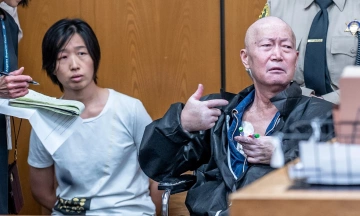
While police searched for Paul, he soon called 911 himself, reporting he had been beaten in a fight. Paul was taken by ambulance to a St. Paul hospital for treatment and was arrested there. Minneapolis authorities charged him with assaulting Denise and murdering Barbara.
 |
Paul Stephani upon his arrest. Photo: Oxygen |
Paul went to trial in February 1984 and was convicted of both charges. He received a 40-year prison sentence for Barbara's murder and an 18-year sentence for the aggravated assault of Denise. However, Paul was never prosecuted for Kimberly's murder or Karen's attack.
In 1997, after being diagnosed with terminal cancer, Paul confessed to attacking Karen, Kimberly, Barbara, and Denise. He also admitted to murdering Kathleen Greening, a female teacher he had dated in 1982. Paul told police that after their date, he returned to Kathleen's house and drowned her in the bathtub.
"An evil person is an evil person. It does not get any better just because he says he is sorry and admits to killing people", prosecutor Tom Foley stated.
Paul died in prison in 1998, six months after confessing his crimes.
Tue Anh (based on Oxygen, The Wrap)