Richard Floyd McCoy Jr. was born in 1942 in North Carolina. After graduating from high school, he attended Brigham Young University but later dropped out to join the military.
Upon returning home, McCoy married and served another term in the military. When he came back to Utah, he considered a third military operation, but his wife objected, so he took up skydiving as a hobby instead.
He returned to Brigham Young University, this time to study law enforcement. McCoy told friends he wanted to become an FBI or CIA agent.
However, money was tight. McCoy received only USD 243 per month from his veteran's benefits program, which was not enough to support his wife and two children. The family faced severe financial difficulties, and his marriage began to unravel.
McCoy's wife, the family's primary breadwinner, threatened divorce. McCoy also believed his veteran's benefits would soon be cut, so he needed to find another source of income.
During this time, the daring airplane hijacking by the mysterious figure DB Cooper was widely reported. As a former pilot, Richard McCoy was very interested in these incidents and had written his college graduation thesis on how best to prevent hijackings.
In his research, he realized there was no way to prevent hijackings. In fact, airline security systems were flawed in many aspects.
McCoy told a friend that Cooper should have demanded USD 500,000 instead of USD 200,000. He also claimed to have devised a perfect hijacking plan. If successful, his family would live comfortably for life.
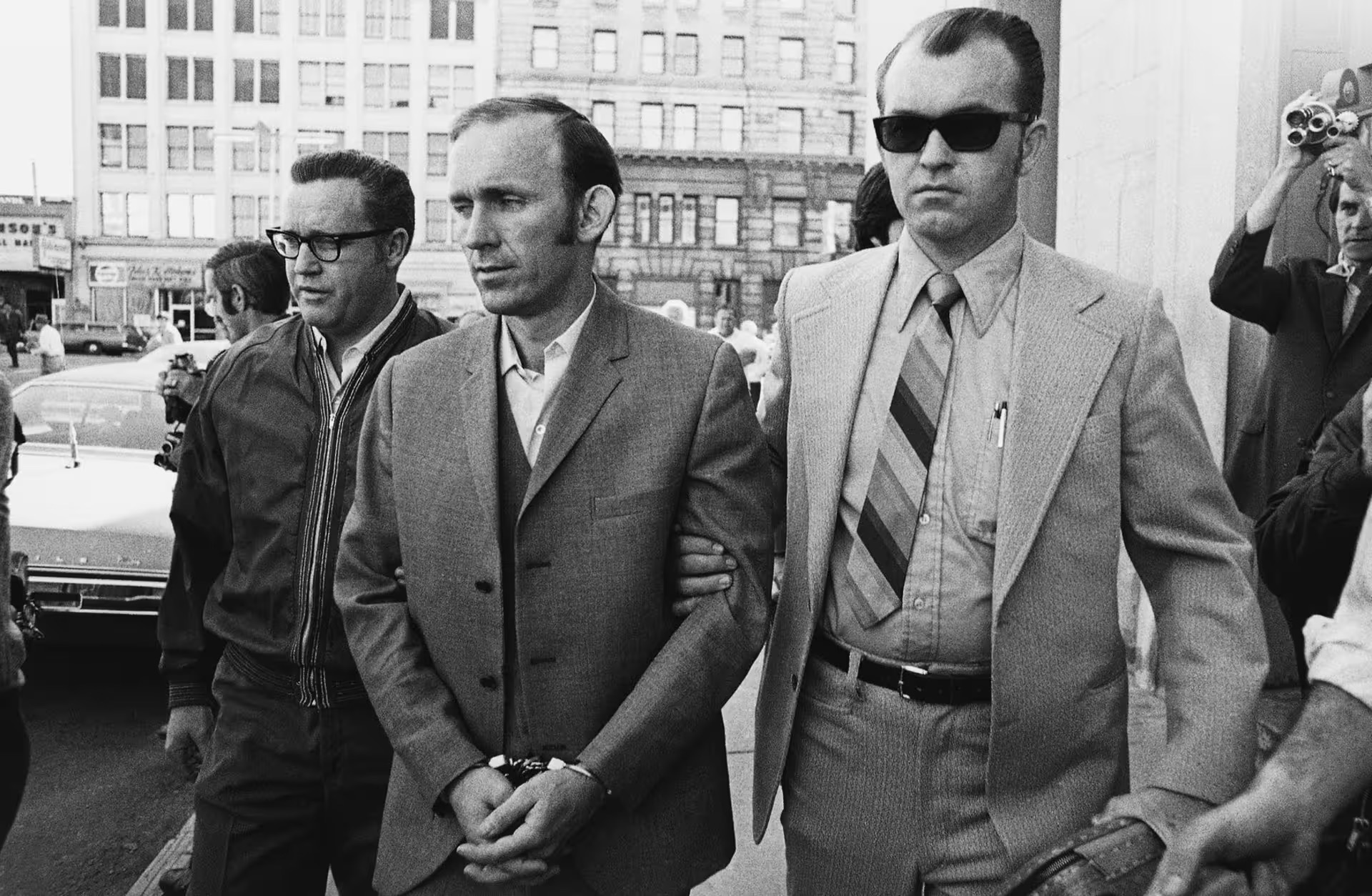 |
Richard Floyd McCoy Jr. in court in 1972. Photo: History |
McCoy convinced his wife to give him USD 500 to execute his perfect plan: buying a plane ticket, a gun, and a disguise.
His wife later stated she did not believe her husband would commit the crime, but she bought him a parachute before driving him to Salt Lake International Airport.
McCoy boarded United Airlines Flight 855 to Denver, Colorado, carrying 85 passengers and six crew members. This was a Boeing 727, the same type of aircraft DB Cooper had hijacked four months prior.
In the small restroom, McCoy changed from his brown suit and shoes into the flashy, fashionable attire of that era: a green floral shirt, an untied blue tie, a red and blue striped sports jacket, and black and white leather shoes.
He applied heavy makeup to his face and neck and wore a wig, knowing he needed to conceal his most prominent feature: his protruding ears. McCoy tried to use water and hairspray to keep the wig in place, but the newly dyed black hair faded all over his face and smeared his makeup, making him look suspicious.
Twenty minutes after takeoff, a flight attendant reported the suspicious passenger to the captain.
A pilot on leave, who happened to be on the flight, walked past McCoy's seat and confirmed he was armed. As the pilot approached, McCoy pulled out a pistol and handed over an envelope labeled "hijacking instructions." Inside were two typewritten pages detailing his demands, a grenade's safety pin, and a bullet.
The letter ordered the crew to fly to San Francisco and deliver USD 500,000 in cash along with four parachutes, while avoiding any police intervention.
The captain decided the safest option was to comply with the hijacker's demands. Passengers were informed the plane needed repairs and would be diverted to San Francisco. The crew notified San Francisco International Airport that they had been hijacked and were en route.
United Airlines agreed to meet the demands. When the plane landed in San Francisco, the airline delivered two luggage bags containing USD 500,000 in cash and four parachutes.
All passengers were released, but the Boeing 727, under McCoy's command, had to continue flying. By this time, the sun had set, and darkness enveloped the sky.
McCoy then used handwritten notes to instruct the crew to fly to an altitude of 16,000 feet, maintaining exactly 180 miles per hour along specific waypoints, creating a zigzag flight path in the sky.
Two C-130 Hercules transport planes from the Coast Guard followed the Boeing 727, but McCoy warned that if any pursuing aircraft were seen, he would detonate the plane after parachuting, activating a hidden explosive device. The captain had to request the two C-130 planes maintain a safe distance.
About two hours later, having reached a favorable altitude and wind direction, McCoy parachuted out, vanishing into the sky with a briefcase full of money.
The entire incident lasted five hours.
Forty-eight hours to solve the case
The plane landed safely. The FBI quickly arrived at the scene to collect evidence. Meanwhile, Provo city police and the Utah County Sheriff's Department searched the rural area near Provo, where they believed McCoy had parachuted. They found no trace of him that night.
The next day, McCoy was on duty with the National Guard and piloted one of the helicopters involved in the search for the hijacker.
The investigation progressed. That morning, the FBI Office in Salt Lake City received a phone call.
The caller was McCoy's friend, who stated that a few days prior, McCoy had talked about a perfect hijacking. The friend recounted McCoy's aerial combat record in the military and affirmed he was capable of such an act.
The FBI now had a specific name. The search in Provo also quickly yielded a clue. A driver reported picking up a hitchhiker wearing a parachute suit and carrying a parachute bag at a roadside hamburger stand.
The FBI took a photo of McCoy and brought it to the restaurant, where an employee recognized him as the person who had ordered a smoothie the previous night.
FBI agents summoned McCoy for questioning. He denied any involvement in the hijacking and agreed to provide a handwriting sample. The Army also assisted, providing McCoy's fingerprints and handwriting samples they had on file.
All three handwriting samples matched. Fingerprints on a Mainliner magazine cover also matched those stored by the military.
The FBI had sufficient evidence to obtain a search warrant, so agents searched McCoy's home in Utah and found USD 499,970 in cash.
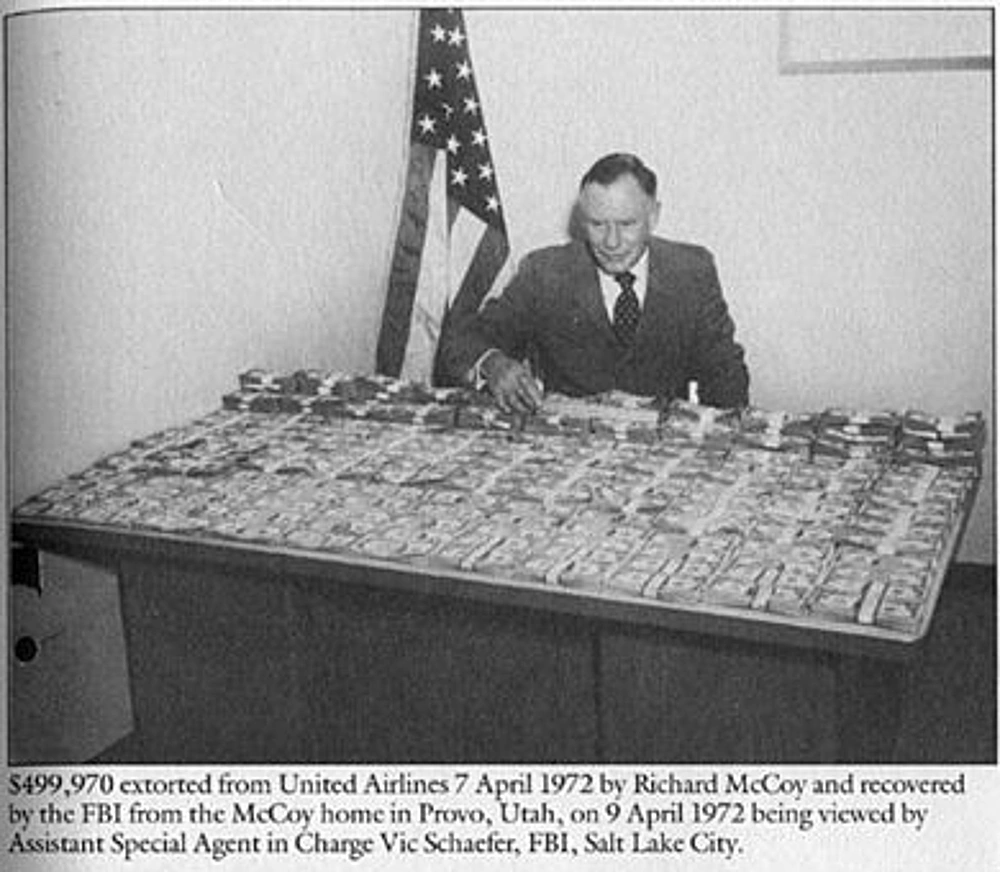 |
News reports in 1972 indicated investigators recovered USD 499,970 in cash, bound with bank rubber bands, inside McCoy's home. Photo: Salt Lake Tribune |
McCoy rejected all accusations, but the evidence against him was clear. He was convicted of air piracy and sentenced to 45 years in prison.
After two years in prison, McCoy executed a daring escape, stealing a garbage truck with a fake gun made from dental paste and ramming through the prison gate.
He evaded capture for three months but was tracked by the FBI to Virginia Beach in November 1974.
In a shootout with agents, McCoy, then 31 years old, was killed. However, his wife, children, and several agents believed McCoy was the notorious hijacker DB Cooper.
Hai Thu (According to ATI, USPA, NYP)