One August night, returning to their home in Eugene, Oregon, after a shift at their grocery store, Chong Man Kim and his wife were horrified to find their door forced open and belongings ransacked. Two hidden safes were discovered: one was pried open, and the other had vanished.
All their cash, wedding rings, family heirlooms, and a valuable coin collection were gone. The thieves left only a few loose coins scattered on the floor.
"50 years of work, 50 years of saving for my retirement dream, and now I have nothing left", said Kim, 69, an immigrant from South Korea, his voice choked with emotion.
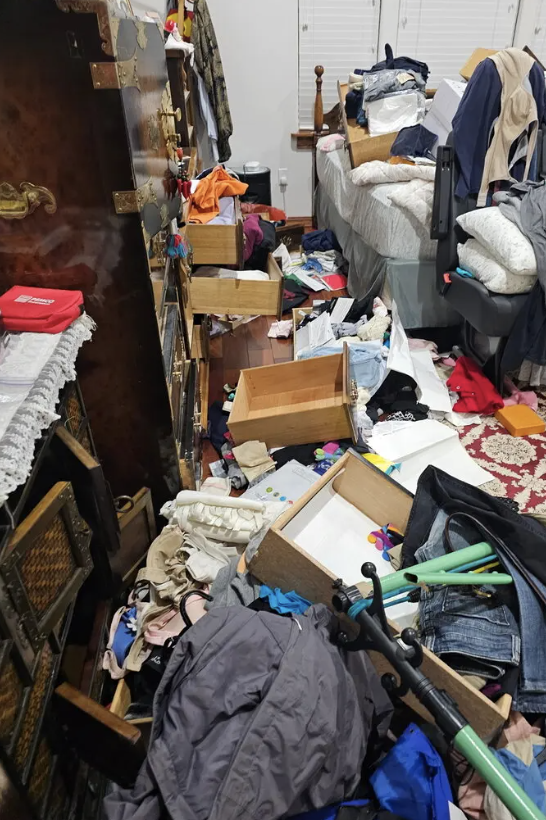 |
The cluttered home of the Kim family in Eugene, Oregon, after the robbery. Photo: Chong Man Kim
Mr. Kim and his wife are typical victims in a rising wave of thefts across the US. According to police, organized crime rings, mostly originating from South America, are executing sophisticated attacks targeting Asian American families.
Over the past year, law enforcement agencies have recorded numerous similar cases in Florida, Wisconsin, Ohio, Colorado, Pennsylvania, and Oregon.
Police indicate that criminals target Asian business owners, assuming they often keep large amounts of cash at home rather than depositing it in banks. Additionally, their diligent work habits with fixed hours and language barriers make them easy targets who are less likely to report crimes.
"They view these as ideal prey", stated Eugene Police Chief Chris Skinner. He believes this indicates a professional operating model by gang-style crime organizations, with total losses for victims reaching millions of USD.
Eugene, a peaceful town with 4% Asian population, has recorded three waves of robberies since early 2024, resulting in losses of approximately 1,7 million USD. A report from the Asian American Foundation shows that out of 485 robberies from 2018 to 2024, most occurred in private homes, and "the targeting of ethnicity is intentional".
These robbery groups do not act impulsively; they plan meticulously. They often arrive in a town, rent vehicles and short-term accommodations to establish a base.
The criminal groups track their targets for several days, using hidden cameras disguised in bushes and wifi jamming devices to disable alarm systems. They even pose as gardeners or delivery personnel to scout homes during the day. When residents leave for work, they break in, crack safes, and escape within minutes.
In Florida, police once found a group of suspects pretending to play basketball at a public court, solely to position cameras towards potential victims' homes.
 |
Chong Man Kim and his wife, Byung Sook, own an Asian grocery store in Corvallis, Oregon, and live nearby in Eugene. Photo: Amy Qin
Dismantling these gangs is likened to a game of "whack-a-mole": when one group is caught, another emerges. Although Eugene police have arrested 13 suspects over the past two years, recovering stolen assets remains almost impossible.
Legal hurdles also pose a challenge. Lenient bail regulations in some states allow suspects to post bail and flee soon after arrest. Recently, 7 Colombian citizens were arrested in Eugene in connection with a series of thefts. Police found evidence that they had transferred money and shipped stolen goods back to their home country. However, a lack of close coordination between local police and federal agencies, due to immigration concerns, complicates investigations into the ringleaders.
The wave of thefts has instilled widespread fear within the Asian American business community. Many have begun altering their habits: moving all assets to banks, installing wired alarm systems instead of wireless ones, and even acquiring weapons.
"You have to confront violence with toughness", said Bruce Chen, a restaurant owner in Eugene. He purchased a gun after his home was burglarized in 2022.
For Mr. Kim, the theft not only took his retirement savings but also stole his sense of security. He has experienced months of depression, torment, and shame for failing to protect his family. The image of a secure America he once believed in when he arrived 45 years ago has now shattered.
"We can't trust anyone now, even in our own home", he said.
Minh Phuong (According to NYTimes)