Do not brush immediately after consuming acidic foods
Many people have a habit of brushing their teeth right after having an evening snack, soft drink, or milk to remove plaque. However, this action can be counterproductive if you have just consumed acidic foods.
Acids from carbonated soft drinks and citrus fruits temporarily demineralize the tooth enamel surface. When teeth are weakened, the friction from a toothbrush will accelerate the erosion process.
Doctor Edmond Hewlett from the University of California, Los Angeles (UCLA) and the American Dental Association (ADA) recommends rinsing your mouth with clean water and waiting about one hour after consuming acidic foods before brushing. Saliva needs this time to neutralize acids and remineralize tooth enamel.
A study by King's University (UK) in early 2026 also indicated that the habit of sipping acidic drinks or eating fruit between meals increases the risk of tooth erosion. Therefore, if you have just been exposed to acid, you need to rinse your mouth and allow a resting period before picking up your toothbrush.
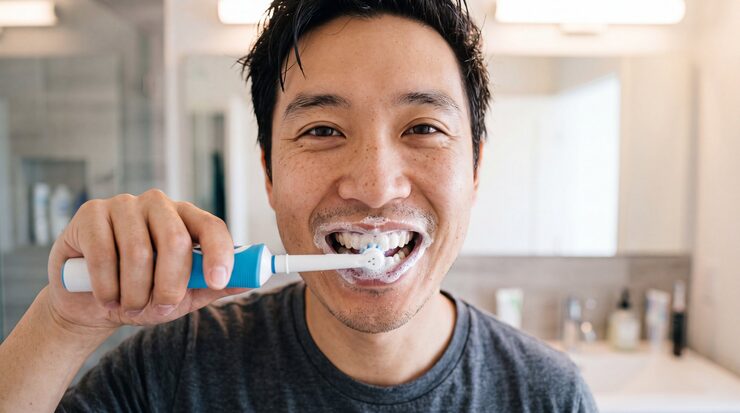 |
Brush your teeth at least one hour after eating acidic foods. Photo: Magnific |
Brushing hard does not mean clean
A toothbrush with quickly splayed bristles is a sign of applying too much force. Many people scrub their toothbrushes horizontally along the gumline dozens of times, believing that vigorous scrubbing is necessary to remove plaque. In reality, studies on the PubMed medical database conclude that hard-bristled toothbrushes and excessive brushing force, when combined with toothpaste, can cause dentin abrasion and soft tissue damage.
General guidance from dentists is: choose a soft-bristled toothbrush, position it at a 45-degree angle to the gumline, and move it gently with short strokes. Users need to clean all tooth surfaces evenly for about two minutes with light pressure, rather than trying to brush very hard. Toothbrushes also need to be replaced after 3-4 months.
Do not ignore interdental spaces and fluoride
Toothbrush bristles cannot fully reach the area between two teeth. Therefore, the American Dental Association and the National Health Service (NHS) in the UK both emphasize the importance of using dental floss or interdental brushes every day to clean plaque and prevent periodontal disease.
Additionally, fluoride toothpaste plays a core role in remineralizing tooth enamel. To optimize protective effectiveness, the NHS provides another scientific recommendation that differs from many people's habits: only spit out the toothpaste foam, do not rinse your mouth with water.
UK health experts state that rinsing immediately with water will wash away the protective fluoride layer before it has time to absorb into the teeth. After spitting out the foam, you should only use a towel to wipe around your mouth and not eat or drink anything else (besides plain water) before sleeping. The NHS also recommends not using mouthwash immediately after brushing, as this chemical can also wash fluoride off the tooth surface.
The core principle for oral protection is maintaining brushing two times daily, one of which must be at the end of the day. If you frequently experience sensitivity when eating hot or cold foods, prolonged gum bleeding, or indentations appearing at the gumline, consult a dentist for timely medical intervention.
Bao Nhien (The Aboluowang, NHS)