Having lived in Giang Vo Ward for 15 years, Huy, 35, has noticed Hanoi's winters becoming increasingly dense. Tall buildings disappear behind a layer of murky haze, a red alert signal for air pollution.
For nearly a month, he has avoided going outside. After just a 15-minute motorcycle ride, his face is covered in a layer of black dust, despite wearing a mask. "When I pressed a wet towel to my skin and lifted it, I could immediately see murky black streaks dissolving into the water", he described.
The dust has caused his sinusitis to flare up. Prolonged sneezing fits and severely blocked nasal passages at night disrupt his sleep. His three-year-old daughter also experiences skin irritation and rashes whenever she goes outside.
The family's apartment has been shut tight for weeks. The air purifier runs at full capacity, but the warning light remains red. Unable to endure, Huy and his wife decided to "evacuate". Their plan to visit his wife's hometown in Hung Yen fell through because the pollution index there also exceeded 200 (a very unhealthy level) by late November. They redirected to his hometown in Nghe An, using all their remaining annual leave and arranging for their daughter to miss three weeks of school.
"Leaving the capital at this time is a last resort, but at least my family can truly breathe", Huy said.
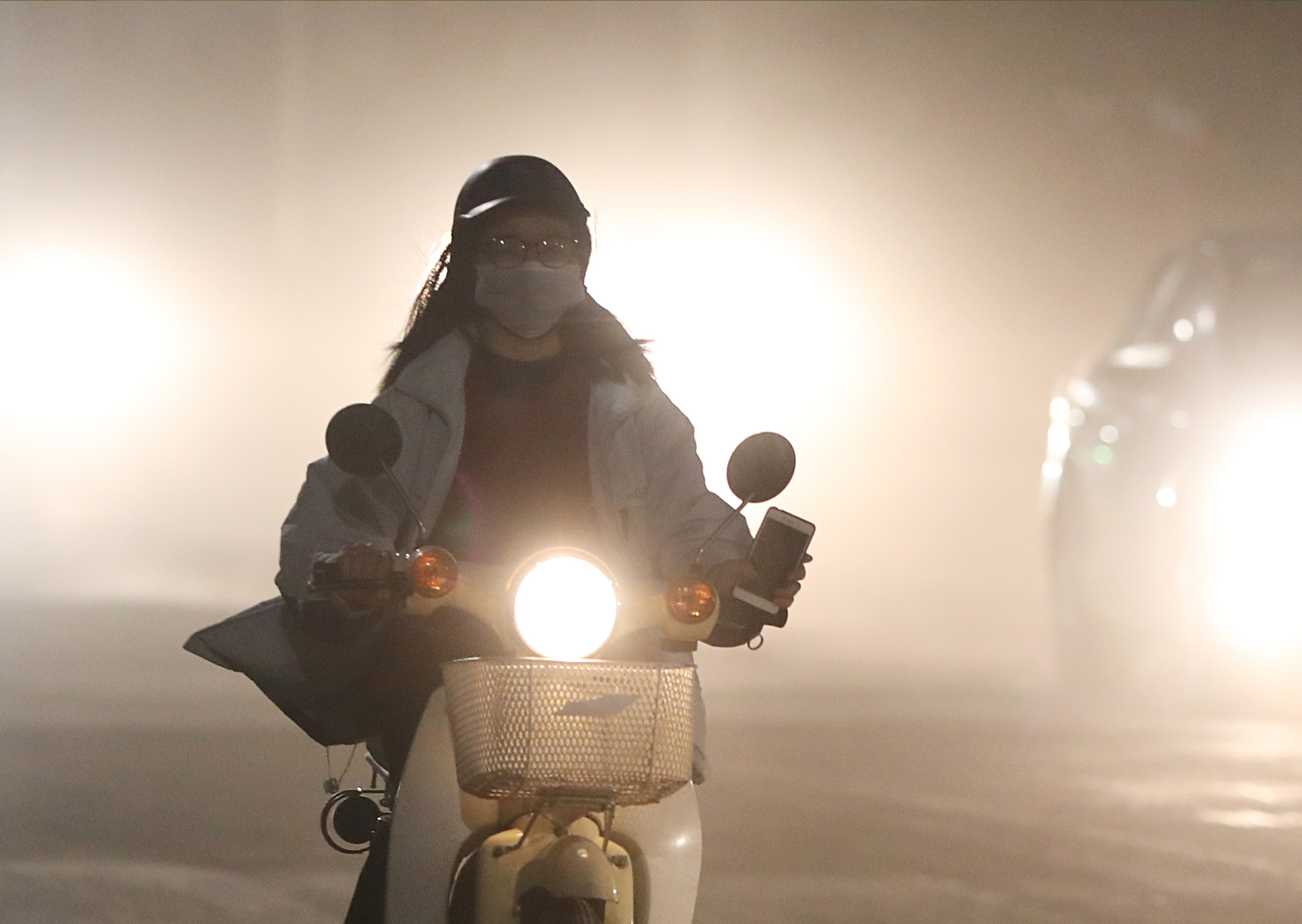 |
Hanoi experiences continuous air pollution. Photo: Ngoc Thanh |
Thuy Anh, 28, from Tay Ho Ward, also chose to leave the city, meticulously planning her "escape" location. Despite living in a breezy lakeside area, she still suffered from headaches and shortness of breath due to fine dust.
After checking the AirVisual air quality map and seeing neighboring provinces like Thai Nguyen and Bac Ninh displayed in purple (very unhealthy), Thuy Anh decided to book a flight to Da Lat for 7/12.
"Flight tickets and last-minute hotel bookings are expensive, but if I stayed in Hanoi, the money I earn might only be enough to treat respiratory illnesses", Thuy Anh shared. For her, this trip is also a survey for a long-term plan to leave Hanoi if air quality does not improve in the next one or two years.
The decisions by Huy and Thuy Anh reflect a growing trend: "escaping the dust". On social media platforms, the topic of "escaping Hanoi air pollution" is trending. Groups sharing tips for finding destinations with good air quality attract thousands of interactions.
These escape trips are primarily undertaken by young freelancers, those with remaining annual leave, or families with preschool-aged children who are not yet pressured by school schedules. Preferred destinations are high-altitude mountainous regions or areas with good air quality indexes.
In Da Lat, Tran Kim, 35, a homestay owner, reported a sudden surge in bookings over the past two weeks, a contrast to the quietness of the previous month. More than 50 regular guests from Hanoi have booked long-term stays to work remotely and "cleanse their lungs". "Whenever the city experiences heavy pollution, they come here", Kim said.
In Ta Xua, Son La, Manh Quan, 50, noted nearly 100 guests filling his two accommodations during the weekend of 6-7/12. Most were families with young children. "Their first words upon arrival were complaints about the stifling, dusty conditions in the capital", Quan recounted.
 |
Thuy Anh on her trip to Da Lat to avoid fine dust on 8/12. Photo: Supplied by subject |
On 9/12, the IQAir monitoring system ranked Hanoi as the 9th most polluted city globally. Many downtown monitoring points, including Tay Ho, Tran Vu, and Hoang Quoc Viet, recorded "very unhealthy" levels (AQI above 200). Neighboring provinces like Hung Yen, Bac Ninh, and Thai Nguyen were also enveloped in haze.
Previously, on 2/12, Hanoi issued a recommendation for the elderly and children to limit outdoor activities. Schools were asked to monitor the daily AQI to adjust class schedules, even considering student breaks if pollution became too severe.
Explaining the pollution episode, Doctor Hoang Duong Tung, Chairman of the Vietnam Clean Air Network, stated that this is a common phenomenon in winter. Still weather conditions and temperature inversions trap pollutants in lower atmospheric layers. This, combined with local emission sources (traffic, construction) and those from nearby industrial zones, prevents air dispersion.
Tung warned that PM2.5 fine dust is a "silent killer". Citing research by Berkeley Earth (US), inhaling air with a PM2.5 concentration of 22 µg/m³ for 24 hours causes damage equivalent to smoking one cigarette. Given Hanoi's pollution levels in recent days, every resident, including children, is passively "smoking" multiple cigarettes daily.
While awaiting macro solutions to address this situation, the spontaneous migration wave continues. A VnExpress reader survey asking, "Have you moved to avoid air pollution in Hanoi?" revealed that 27% had moved, 58% wanted to but could not, and only 15% chose no.
Duy Hoang, 35, from Dong Da District, recently took his pregnant wife to her hometown in Thai Binh and requested to work remotely for two weeks.
"I do not want these year-end 'migrations' to escape dust to become an unfortunate habit for Hanoians, but currently, this is a mandatory health measure for my family", he said.
Nga Thanh - Quynh Nguyen