"Chopsticks and spoons are disposable items. For Italian pasta, what would you offer?", the instructor asked. Five trainees hesitated, then one by one raised cards showing chopsticks, spoons, and forks.
"There is no fixed answer", the instructor explained. "Some customers use forks, others prefer chopsticks. The most important thing is to ask beforehand. That is thoughtfulness". The class fell silent for a few seconds before nodding.
These employees, hailing from China, Myanmar, and Nepal, work at bustling stores in central Tokyo. They attend school during the day and participate in a three-hour evening training course to practice standard Japanese service procedures.
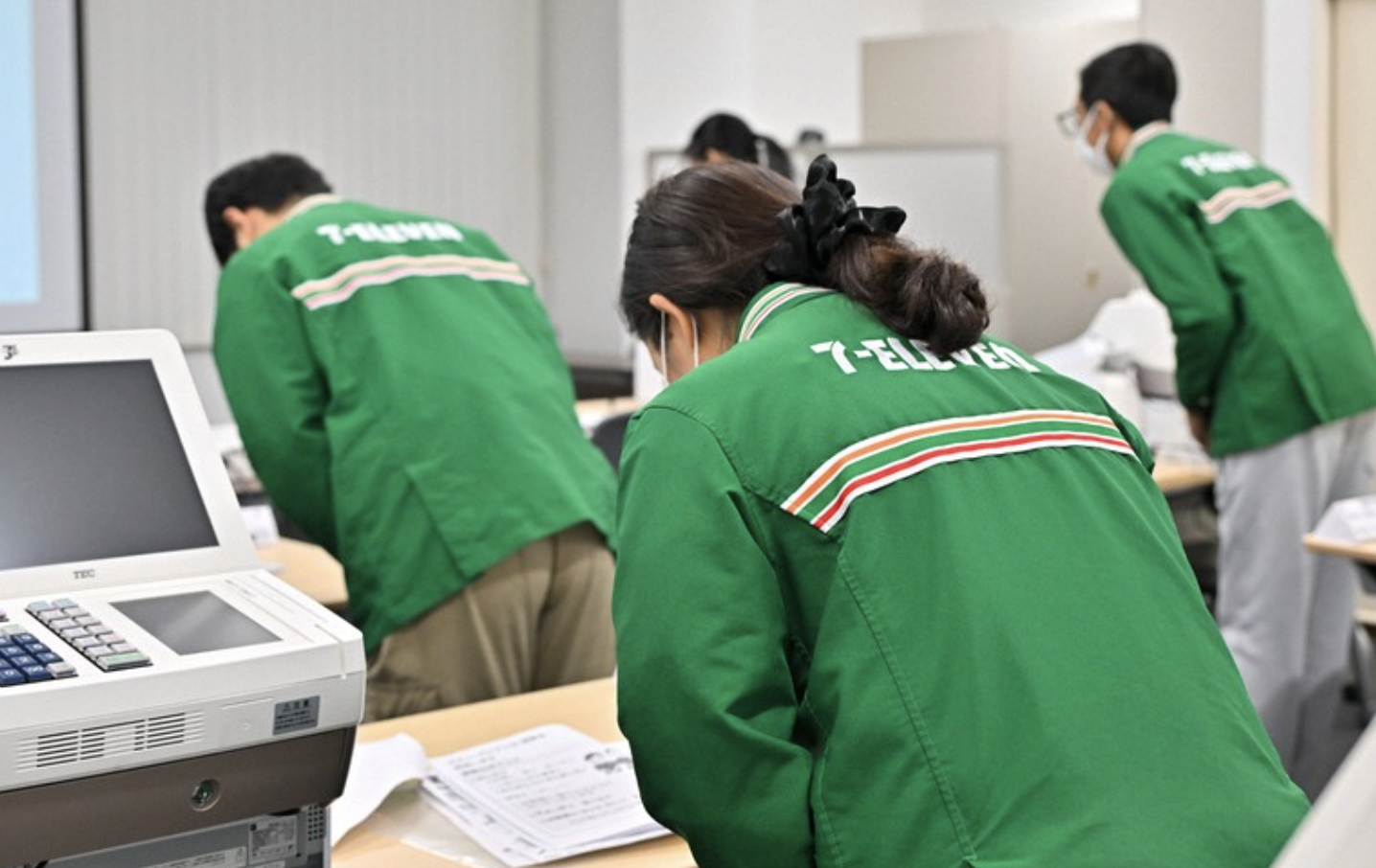 |
Foreigners participate in hospitality training in Chiyoda district, Tokyo, Japan. Photo: Mainichi.
In Japan, service extends beyond mere procedure; it embodies Omotenashi, a renowned standard of hospitality. Unlike Western service models, which often rely on requests and tips, Omotenashi prioritizes proactivity and sincerity. Employees are expected to observe and anticipate unspoken customer needs, responding in a way that fosters a sense of absolute respect.
This ethos manifests in minute details: bowing at the precise angle, presenting receipts with two hands, and offering a synchronized greeting upon a customer's entry. Every action is standardized and maintained daily.
Previously, franchise stores handled their own employee training. However, facing staffing shortages and high turnover, 7-Eleven centralized most programs at its headquarters. Store owners now readily pay fees to send staff for this specialized training.
The primary reason stems from a shifting workforce demographic. Most employees are international students new to Japan, often facing language barriers and unfamiliarity with local customs. These courses extend beyond sales operations, offering foundational lessons in cultural etiquette to prevent misunderstandings.
The evening class grew noticeably livelier during the communication practice segment. Trainees repeatedly rehearsed phrases such as: "Plastic bags incur a charge, would you like one?", and "Here is your change".
A Chinese trainer with 17 years of experience at Lawson shared, "Even an abrupt remark or incorrect intonation can displease customers. We must practice until it becomes a reflex".
A 23-year-old male trainee from Myanmar, who arrived in Japan just over one month ago, acknowledged honorifics as his biggest hurdle. Despite fluently reciting sample phrases from watching Anime, he still found himself flustered in real-world scenarios. "The course helped me understand why items must be handed over with two hands. It's not just a rule; it's a sign of respect", he stated.
Beyond 7-Eleven, other major chains are also competing fiercely for talent. FamilyMart conducts over 100 online training sessions annually for foreign employees, featuring Vietnamese and Chinese trainers. They also release multilingual instructional videos, including Vietnamese, enabling employees to self-study in stores.
According to the Immigration Services Agency, Japan recorded nearly 4 million foreign residents as of 6/2025, a figure double that of 2012. Amidst an aging population, these convenience store workers are becoming an indispensable component of Japan's economic engine.
By Ngoc Ngan (Source: Mainichi)