Results from the Programme for International Student Assessment (PISA) 2025, published by the Organisation for Economic Co-operation and Development (OECD) on September 8, 2025, reveal that approximately 41% of Vietnamese students achieved Level 2 or higher in reading comprehension. This figure is significantly lower than the OECD average of 69%. Furthermore, almost no Vietnamese students reached Level 5, compared to 6% across OECD countries. Notably, there was a sharp increase in students exhibiting "skim reading" syndrome, characterized by quick but incorrect answers. Performance also declined markedly in tasks involving long texts.
Experts suggest that while these figures are not yet conclusive about a general decline in student ability, they serve as a critical warning regarding the erosion of deep reading skills.
"Reading comprehension is the foundation of all subjects. In the age of AI, the ability to evaluate information and critically think about what we read is crucial", stated Associate Professor Doctor Nguyen Mai Hoa from the Faculty of Education, University of New South Wales (Australia).
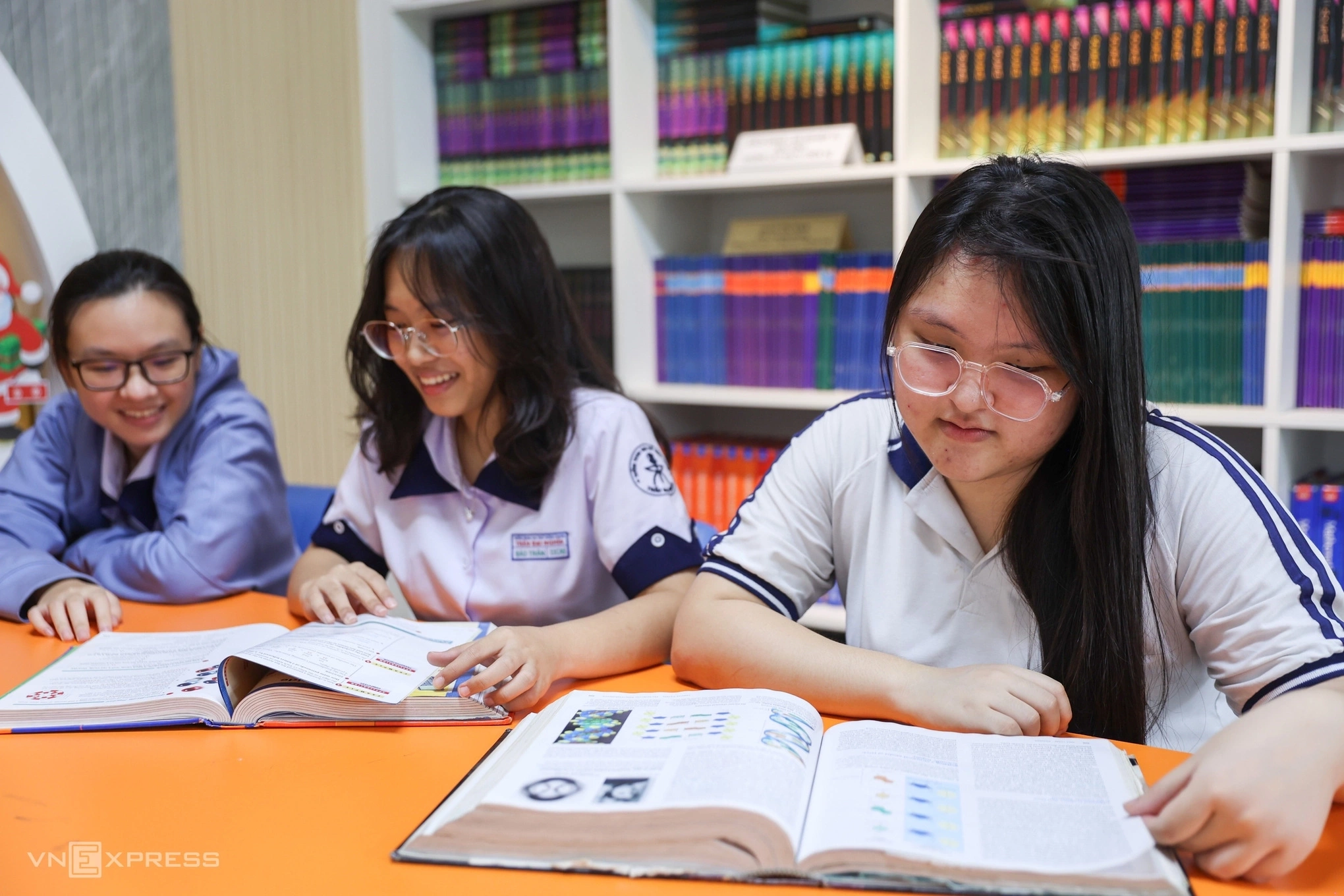 |
Students reading books at the library of Tran Dai Nghia High School for the Gifted, May 2026. *Photo: Quynh Tran* |
PISA's definition of reading comprehension extends beyond simply reading text and finding answers. It demands the ability to acquire, analyze, evaluate, and apply information from various text types for learning, problem-solving, and decision-making.
At higher levels of reading comprehension, particularly in digital environments, readers must cross-reference multiple sources, process abstract or counter-intuitive concepts, and distinguish factual data from personal opinions based on implicit meanings.
Beyond family-related factors cited by the OECD, such as parental engagement or reading culture, many experts highlight a new element: the changing habits of human information consumption.
The brain accustomed to 'sprinting'
Doctor Dang Quang Vinh, a lecturer at British University Vietnam (BUV), explained that growing up with short video platforms has conditioned young people to consume information in fragmented, constantly changing forms.
"When information is consistently condensed into headlines, bullet points, or ready-made answers, the ability to patiently read, follow arguments, and connect ideas independently is easily eroded", Dr. Vinh noted.
Offering a deeper analysis, Associate Professor Doctor Nguyen Van Thang Long, a lecturer at RMIT University Vietnam, suggested it would be simplistic to attribute the entire problem to short videos. This format, he argued, is an effective communication tool, capable of disseminating knowledge, vocabulary, and vivid scientific simulations to a broad audience. Many educators use short videos to spark curiosity, guiding viewers towards longer books or courses.
The core issue lies not in the length of the video, but in how technology platforms organize the user experience. News feeds are algorithmically designed for infinite scrolling, continuous scene changes, and topic shifts with a single swipe. This environment trains the brain to crave constant novelty and adapt to a rapid pace of information reception.
According to psychologist Daniel Kahneman's "Two Systems of Thinking" theory, System one processes information quickly based on intuition and existing patterns, while System two operates more slowly, requiring greater effort to analyze complex problems. These two systems are not opposing but complementary. Fast and accurate intuition often develops after a process of slow, repetitive thinking.
In this context, deep reading serves as a form of training for slow thinking. Readers must engage with an issue for a sufficient period, retain information, and follow arguments before drawing conclusions.
"Forcing someone accustomed to quick conclusions from short videos to construct arguments from long texts is like making a sprinter run a marathon", Mr. Long stated.
AI takes over cognitive tasks
If short videos reduce patience, artificial intelligence (AI) intervenes in the process of logical thinking. Previously, to complete a written assignment, students had to read materials, select ideas, arrange arguments, and write themselves. Now, with a single command, AI can summarize text and generate a complete article.
The PISA 2025 survey recorded a high level of AI chatbot use among Vietnamese students for learning support. As many as 69% of students had used these tools, primarily for AI to summarize texts (47%) and draft articles (52%).
"Technology does not automatically make people less intelligent, but if it continuously replaces activities designed to train thinking and language, a decline in reading comprehension is understandable", Dr. Vinh analyzed.
In the burgeoning era of AI and social media, experts contend that education must adapt rather than prohibit. In a study published in May 2026 on educational innovation for sustainable development in the AI era, Associate Professor Hoa and G20 education researchers emphasized the importance of teachers designing meaningful learning experiences. They advocate for guiding students to process and critically analyze information, moving beyond mere knowledge transmission.
Given this context, educators believe that prohibiting technology is not feasible. Instead, education and families need to adjust their approach. Students must be trained in argumentation by consistently asking "Why?" and "What evidence proves it?", rather than simply seeking "What is the answer?".
Crucially, the explosion of artificial intelligence makes understanding this tool an essential requirement for teaching staff. Instead of fearing student cheating, teachers can transform AI into a "companion" that stimulates thinking. For example, an instructor could provide an AI-written answer, then ask students to analyze its flaws, verify data, and propose revisions. This process directly cultivates evaluation and independent thinking skills.
 |
A family in Ha Dong, Hanoi, sets up a home library to spread reading culture to children in the residential area. *Photo: Robert Linh* |
Associate Professor Hoa also suggested applying Bloom's Taxonomy to design lessons, guiding students from basic memorization to higher cognitive levels such as analysis, synthesis, and evaluation.
At a macro level, this international education research expert stressed that the education sector needs to continue shifting its focus from knowledge memorization to the ability to apply knowledge, solve problems, and engage in critical thinking. Deep reading should be integrated across many subjects, rather than being confined solely to literature classes.
The final link in this chain comes from families, fostering students' reading habits. The goal is not just to read extensively, but to read reflectively and critically.
"When families, schools, and society collectively create an environment that encourages inquiry, students will develop independent thinking and lifelong learning abilities — the most important 'weapons' in the digital age", the educator concluded.
Phan Duong