Lieutenant Colonel Pham Vu Son, Head of the Collections Department at the Vietnam Military History Museum, announced the museum recently received a 122 mm cannon. This artifact was transferred by the Thai Binh Provincial Military Command after being stored for a long time at the provincial museum. This cannon was used by Company 1, Thai Binh Provincial Artillery Battalion, in fierce battles to protect the Thai Binh sea region from 1965-1967, when the United States expanded its war of destruction against North Vietnam with air and naval forces.
The cannon, bearing serial number 122-31/37CB02-11, is a 122 mm long-barreled K31/37 (A-19) artillery piece, manufactured and supplied to Vietnam by the Soviet Union. It has a barrel length of 5,65 m, an overall length of 8,725 m, and weighs nearly 8 tons. Constructed from alloy steel, it was operated by a 9-person crew. The cannon could fire 3-4 rounds per minute, with a muzzle velocity of 806 m/s, allowing for a range of over 20 km. This ensured its effectiveness in coastal defense and anti-ship operations. The cannon's body still bears embossed Russian inscriptions, "ПУШКА - ОБРАЗЦА 1931/37", meaning "cannon model of 1931/37", along with the Soviet OTK quality control diamond symbol. According to Mr. Son, this type of cannon underwent official technical acceptance after World War II before being supplied to Vietnam.
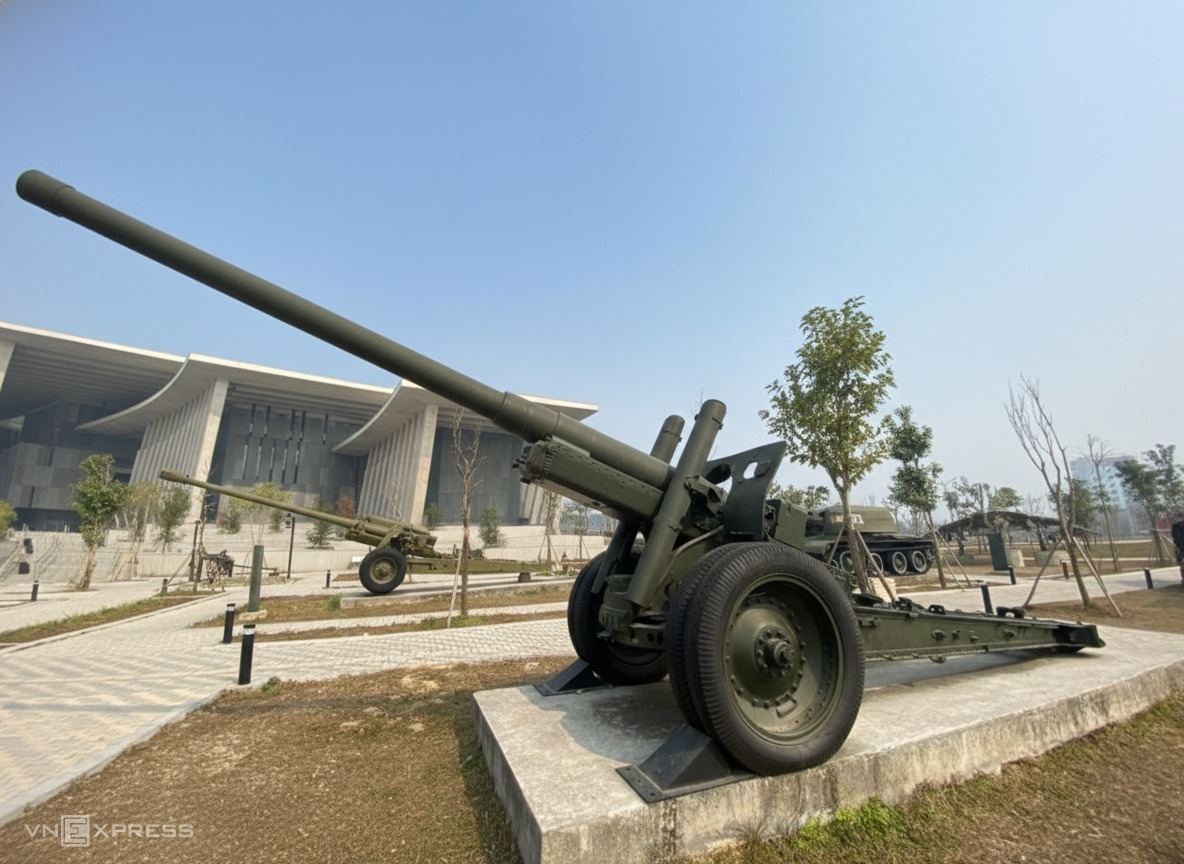 |
The cannon, serial number 122-31/37CB02-11, displayed outdoors at the Vietnam Military History Museum. Photo: Hoang Phong |
The cannon, serial number 122-31/37CB02-11, displayed outdoors at the Vietnam Military History Museum. Photo: Hoang Phong
From mid-1965, as the United States launched Operation "Rolling Thunder", Thai Binh became a crucial area in the plan to blockade sea routes and threaten the North Vietnamese rear. As a coastal province with a dense river system flowing into the Gulf of Tonkin, Thai Binh was identified as a gateway for controlling strategic waterways. Tien Hai district, home to the Ba Lat, Lan, and Tra Ly river mouths, was designated a key defense line by the Military Region 3 Command and the Thai Binh Provincial Military. Forces stationed there were tasked with preventing US 7th Fleet and Task Force 77 warships from approaching the coast. Local Party committees and authorities shifted to a wartime footing, building a coastal defense network combining main forces with local units.
Within the firepower system deployed in Tien Hai, the 122 mm long-barreled K31/37 cannon was identified as the primary weapon. With its long range and powerful destructive capability, the cannon was responsible for destroying surface targets such as destroyers and patrol boats, while also providing fire suppression when the enemy attacked from the sea or landed commandos.
From 1965 to 1967, the military and people of Tien Hai established an artillery battery system along the sea dike stretching from Dong Lam commune to Nam Phu. The 122 mm cannon, serial number 122-31/37CB02-11, was regularly moved between positions, camouflaged in bamboo groves and semi-fortified bunkers to avoid US aerial reconnaissance and attacks. The dispersed deployment of positions, coupled with concentrated firepower during combat, helped maintain the element of surprise. Artillery forces meticulously calculated firing parameters based on a network of long-range observation posts located at high points along the coast, initiating artillery duels when enemy ships entered effective range. In the Tien Hai battlefield, fire engagements were continuous and fierce. The US Navy used heavy artillery from warships to bombard coastal areas and civilian structures, while A-4, A-6, and F-4 aircraft constantly bombed to destroy Vietnamese artillery positions.
The 122 mm cannon became a priority target for enemy attacks. To protect the positions, ground artillery units coordinated closely with anti-aircraft artillery forces. Notably, Company 4 of female militia anti-aircraft gunners from Dong Lam commune, equipped with 37 mm cannons, directly protected the airspace above the ground artillery positions. Company 5 of the Tien Hai district self-defense anti-aircraft artillery protected the Tra Ly estuary area, ensuring the safety of observation posts and military radar stations. Additionally, militia forces in Nam Phu and Nam Thinh communes played a significant role in logistics and directly participated in combat. Militia platoons were responsible for digging and building fortifications, camouflaging positions, and transporting hundreds of artillery shells, each weighing 22 to 25 kg, under intense bombardment. At times, the cannon was moved by human strength and tracked tractors over muddy dike sections, constantly changing firing positions, making it difficult for the enemy to accurately determine its coordinates for counterattacks.
During 1965-1967, the military and people of Tien Hai fought a total of 1.064 battles. In a specific artillery duel on 17/11/1966, at the Ba Lat estuary area, under the command of the Tien Hai District Military Command, gun crews from Company 1, Thai Binh Provincial Artillery Battalion, including this cannon, simultaneously opened fire on a squadron of US destroyers bombarding the coast. They set one warship ablaze, forcing the enemy to withdraw from the area. By the end of the defense of the Thai Binh sea region, the province's military and people had shot down 44 US aircraft, set 4 warships ablaze, and captured or eliminated many pilots. The 122 mm K31/37 cannon is now displayed at the Vietnam Military History Museum, a testament to the days and nights of holding ground and the coastal defense of North Vietnam.
Son Ha