The project, overseen by the Dong Hoi City People's Committee, commenced in early 2020 and was constructed by a joint venture of Hai Thanh Company and Tien Thanh Company. Following a storm in October 2021, the seawall sustained damage, preventing its acceptance and finalization. From 2022 to 2025, each storm season brought further wave encroachment, deeply scouring the seawall's foundation. However, repairs were not undertaken due to a lack of funds.
Initially, over 200 meters of the seawall were eroded, but this has now spread to over 700 meters at both ends of the structure. Many sections of the seawall have crumbled, exposing rebar, and the 3-meter concrete road above it, adjacent to the residential area, is broken. Some eroded areas are now dangerously close to homes and businesses in Dong Hoi ward.
Tran Thi Thanh Van, owner of a coastal restaurant, stated that the seawall area once accommodated tables and chairs for guests to enjoy the sea view. However, years of prolonged damage to the seawall have deterred customers, forcing many establishments to close.
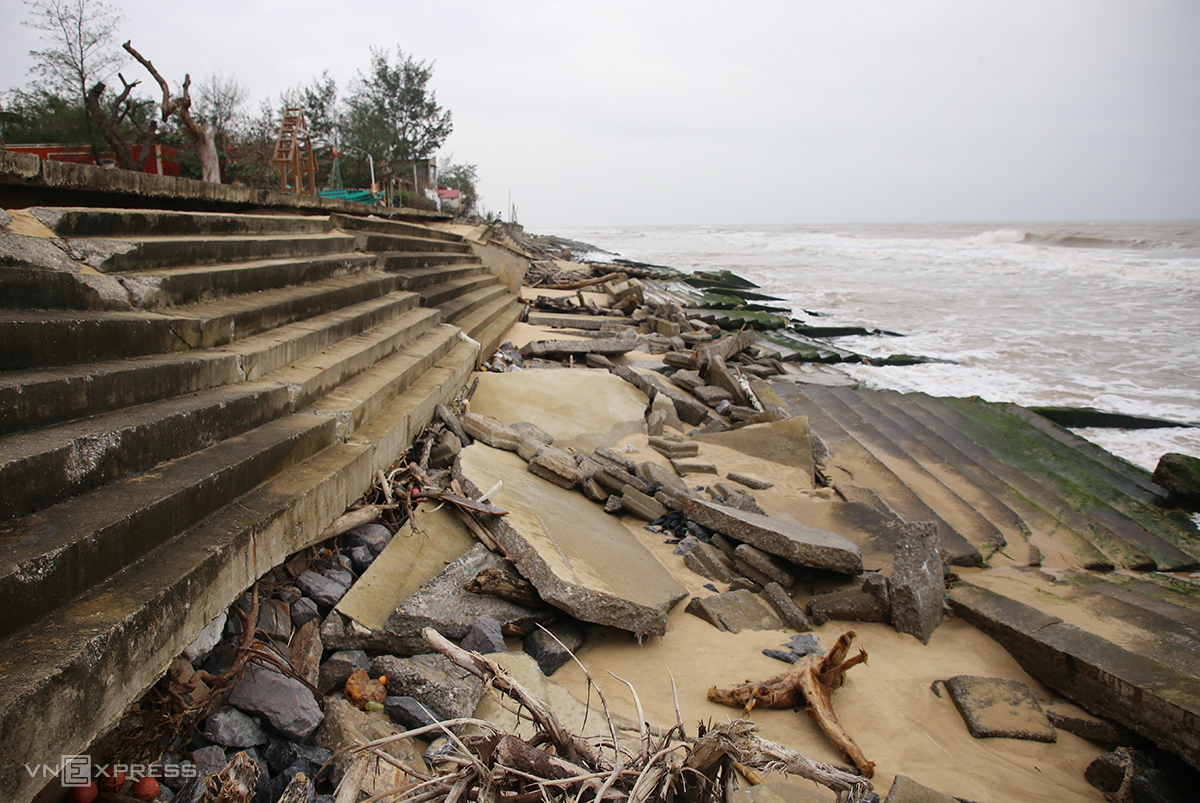 |
Over 700 meters of the seawall have collapsed into the sea. Photo: Dac Thanh |
In March 2025, Dong Hoi City collaborated with various departments, research institutes, and experts to survey and assess the situation. A workshop was also held to determine the causes of the damage. Findings revealed severe and continuous erosion in the area for many years, with the beach level dropping consistently from 2018 to 2025. An estimated 376,000-581,000 cubic meters of sand were washed away, and the -2 to -6 meter contour line shifted inland by 47-98 meters, reducing the area's ability to dissipate waves. Consequently, nearshore waves are 33-34% higher, and coastal current speeds have increased by 28-43% compared to 2018.
Beyond natural factors such as an imbalance between accretion and erosion, sediment deficit, and rising sea levels, the project also suffered from initial design flaws. These did not fully account for hydrodynamics and coastal morphological changes. Design standards at the time were not updated to meet stricter requirements, leading to foundation scouring and the eventual collapse of the entire structure.
The workshop recommended urgent repairs using a sloping revetment with riprap or precast concrete components, combined with a geotextile filter layer to reinforce the foundation. This approach aims to utilize existing structures, ensure rapid construction, and provide immediate safety for residents and the coastal road. For a long-term solution, an offshore submerged breakwater is needed to reduce wave energy, restore natural sand beaches, and protect tourist landscapes.
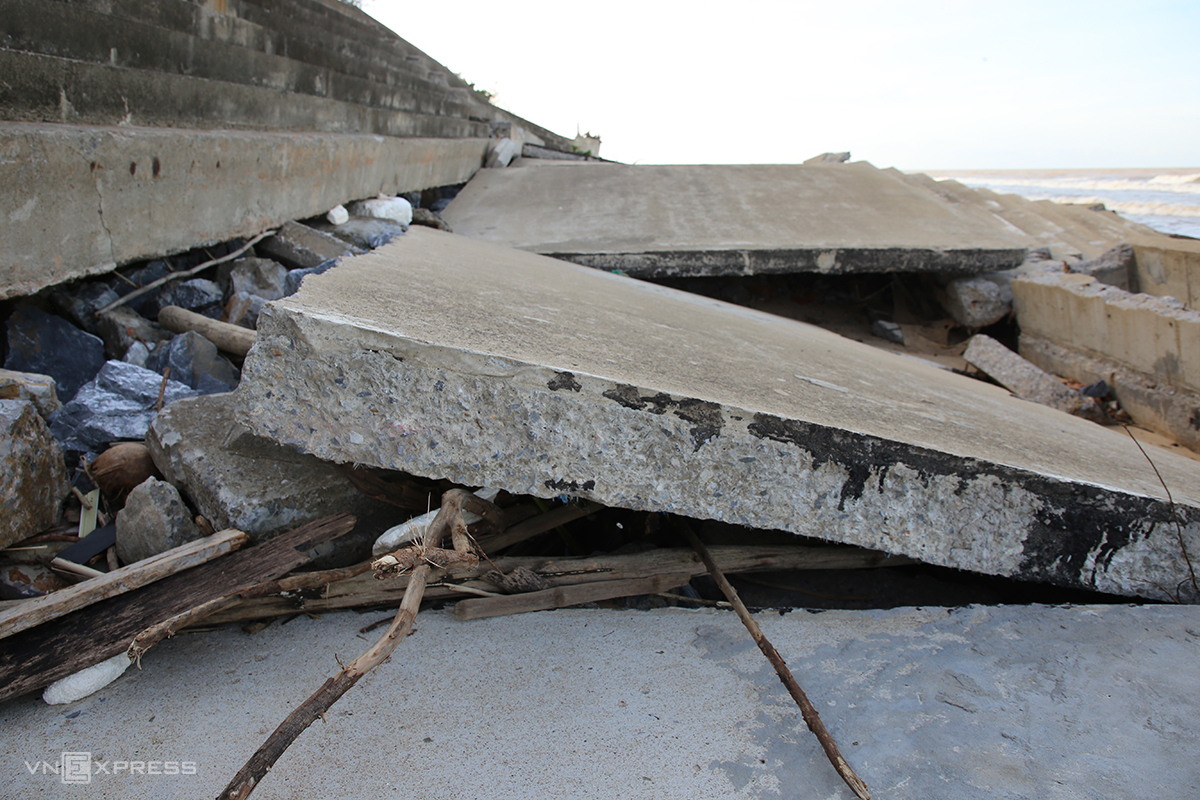 |
Broken concrete washes into the sea. Photo: Dac Thanh |
Dong Hoi ward has requested that the Provincial People's Committee and the Department of Finance approve the project settlement and allocate urgent funds to repair the seawall and implement the recommended solutions.
Nhat Le Beach, stretching over 2 kilometers, is located 1 kilometer from the center of Quang Tri, at the mouth of the Nhat Le River. It was once ranked among the top 10 most beautiful beaches in Vietnam, known for its white sand and gentle waves, attracting many tourists.
Dac Thanh