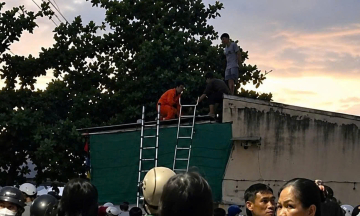
In early May, amidst the scorching central Vietnam sun, Cuong received news from villagers about three unidentified graves trapped between fence walls in the local cemetery. The graves were discovered over 20 years ago when a family dug a house foundation, and were subsequently buried temporarily. With no relatives, no headstones, and no access, the three graves were almost forgotten.
Choosing the early morning, Hung brought a pickaxe and shovel to carefully excavate and exhume the three graves. By noon, he used a hearse to transport the remains to the cemetery he had built over many years.
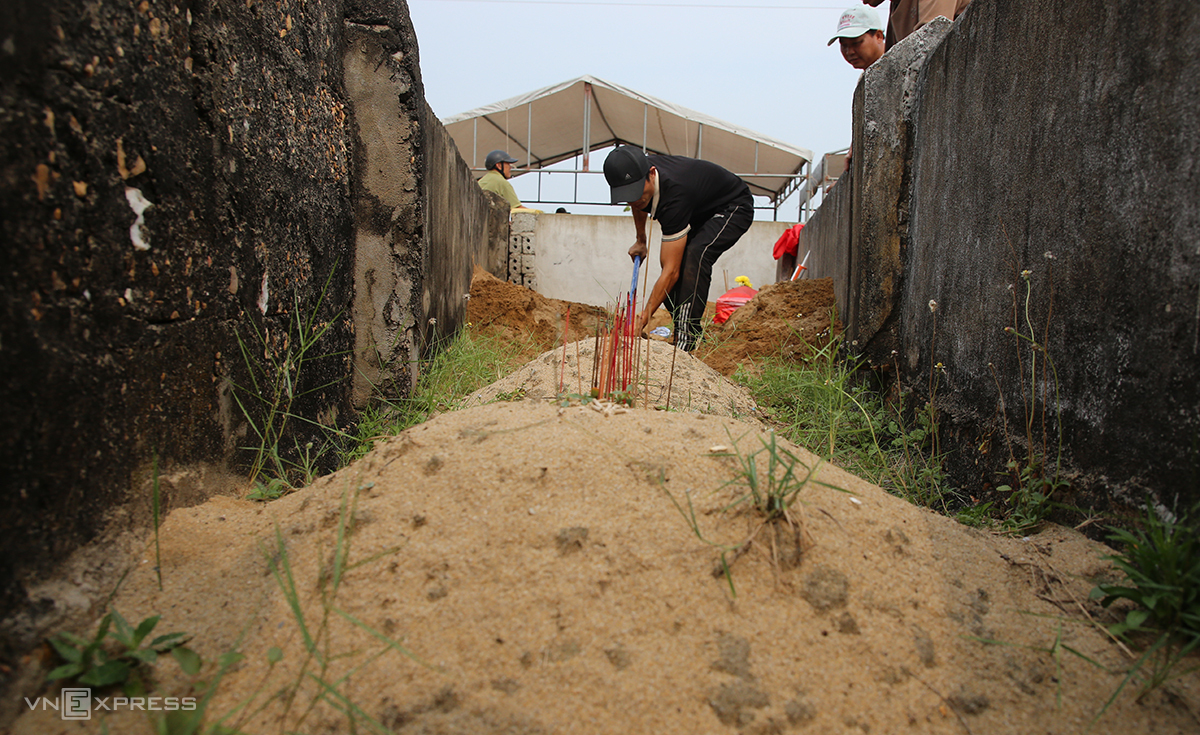 |
Cuong exhumes three unidentified graves trapped between walls in the village cemetery. *Dac Thanh* |
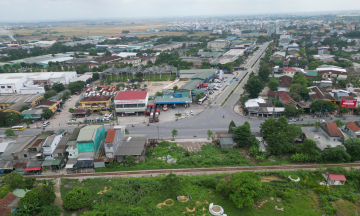
Cuong was born and raised in Canh Duong, an ancient coastal village nearly 400 years old. Spanning less than 1,5 km2, it was once known as one of the "bat danh huong", or eight famous cultural and historical sites of old Quang Binh. During the resistance war against France, the village was honored as a "model fighting village", with thousands of resilient residents holding their ground and fighting through hundreds of large and small raids.
Over generations, wartime evacuations, bombs, storms, and migrations caused many graves to lose their owners. Some fell in battle, others were bodies washed ashore from the sea, temporarily buried by villagers. Many ownerless graves were scattered across sand dunes, along the coastline, or within residential areas.
Coming from a family of undertakers, Cuong, from the age of 17, followed his father and other villagers to relocate 970 ownerless graves to clear land for a craft village. After these relocations, many graves were scattered on sand dunes and near cemeteries, left unattended. Over time, sea sand buried them, and rain and wind eroded them, causing many graves to gradually disappear.
"If I don't exhume them, they will be lost forever", this thought motivated him to pursue gathering ownerless graves into a cemetery.
After three years of planning, in late 2017, Cuong discovered 5 ownerless graves precariously perched on a sand slope, above rice fields, at risk of being obliterated by sand exploitation. He began building a cemetery to gather ownerless graves, providing a resting place for the deceased.
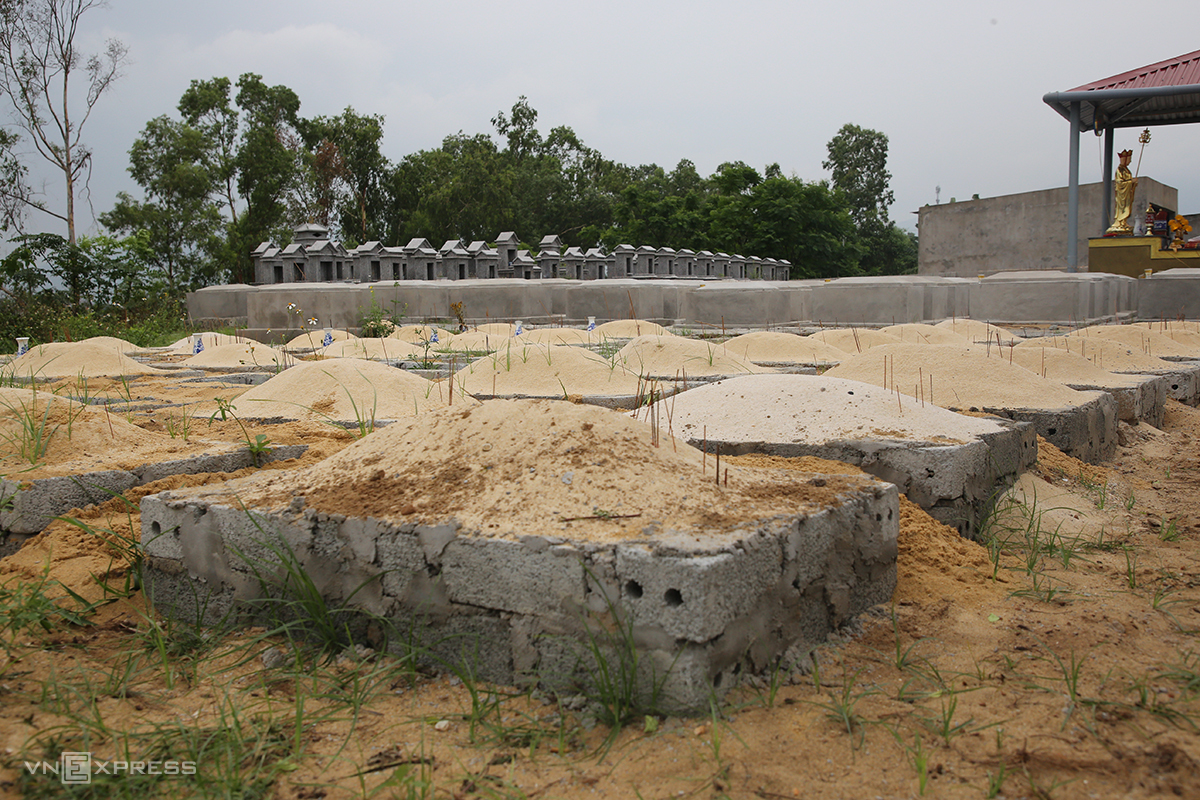 |
The cemetery built by Cuong houses 259 collected graves. *Dac Thanh* |
With his wife's support, who told him, "Husband, just do this virtuous work", Cuong spent 30 million VND to level a sandy plot of land over 1.500 m2, building a private cemetery for graves without anyone to worship them. From the initial 5 graves, after nearly 9 years, it has become the resting place for 259 unidentified graves, meticulously arranged in orderly rows. Of these, 61 graves were supported with stone cladding by a tomb construction business owner, while the rest were built with cement or had walls constructed around sand mounds.
Whenever villagers dig house foundations, erect fences, or discover ownerless remains, they call Cuong. Homeowners might help with purchasing urns, while he voluntarily handles all the exhumation and relocation work. The total cost of building the cemetery to date is approximately 150 million VND. Of this, villagers, including those living far from home, contributed around 100 million VND.
"Canh Duong village has endured war, countless people have died, and many graves are lost. I try to do what I can for them. The living need homes; the deceased need a peaceful resting place," he explained.
On some days with heavy rain, erosion exposed remains; other graves along the coast were dislodged by waves. He would then collect every piece of bone and bring it back to the cemetery. The work is arduous and carries the scent of death, but he is not deterred.
A villager who once discovered three graves while digging a house foundation said that without Cuong, those graves might have remained forgotten or been buried haphazardly. "Cuong does this from the heart; no one forces him," the person stated.
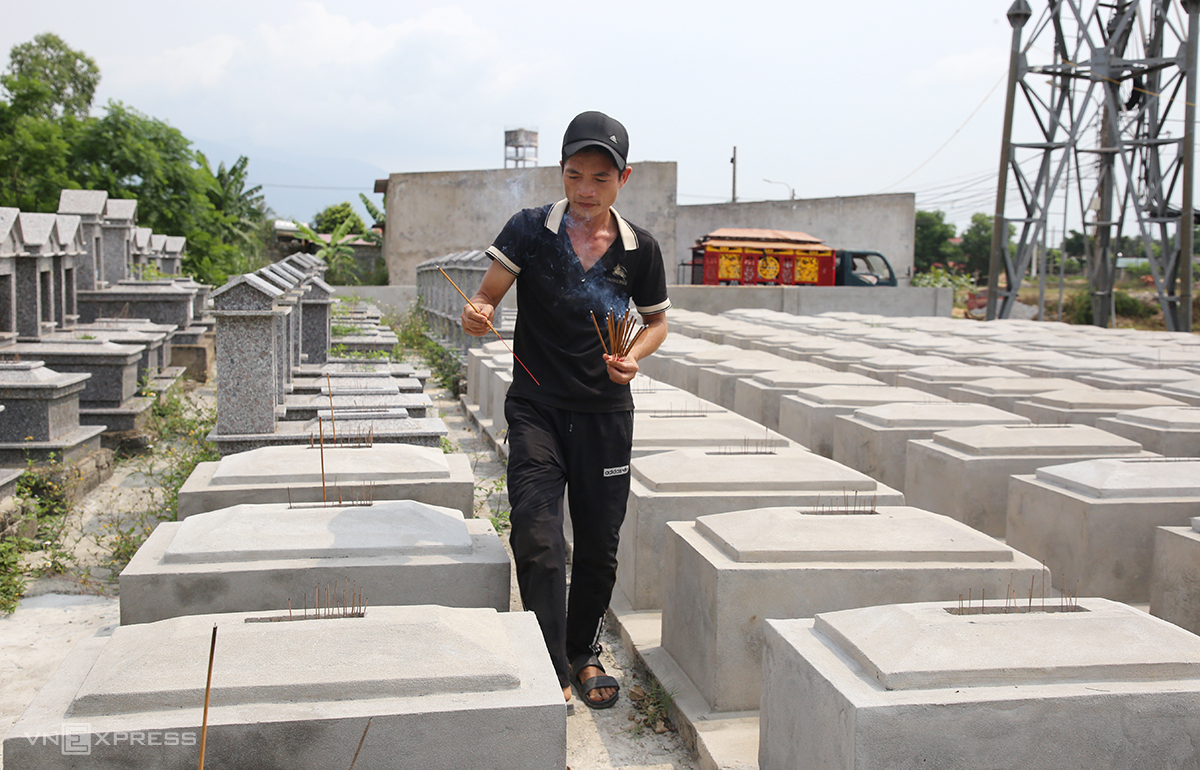 |
Cuong regularly offers incense at the graves. *Dac Thanh* |
The 259 graves are no longer lonely, as Cuong offers incense on the 1st and 15th days of the lunar month. "The village still has many unidentified graves, and I will continue to exhume and gather them until I am old," he shared.
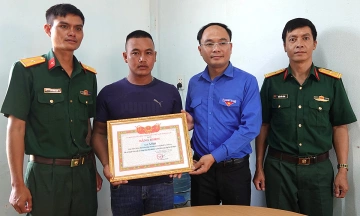
Nguyen Thi Thu Hien, Deputy Head of the Culture and Social Affairs Department of Hoa Trach commune, stated that Cuong is a Party member who has, for many years, gathered ownerless graves for worship at the cemetery. This is a humane act, showing concern for graves without relatives to offer incense, and also contributing to a tidy and clean landscape. The commune People's Committee's advisory department has supported Cuong with some funding.
Dac Thanh