The Forbidden Forest, also known as Ru Cam, covers over 4 ha and sits on a hill approximately 70 m high in Tho Linh village. The forest has been protected by a traditional village covenant for generations, serving as the green lung of this semi-mountainous region amidst harsh winds.
From above, the Forbidden Forest is separated from Tho Linh village by a river over 100 m wide. It forms a lush green expanse adjacent to cultivated acacia forests. The forest boasts hundreds of precious timber trees such as lim, sen, doi, go, and gie. Many trees have trunk diameters exceeding one meter, with their canopies forming dense layers. Due to its proximity to residential areas, wildlife is not abundant, consisting mainly of birds, squirrels, and bees.
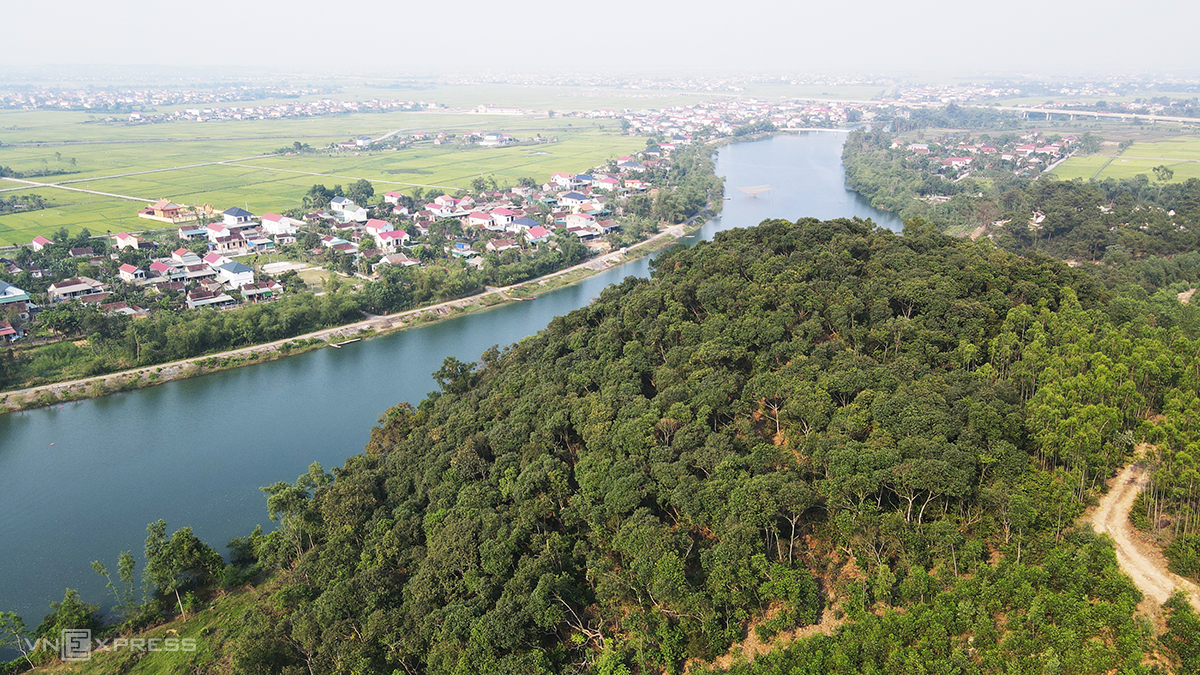 |
The Forbidden Forest spans 4 ha along the Rao Nan river. Photo: Dac Thanh
According to the genealogies of five main families and a stone stele in front of the village communal house, Tho Linh village was established in the late Tran and early Le dynasties, around the 15th century. During that period, the area was frequently harassed by Chiem Thanh forces. The imperial court dispatched a general to the O Chau region, now part of Quang Tri province, to quell the unrest and encourage people to clear land and establish villages. The Forbidden Forest began to form in those early days.
During the 8 years of the U.S. war against Northern Vietnam, the forest provided shelter for soldiers and served as a hiding spot for naval forces whose ships traveled upstream from the Gianh river. Trees along the riverbanks camouflaged the ships, while artillery emplacements at the forest's edge created a strong defensive position.
Phan Xuan Hai, head of Tho Linh village, explained that to protect the Forbidden Forest, the ancestors established an oral covenant. This rule stipulated that all residents, from the elderly to the young, were responsible for safeguarding the forest. Adults were to teach their children not to cut down trees or harm the ecosystem. Violators faced strict penalties.
"The forest is a communal asset, a legacy from our ancestors. Losing the forest is committing a sin against our forefathers," Hai said. This belief is deeply ingrained in the consciousness of the villagers, forming an unwritten rule with strong binding power.
Villagers protect the Forbidden Forest. Video: Dac Thanh
After national reunification, surrounding forests were cleared and cultivated by residents for economic development. However, the Forbidden Forest remained untouched. During the cooperative period, the village only permitted the harvesting of some trees for common projects, but otherwise, the forest was strictly off-limits.
"Residents are clearly aware that this is a forbidden forest. Despite life's hardships, no one considers destroying the forest for timber," said Tran Dinh Truong, head of Linh Can Son hamlet in Tho Linh village.
Currently, to enhance protection and improve the landscape, villagers are planting additional rows of mahogany trees along the forest's edge. These trees create a natural boundary and help retain soil, preventing erosion. The village plans to purchase and plant lim trees around the forest soon.
"The Forbidden Forest is the pride of Tho Linh village. Without the preservation covenant, it would have been cleared for agricultural land," village head Phan Xuan Hai stated. He added that many go wood trees, classified as Group 1 timber, are worth tens of millions of VND per cubic meter. Yet, for the villagers, "don't talk about millions; even hundreds of billions of VND wouldn't make anyone dare touch a tree."
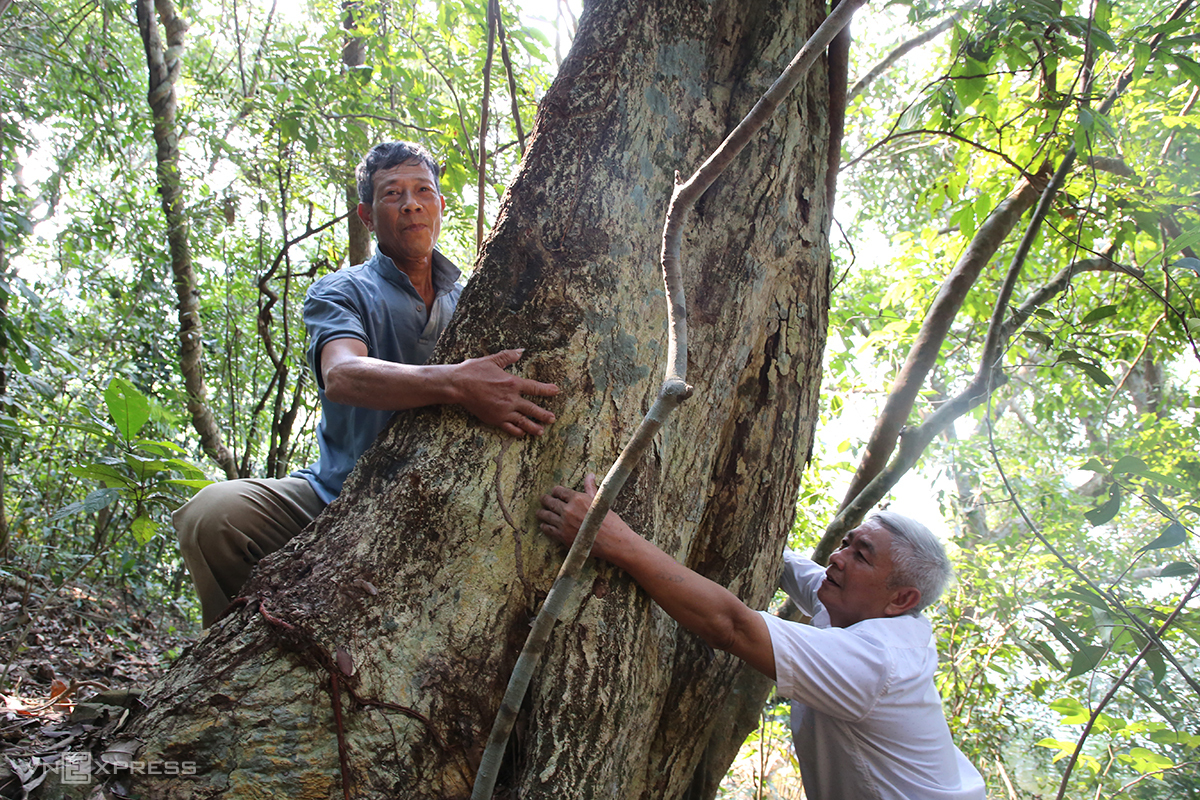 |
A go wood tree so large it takes two people to embrace. Photo: Dac Thanh
Dac Thanh