The 2025 report on environmental quality, water resources, and emission source monitoring reveals a decline in Ho Chi Minh City's air quality. This deterioration is mainly attributed to rising fine dust pollution and traffic noise, concentrated in key urban areas.
The conclusions are based on monitoring results from 118 locations, including 36 in Ho Chi Minh City, 29 in Binh Duong (12 times per year), and 53 in Ba Ria - Vung Tau (6 times per year). Monitored parameters included: total suspended particulates (TSP), PM10, PM2.5, carbon monoxide (CO), nitrogen dioxide (NO2), sulfur dioxide (SO2), benzene, toluene, xylene, styrene, meteorological factors, and noise.
In 2025, Ho Chi Minh City experienced an increasing trend in TSP and PM10 concentrations. These elevated levels were particularly noted in major traffic areas, near industrial parks, industrial clusters, seaports, and mining sites. Conversely, some residential areas saw no significant increase, with some even showing a decreasing trend.
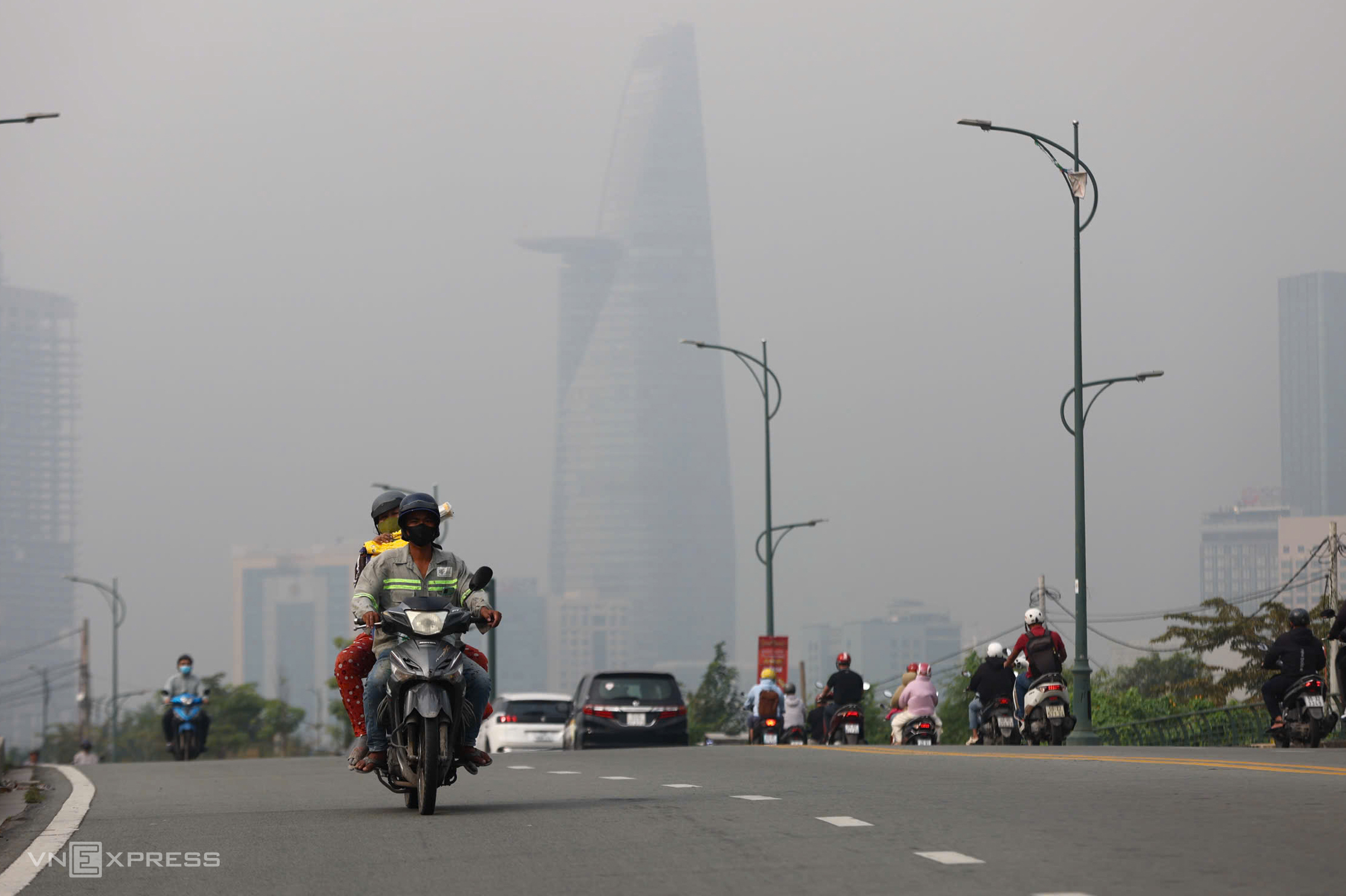 |
Ho Chi Minh City shrouded in mist, morning of 17/12. *Photo: Quynh Tran* |
A significant concern is PM2.5, ultrafine dust directly harmful to health, which exceeded standards by 1,1 to 4,6 times at several traffic and industrial locations. In the previous year, these PM2.5 levels remained within permissible limits. Benzene concentrations, a known carcinogen, also increased and surpassed standards at some traffic points. While noise levels slightly decreased overall, they still exceeded thresholds on major traffic arteries and at solid waste treatment areas. This is primarily due to high vehicle density, ongoing construction, infrastructure expansion, and material transport. Other parameters such as SO2, NO2, CO, lead (Pb), and vibration were generally stable and within permissible limits.
The primary emission sources contributing to this decline are transportation, industrial production, construction, daily domestic activities, and inter-provincial impacts from Dong Nai and Long An. Experts note that environmental pressure in Ho Chi Minh City is escalating due to a population exceeding 14 million people and approximately 12,7 million cars and motorcycles, coupled with rapid urbanization and industrialization.
Despite daily Air Quality Index (AQI) readings being mostly good (accounting for 56-87% of days in the year), the Department of Agriculture and Environment assessed Ho Chi Minh City's air quality in 2025 as showing signs of decline. Days with poor air quality accounted for 4-11%, with only one day recorded as bad, and no days recorded as very bad or hazardous. However, the increasing environmental burden necessitates tighter air quality control, particularly during peak hours.
To address these challenges, the city proposes installing an additional 157 air monitoring stations. These stations aim to enhance monitoring capabilities, provide early warnings, and improve emission source control. Concurrently, the construction sector recommends a roadmap for "greening" transportation, which includes expanding the use of electric and clean energy vehicles, piloting low-emission zones, tightening control over motorcycle emissions, and mandating construction projects to implement dust reduction measures during construction.
Le Tuyet