At the seminar "Leverage from 3,000 km of expressways" on 17/12, representatives from management agencies, businesses, and experts discussed factors accelerating expressway projects. Key points included resolving material supply challenges, applying special mechanisms, and reforming construction methods.
Data presented at the seminar revealed that from 2001-2010, Vietnam had only 89 km of operational expressways. This increased to 1,163 km between 2011-2020. In the last 5 years alone, the transport sector completed approximately 1,800 km, bringing the total length of expressways close to the government's 3,000 km target.
Drawing from the experience of constructing over 400 km of expressways, Nguyen Ba Doan, Political Commissar of Army Corps 12, emphasized that material supply is a decisive factor in project progress. He noted that projects which secure materials early gain a significant advantage in terms of schedule. For example, on the Can Tho - Ca Mau expressway project, proactive material sourcing allowed the construction unit to complete its work one month ahead of schedule.
Beyond materials, Doan also highlighted human resources as a major challenge, with engineers becoming increasingly difficult to recruit while construction demands grow. He proposed appropriate incentive and reward mechanisms for contractors who organize additional shifts and overtime to maintain progress.
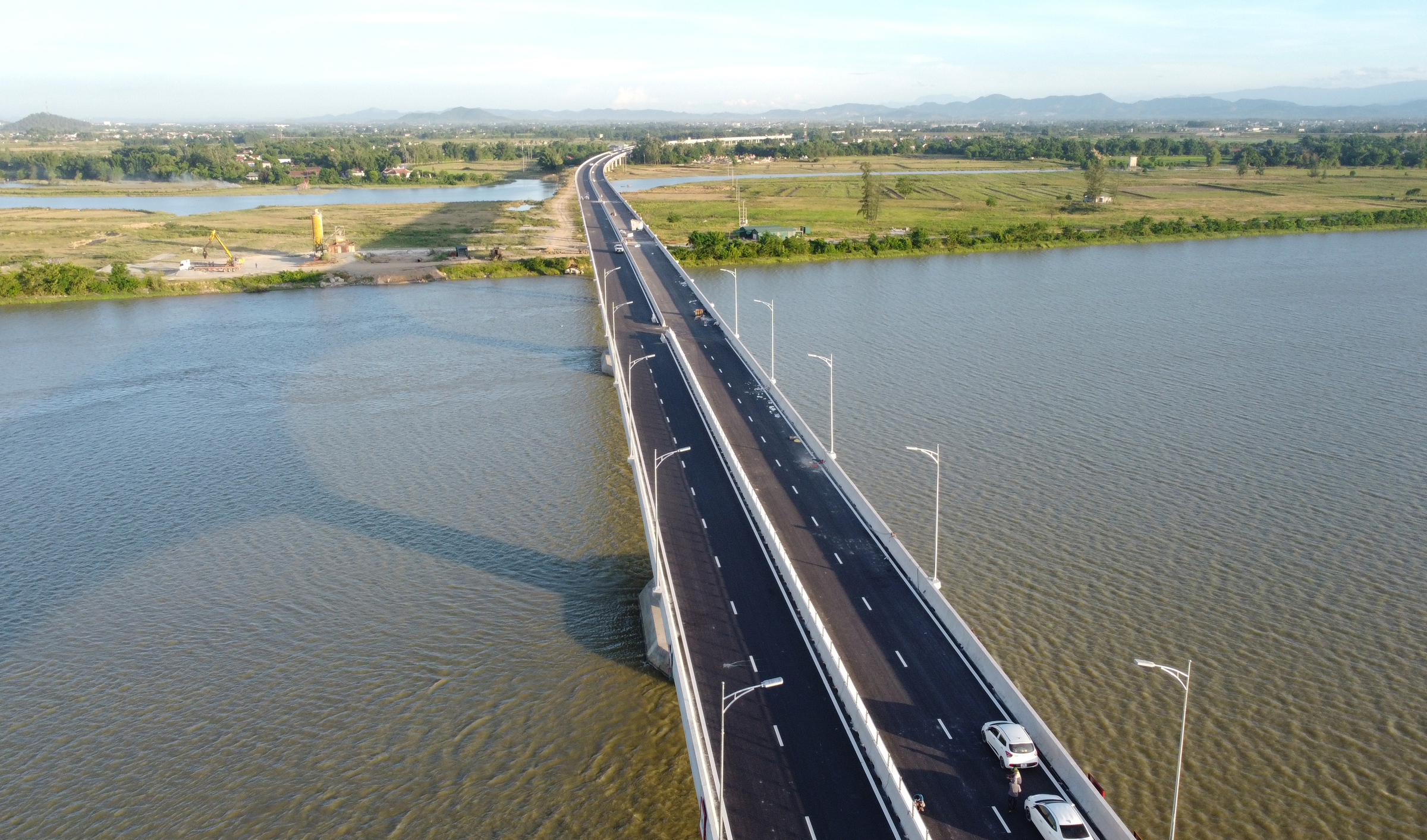 |
The Dien Chau - Bai Vot section of the North-South expressway passing through Ha Tinh. Photo: Duc Hung |
The Dien Chau - Bai Vot section of the North-South expressway passing through Ha Tinh. Photo: Duc Hung
Sharing insights from a business perspective, Pham Van Khoi, Chairman of Phuong Thanh Company, recounted an experience on the Vung Ang - Bung project in Quang Tri. The sand well foundation method required yellow sand, but the licensed local mine only yielded about 10,000 m3 annually, far below the project's demand. Despite local authorities approving material extraction, public opposition caused delays. To ensure progress, the contractor had to switch to an alternative method, incurring an additional cost of about 40 billion VND. This adjustment, according to Khoi, allowed the project to finish 6 months ahead of schedule.
Khoi also noted that domestic businesses are actively adopting many modern global technologies but face hurdles with testing regulations and unit prices. The lengthy process for some technologies to be approved for practical application leads businesses to seek more flexible mechanisms.
Regarding tunnel construction, Nguyen Quang Huy, General Director of Deo Ca Group, stated that on tunnel 3 of the Quang Ngai - Hoai Nhon project, the company improved construction methods by expanding the tunnel space to accommodate more equipment and machinery. This innovation increased the length of each excavation step from 1-3 meters to 4-6 meters, significantly reducing construction time.
Le Van Duong, Deputy Director of the State Authority for Construction Quality Inspection, mentioned that his agency has conducted hundreds of project surveys, involving material and technology experts. He explained that the agency not only inspects but also advises and supports contractors and investors in overcoming difficult stages.
Le Quyet Tien, Director of the Department of Construction Economics and Investment Management (Ministry of Construction), highlighted that many challenges for the North-South expressway projects were resolved through resolutions from the National Assembly and the Government. These allowed for parallel investment procedures, expedited site clearance, and swift allocation of material mines.
According to Tien, the State Steering Committee for National Important Projects and Key Transport Sector Projects, along with the Ministry of Construction, consistently monitors project sites. This ensures timely resolution of emerging issues and facilitates resource flow for contractors.
Concluding the seminar, Associate Professor Doctor Tran Chung, Chairman of the Vietnam Association of Road Traffic Infrastructure Investors, stated that the 3,000 km expressway target serves as a foundation for achieving the 5,000 km goal by 2030. This is linked to improving institutions, mechanisms, and applying scientific and technological advancements in transport infrastructure construction.
Doan Loan