In mid-march, every day from 5 PM, the Rao Nan river, a tributary of the Gianh river flowing through Linh Can Son village, Nam Ba Don commune, becomes bustling. Dozens of people bring nets, paddle boats, or sit in small riverside huts, preparing their lift nets.
The section of the river flowing through Linh Can Son village is about 3-5 meters deep with calm waters. One side features a residential area, the other an acacia plantation. From here, the Gianh river mouth is about 25 km away. In march, sardines migrate from the sea into the river to spawn. Upon encountering the Rao Nan irrigation dam, which is about 6 meters high, the fish cannot swim further upstream and gather in large schools in the downstream area.
According to locals, sardines typically move in large schools. During the day, they swim in deeper waters, but as dusk falls, they rise closer to the surface, swimming along the riverbanks. The period from 5 PM to 8 PM is when the fish are most abundant.
To catch sardines, Mai Xuan Hao has invested in two lift net setups positioned close to the riverbank, each costing about 30 million dong and usable for about 6 years. Each lift net system consists of four large poles driven into the riverbed, supporting a 50 square meter net below. The four corners of the net are connected to pull ropes via a pulley system that leads into a small hut.
Each time he fishes, he lowers the net to the riverbed for about 20 minutes before pulling it up. As the pulley ropes turn, the net is gradually raised from the water, gathering all the fish into its base. If the operation is too slow, fish can jump out.
The waterlogged net is quite heavy. Hao paddles a basket boat to the middle of the river, using a pole over one meter long to stir beneath the net, herding the fish into one corner and helping drain water. He quickly collects the fish from the bottom, unties the rope, and drops them into a plastic basket below.
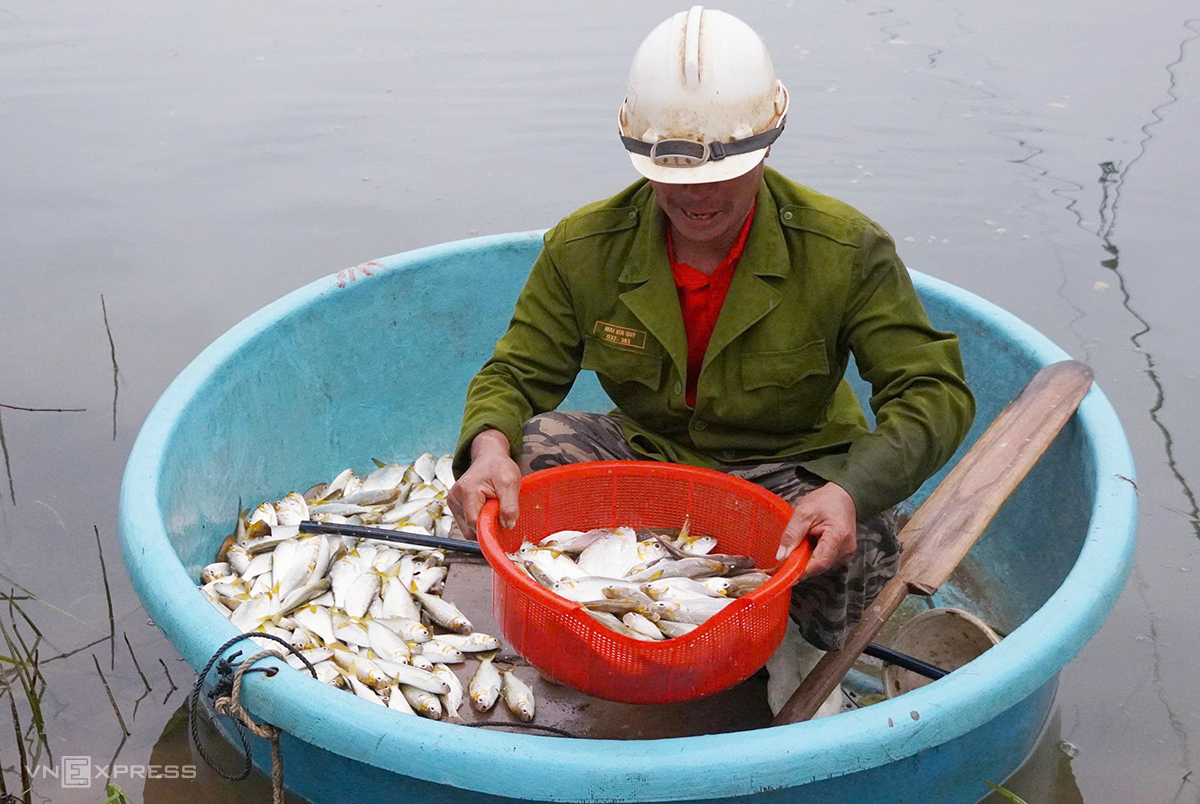 |
Sardines caught by Hao's lift net are brought to shore for sale. Photo: Dac Thanh |
The process of pulling the lift net repeats multiple times, ending at 8 PM. Since before Tet (Lunar New Year), he has gone fishing every day. "On good days, I get over 100 kg, selling for more than 3 million dong; on slow days, only a few dozen kilograms," Hao stated.
According to Linh Can Son residents, sardines are considered a "gift from nature" for this river region. However, the fishing season only lasts a few months each year. Therefore, after the sardine season concludes, the lift nets are kept to continue catching other fish and shrimp in the river.
Besides using lift nets, many villagers also cast fishing nets to catch sardines. As dusk falls, dozens of small boats depart the shore, spreading out along the river section. Tran Dinh Tuat, a regular net fisherman on the Rao Nan river, prepares three nets, each about 100 meters long and nearly one meter high, woven from fine nylon thread.
Every afternoon, Tuat paddles his boat over 10 meters from the bank and casts his nets along the current. About half an hour later, once the nets cover a section of the river, he and others return home for dinner.
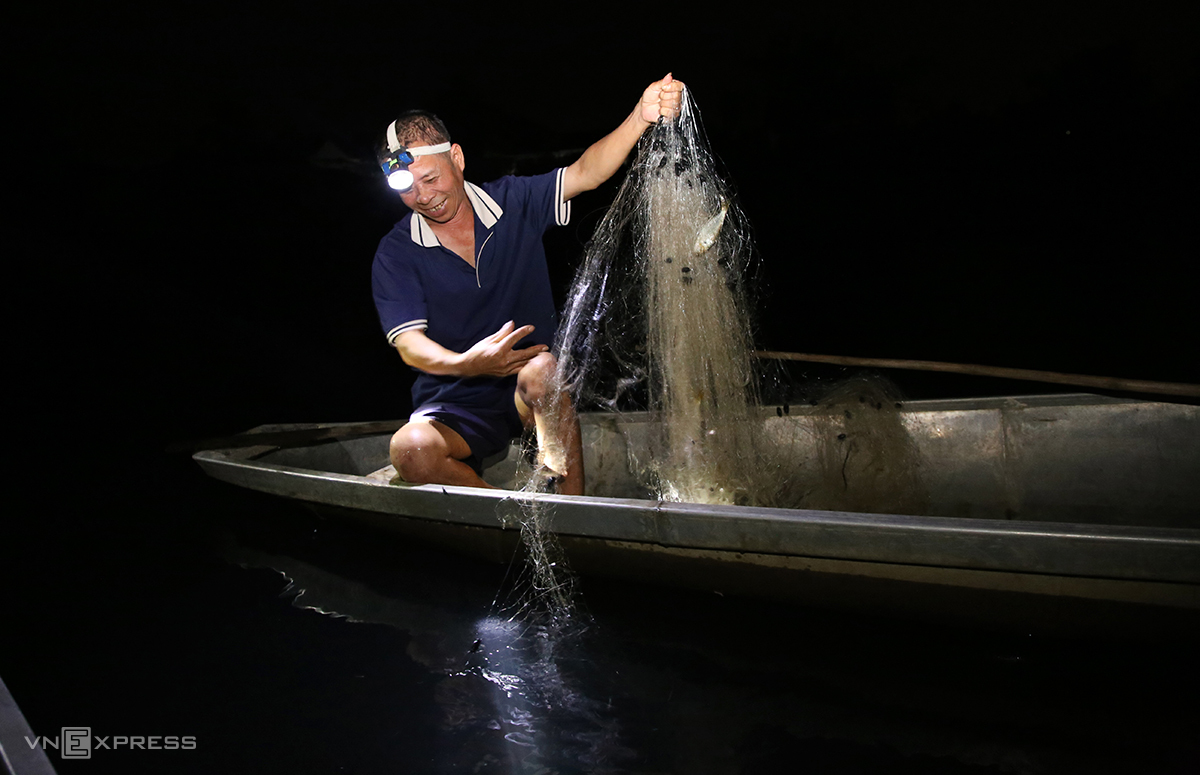 |
After nearly two hours of casting, Tuat retrieves his nets. Photo: Dac Thanh |
Around 7:30 PM, they bring flashlights to the river to retrieve their nets. By this time, it is completely dark, with only flickering flashlight beams visible on the water. The sound of paddles splashing mixes with calls asking about the catch.
Sitting in his small boat, Tuat wears a headlamp and pulls up sections of the net one by one. Silvery sardines are entangled in the mesh. For Tuat, fishing is a secondary occupation, an evening endeavor to earn extra income and provide food for his family.
Baskets of freshly caught, silvery fish are sold directly at the riverbank to traders or local residents. If not all are sold, they put the fish in ice chests to preserve them at home. Before and after Tet Nguyen Dan (Lunar New Year), when yields are not yet high, sardines sell for about 40,000 dong per kg. Currently, with more fish arriving, the price has dropped to 25,000 dong per kg.
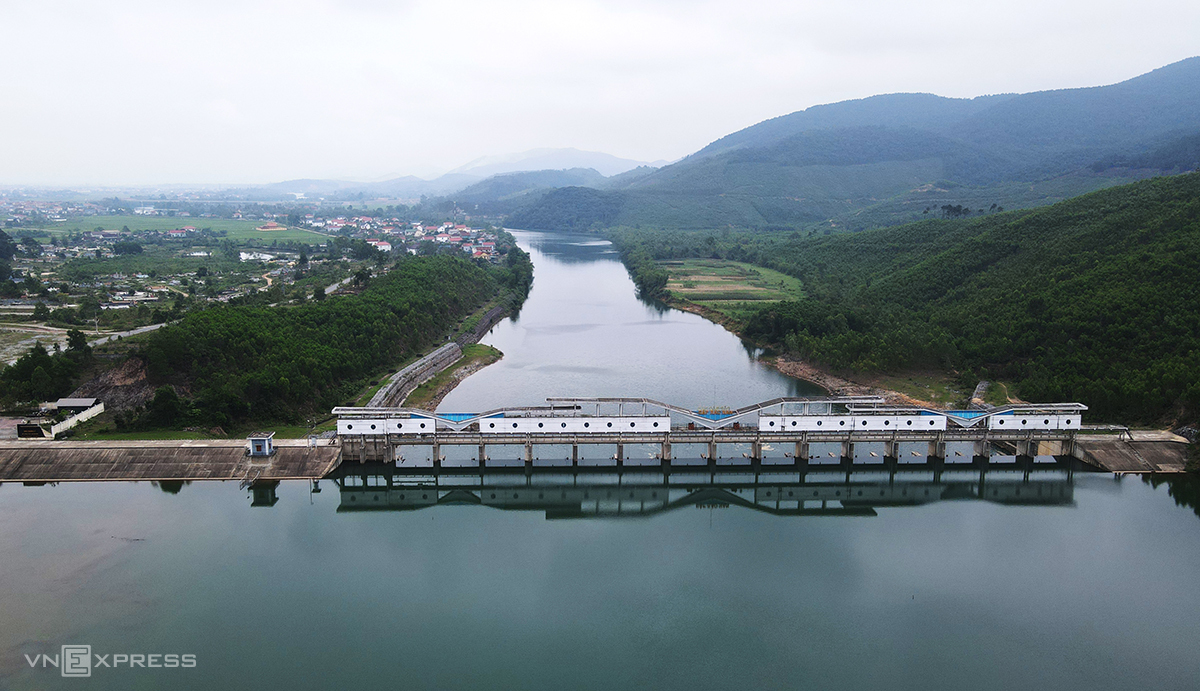 |
Sardines often gather at the foot of the Rao Nan irrigation dam. Photo: Dac Thanh |
Sardines belong to the same family as herring but have thicker bodies and are larger. Adult fish are about 25 cm long, with flattened, silvery-white bodies, small scales, and oily, shiny skin. The flesh is soft but contains many small bones. Local residents prepare sardines in various ways, such as deep-frying, charcoal grilling, braising, or grinding them into fish cakes.
Dac Thanh