At 11 am on 17/12, data from two monitoring stations of the Environment Agency showed Hanoi's air quality was unhealthy. The station at the gate of Hanoi University of Science and Technology on Giai Phong Street recorded an AQI of 178, while the station at 556 Nguyen Van Cu registered 160.
Pollution began to rise on the afternoon of 16/12, following the weakening of the cold air mass. Before this, Hanoi had experienced three consecutive days of good air quality, with AQI levels below 50.
Beyond Hanoi, several northern localities also reported unhealthy air quality. The monitoring station at 437 Nguyen Van Linh, Hung Yen province, recorded an AQI of 167; the station at 106 Tran Hung Dao, former Hai Duong City (now Hai Phong City), registered an AQI of 160. Thai Nguyen and Bac Giang experienced poor air quality.
AQI, or air quality index, reflects the level of pollution and its impact on human health; a higher index indicates a greater risk. According to authorities, current air pollution is mainly due to fine dust particles, PM2.5.
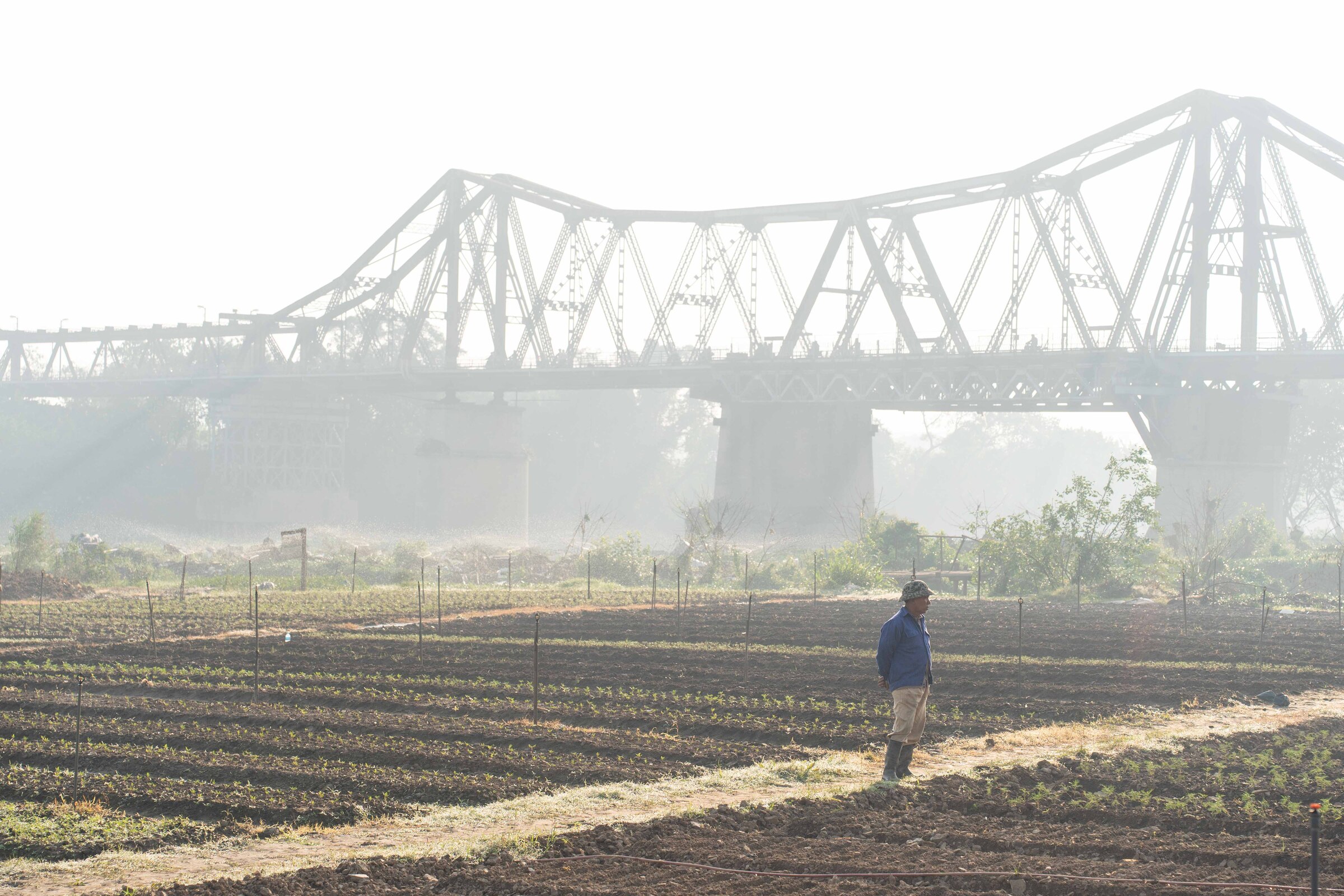 |
Air pollution on 29/11 at the Red River's sandbank. Photo: Hoang Giang
Data from the IQAir system showed that at noon on 17/12, Hanoi ranked 12th among the world's most air-polluted cities with an index of 179; Sarajevo (Bosnia and Herzegovina) topped the list with an AQI of 401. In Hanoi, the Trung Yen Park station recorded the highest AQI at 256, while areas like Ho Tay, Hoang Quoc Viet, and Tran Vu fluctuated between 170 and 180.
The Environment Agency forecasts that air quality will continue to worsen in the coming days. On 18/12, the AQI in Hanoi, Hung Yen, Hai Phong, Ninh Binh, and Bac Ninh could exceed 200, reaching very unhealthy levels; Ninh Binh and Hung Yen specifically might surpass 230.
According to the air quality forecasting system of the University of Engineering and Technology, Vietnam National University, Hanoi, the northern region is experiencing a prolonged pollution episode from 16/12 to 20/12, with the peak pollution expected around 19/12 before gradually decreasing due to strengthening cold air.
Previously, from 8/12 to 14/12, the northern region, especially Hanoi, endured its most severe air pollution episode since the beginning of winter. On the night of 12/12, the Environment Agency's monitoring station recorded an AQI of 282, approaching hazardous levels; on the IQAir system, many monitoring points in Hanoi displayed hazardous AQI levels, exceeding 300.
Gia Chinh