On 2/12, the Traffic Police Department (Ministry of Public Security) announced that the government amended Clause 3, Article 10 of the Road Traffic Order and Safety Law, incorporating feedback from National Assembly delegates.
According to the law, from 1/1/2026, children under 10 years old and shorter than 1.35 m must not sit in the same row as the driver (unless the vehicle has only one row of seats) and must use or be instructed to use appropriate safety devices. Drivers who fail to comply will face fines from 800,000 to 1 million VND under Decree 168/2024.
However, the department adjusted the regulation to exempt commercial passenger transport vehicles from this requirement. This aims to avoid difficulties for taxis, ride-hailing services, and passenger buses, while also aligning with vehicle usage conditions in Vietnam.
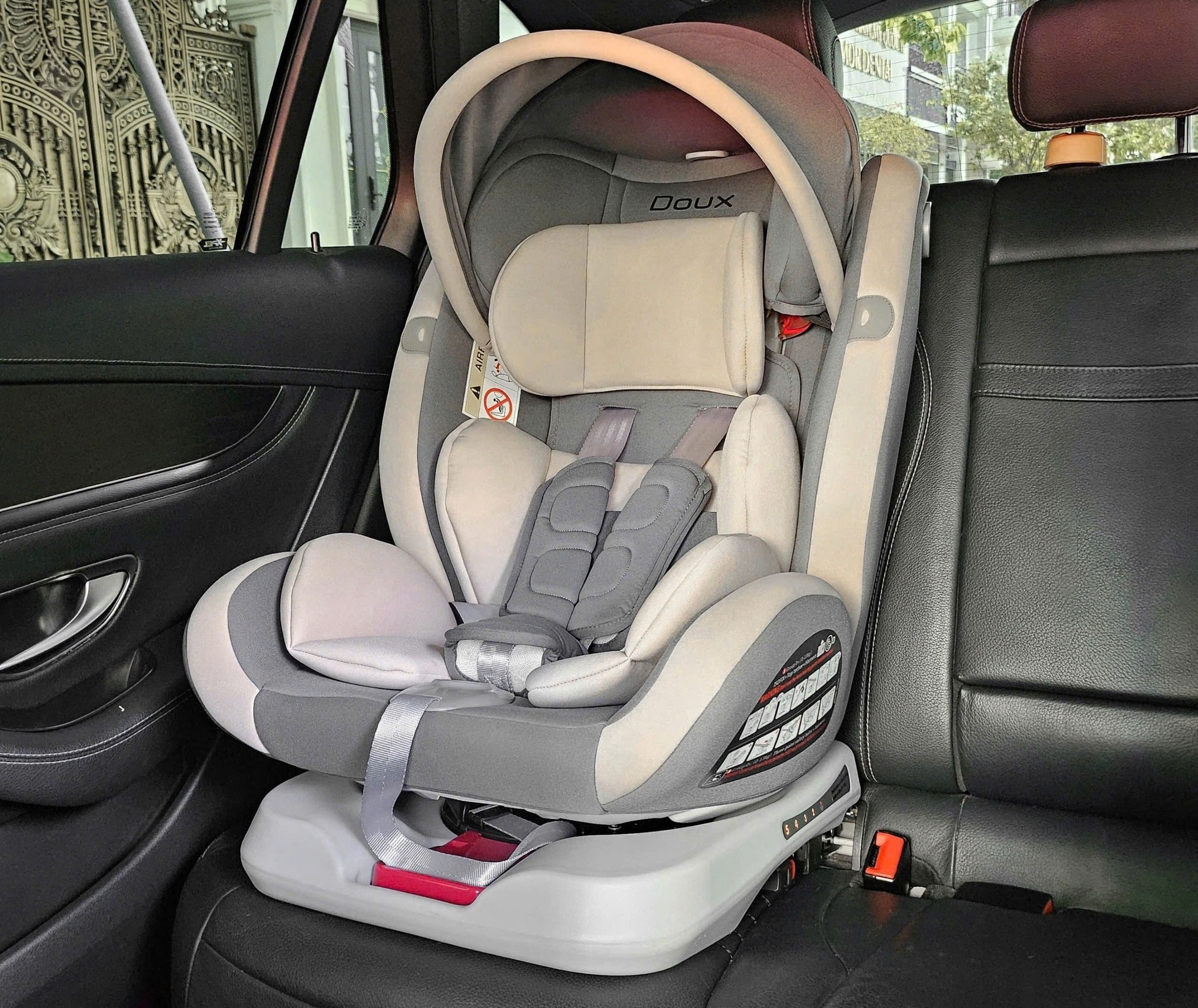 |
Child safety seats installed in a car. *Photo: Mina* |
Previously, during a discussion session on 17/11, many National Assembly delegates argued that mandating child seats in taxis and ride-hailing vehicles from 2026 could increase costs, pose risks, and be impractical. Delegate Ha Sy Dong noted that while the regulation suits countries with high car ownership, a rigid requirement in Vietnam might lead parents to transport children by motorbike, which carries greater risks. He cited experiences from Indonesia and the Philippines, where similar regulations resulted in a 15-30% increase in motorbike transport for children.
Standard 123/2024 specifies that child safety seats come in 4-5 sizes based on weight. Delegate Dong pointed out that if this were mandatory, each taxi would need to carry all these seat sizes, which he considered "impossible to implement." Accommodating families with two children would be particularly challenging for taxis. Additionally, tourists cannot carry seats throughout their journey, and the limited number of taxis equipped with child seats would result in booking difficulties, longer wait times, and increased costs.
Transport businesses stated that passenger buses and contract vehicles are unsuitable for installing additional child seats, noting that existing seatbelts are the only solution for various passengers. Operators also lack prior knowledge of children traveling until passengers board.
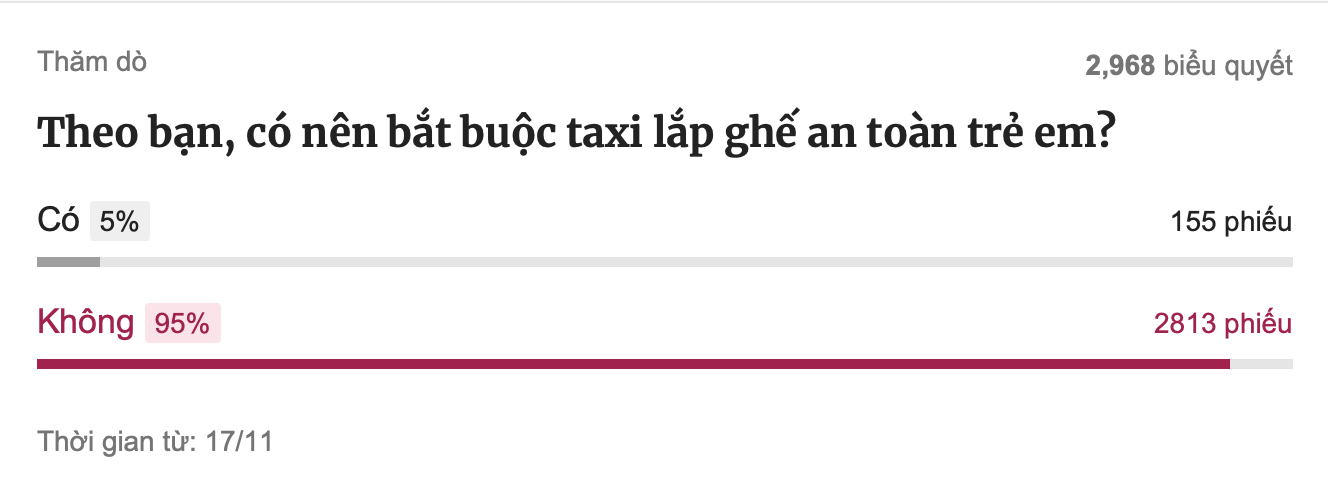 |
Survey results on VnExpress. |
However, Doctor Tran Huu Minh, Chief of Office of the National Traffic Safety Committee, believes that all transport modes still need a roadmap to meet requirements for enhancing child safety.
Child safety devices are defined as systems of seats, bassinets, or booster cushions, accompanied by harnesses, designed to secure children and reduce injuries during collisions or sudden deceleration.
By Viet An