During a National Assembly session on 8/8, General Phan Van Giang, Deputy Prime Minister and Minister of National Defense, stated that a draft amendment to nine laws aims to improve the organization and operational conditions of commune-level military forces within the two-tier local government model.
Across the nation, 3,319 commune-level military commands have been established. Previously, each district typically had one training ground. Following the abolition of the district level and reorganization of communes, each locality now requires a training site for mobilized reserve forces and militia.
However, General Phan Van Giang noted that not every commune or ward needs to construct training grounds for high-lethality weapon exercises. Drills, live-fire exercises, and certain tests can be centrally organized at the provincial level.
Commune-level training grounds will primarily support infantry combat techniques, tactics, physical training, and other basic content. Their size may be about one hectare or smaller, depending on local conditions. In densely populated urban areas with limited land, units can coordinate to share facilities.
"Without training grounds, it is impossible to conduct training, making it difficult to meet force development requirements," he stated, citing the principle, "The more you sweat in peace, the less you bleed in war."
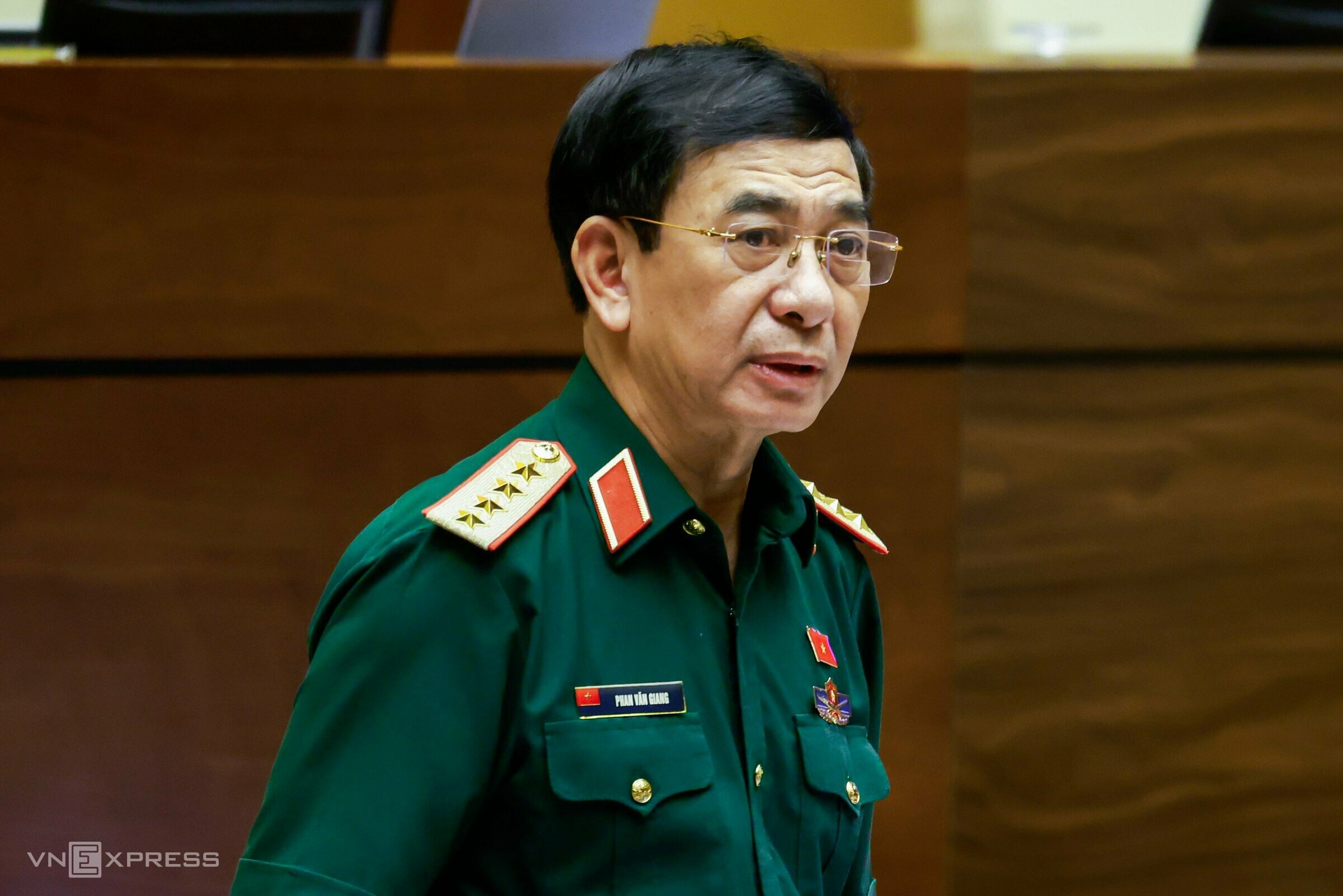 |
Deputy Prime Minister and Minister of National Defense Phan Van Giang explains the draft law to the National Assembly on the morning of 8/8. *Photo: Hoang Phong*
The draft specifies that local budgets will fund the construction of headquarters, training grounds, and drill fields, with the central government budget supporting disadvantaged localities. The Ministry of National Defense is also gradually equipping commune-level military commands and militia forces.
According to General Phan Van Giang, each commune-level military command will be equipped with two vehicles. Localities with better resources can add suitable additional vehicles.
Strict penalties for military service evasion
Previously, Major General Nguyen Thanh Trung, Political Commissar of the Ho Chi Minh City Military Command, noted that most young people understand their responsibilities and are ready to enlist. However, a segment still deceives during registration, preliminary screening, health checks, or deliberately disobeys call-up orders. This act of military service evasion undermines the rule of law and creates injustice for those who comply.
The delegate agreed with the draft's specific definition of violations, including non-compliance with military service registration decisions. However, he proposed clarifying the coordination mechanism between local authorities and functional agencies to detect and strictly penalize those who evade service.
Alongside sanctions, agencies need to strengthen public awareness campaigns and education to help young people understand that enlisting is not only a duty but also an honor and source of pride.
The National Assembly is expected to vote on the draft law on 24/8.
Son Ha