According to the roadmap mandated by the Prime Minister, from 7/2026, gasoline motorbikes will not be allowed to circulate within Hanoi's Ring Road 1, which includes old central districts such as Hoan Kiem, Ba Dinh, Dong Da, and Hai Ba Trung.
To implement this, the Hanoi Department of Construction is researching solutions such as adding parking areas, offering preferential parking fees for green vehicles, and providing free use of roads and sidewalks for up to five years for companies operating public electric bicycles and electric motorbikes.
Hanoi plans to allocate a minimum of 15% of parking spaces in lots within Ring Road 3 for charging stations by 1/1/2030; new constructions are expected to designate at least 30% of parking spots with public charging stations. Charging stations are identified as shared infrastructure, not exclusive to any brand.
Units have surveyed 110 potential locations for centralized charging stations from Ring Road 3 inwards for the initial pilot phase. The city is also researching a battery swapping station system for two-wheeled electric vehicles.
Hundreds of thousands of parking spaces lacking
While acknowledging the city's efforts to achieve the goal of transitioning from gasoline motorbikes to clean vehicles, experts point out that Hanoi faces a severe shortage of land for static traffic, including parking lots and spots. This land currently accounts for only about 0,3-0,4% of urban construction area, whereas general and international planning standards require 3-4%. Both Ring Road 1 and 2 lack sufficient land for building large parking facilities. Without adequate parking, vehicles will overflow onto streets, sidewalks, or into spontaneous residential areas.
According to Associate Professor Doctor Vu Hoai Nam from the University of Civil Engineering, in the initial period of banning gasoline vehicles from Ring Road 1, hundreds of thousands of residents around Hanoi or from outside provinces will not be able to immediately switch to electric vehicles. Alongside the need for motorbike parking at Ring Road 1, there is a need to consider shuttle vehicles such as buses, taxis, and contract vehicles operating in the city center. Limited land will be a major barrier, requiring the city to implement comprehensive planning and invest in infrastructure early.
Concurring with this assessment, Nguyen Van Quyen, Chairman of the Vietnam Automobile Transport Association, added that parking lots should also serve as large-capacity, affordable, 24/7 charging and battery swapping stations along radial routes. These locations should also connect with public transportation for residents to easily access trams, BRT, buses, or bicycles to the city center.
He recommended that the city implement policies to support parking lot businesses and charging station investors, including assistance with site clearance, reduced land use fees, and decisive reclamation of underutilized land. He also suggested organizing parking areas at public offices, cultural and sports centers, or utilizing undeveloped park and flower garden projects.
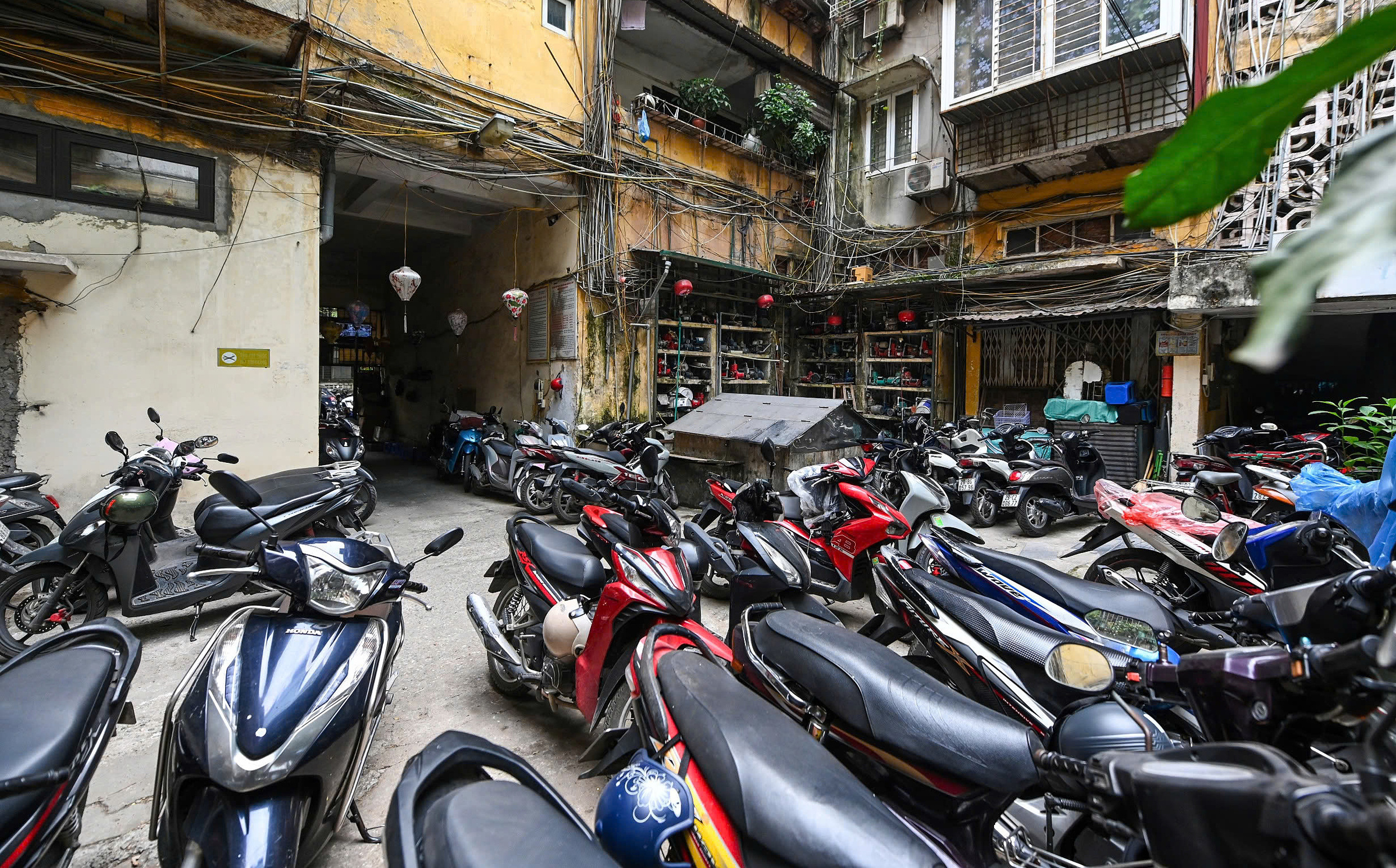 |
Parking lot at an old apartment complex on Le Phung Hieu street. *Photo: Giang Huy* |
Regarding investment in electric vehicle charging stations, Mr. Quyen believes that the 110 charging stations within Ring Road 3, as planned by Hanoi, are insufficient. Along with increasing the number of charging stations, technical factors such as stations having multiple charging ports for various vehicle types need to be considered from the outset.
Nguyen Manh Cuong, Chairman of the Board of Directors of EverEV Company, stated that with incentives, his company is ready to invest approximately 500 ty VND to establish about 2,500 motorbike charging stations or 100 automobile charging stations. However, the biggest issue is the land shortage; many wards and communes, despite having available land, do not agree to his company installing electric vehicle charging stations.
"The city needs to assign electric vehicle charging station construction targets to each ward and commune for local facilities to implement. Parking lots, flower gardens, parks, and even ward offices or cultural centers could be utilized to site charging stations," Mr. Cuong proposed.
Small-capacity charging pole solutions for old apartment buildings
Another challenge is charging points in high-rise apartment buildings. Nguyen Manh Cuong noted that old apartment buildings often do not meet fire safety standards, lacking backup power, fire alarm systems, and smoke extraction, suggesting that charging poles should be placed above ground.
According to Associate Professor Doctor Vu Hoai Nam, residents in apartment buildings with old electrical systems often worry about electric vehicle battery fires, while upgrading the electrical system is very costly. A feasible solution is to install small-capacity charging poles for electric motorbikes, avoiding a complete renovation of the apartment basement, thereby significantly reducing costs.
Additionally, to meet public demand, the city could develop a battery swapping station model. This is the most suitable solution because residents do not need long charging times, vehicles do not occupy much space for charging, and it is safer as batteries are charged in a controlled environment, reducing fire and explosion risks in apartment basements.
Battery swapping points could be located at convenience stores, parking lots, gas stations, and charging stations. To achieve this, standards for battery types are needed to allow for quick battery replacement. "If shared batteries and charging stations are convenient, people will voluntarily abandon gasoline vehicles," Associate Professor Doctor Vu Hoai Nam commented.
Mr. Nam believes that a detailed survey of public demand is necessary to calculate current electricity usage and prepare for future power sources. Hanoi has approximately 8 million gasoline motorbikes, and if they convert, the electricity demand will be substantial.
Experts also recommend complete policies for battery waste disposal and standards for electric motorbikes. Currently, people freely discard used batteries into trash bins, posing a significant threat to soil and water environments. "Electric vehicles reaching consumers need rigorous quality inspection, and the use of electric vehicles with unclear origins should be banned," Mr. Quyen stated.
Doan Loan