The project's groundbreaking ceremony took place in the Ha Long Xanh station area, spanning Tuan Chau and Viet Hung wards in Quang Ninh province. This marks the first high-speed railway to begin construction in Vietnam.
The Hanoi - Quang Ninh line features a dual-track design, a 1,435 mm standard gauge, and will be electrified. Its starting point is at the National Exhibition and Fair Center in Dong Anh commune, Hanoi, with the terminus located in the Tuan Chau ward park area, Quang Ninh province.
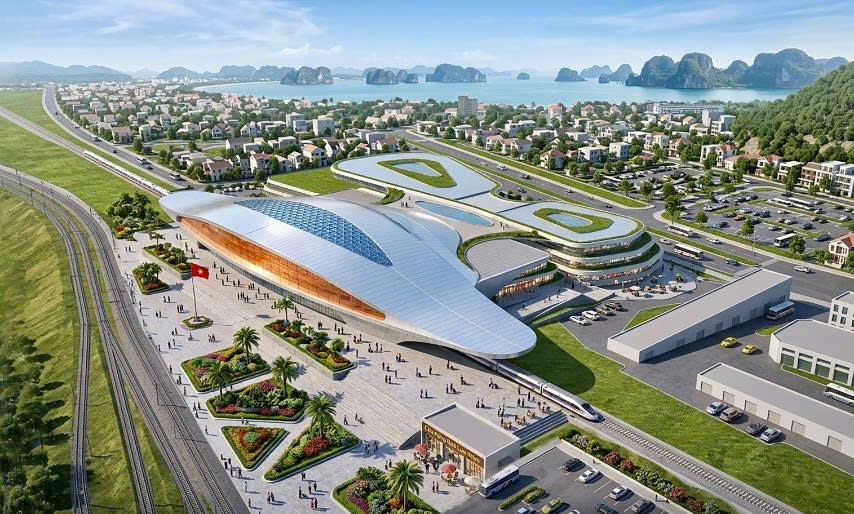 |
Rendering of Ha Long Xanh station for the Hanoi - Quang Ninh high-speed railway. Photo: Xuan Hoa |
The main section of the line is designed for speeds of 350 km/h, while the segment passing through Hanoi will operate at 120 km/h. The route will include five stations: Co Loa, Gia Binh, Ninh Xa, Yen Tu, and Ha Long Xanh. One depot will be situated at Ha Long Xanh station.
The project requires approximately 551 hectares of land: 44 hectares in Hanoi, 19 hectares in Bac Ninh, 210 hectares in Hai Phong, and 278 hectares in Quang Ninh.
The total investment for the project is estimated at 147,370 billion VND, excluding 10,270 billion VND for site clearance costs, which will be covered by the state budget. The investor's capital contribution is approximately 22,110 billion VND, with the remaining over 125,000 billion VND, representing about 85% of the total capital, to be mobilized. The project's investor is Vinspeed High-Speed Road Investment and Development Joint Stock Company.
The railway is expected to be completed in 2028, significantly reducing the current travel time by road between Hanoi and Quang Ninh from two to 2,5 hours to just 25 to 30 minutes.
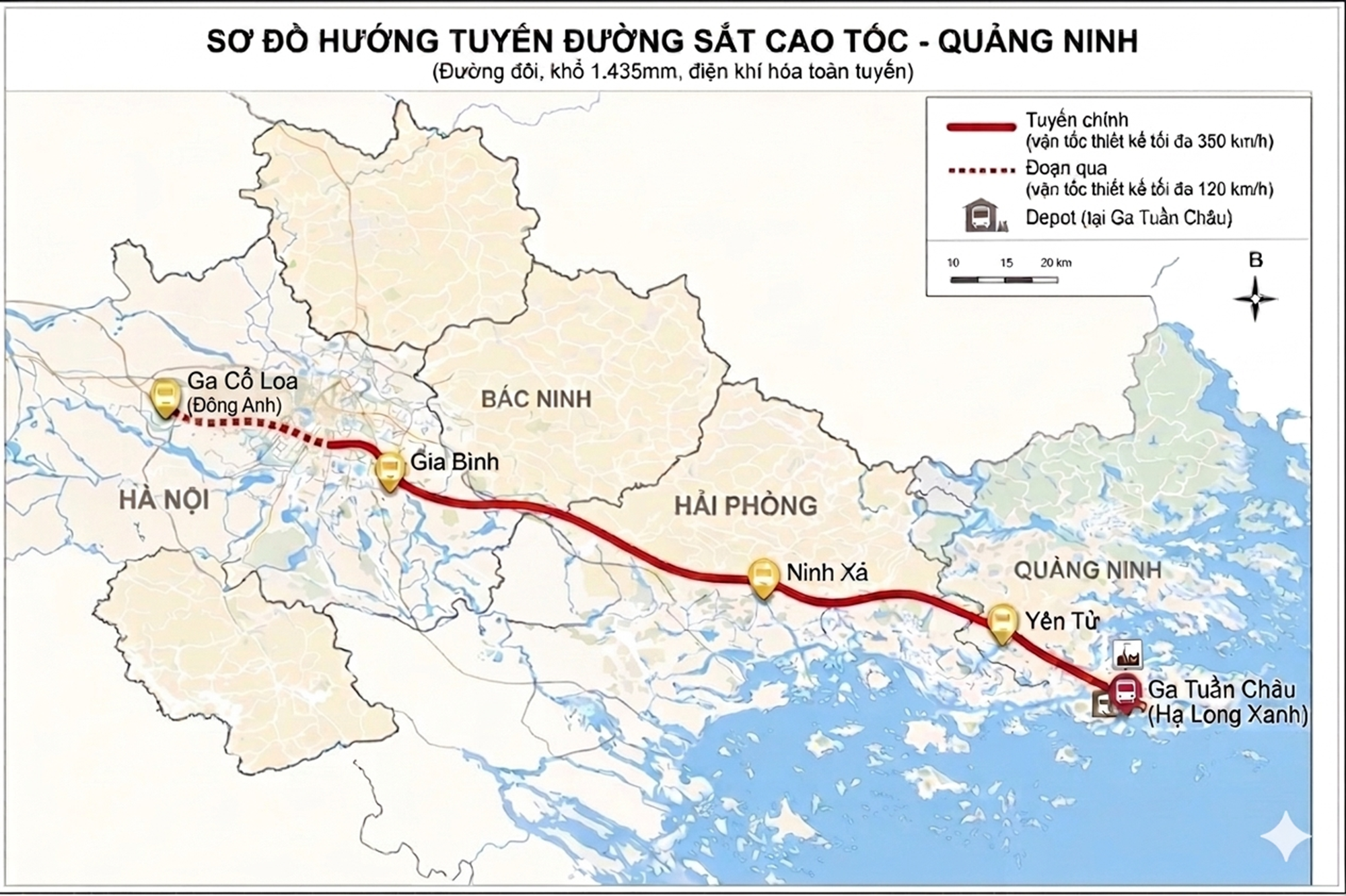 |
Route map of the Hanoi - Quang Ninh high-speed railway. Graphic: Le Tan |
According to the Quang Ninh Provincial People's Committee, the railway aims to meet passenger transport demand along the Hanoi - Bac Ninh - Hai Phong - Quang Ninh corridor. It is expected to drive rapid and sustainable socio-economic development, leverage the advantages of the regional economic corridor, and enhance both domestic and international railway network connectivity.
Le Tan