During a working session with the Ministry of Home Affairs on the morning of 9/9, Deputy Prime Minister Pham Thi Thanh Tra emphasized that reforming salary and social insurance policies is a complex issue affecting many groups. Therefore, the project proposal must be meticulously prepared.
She instructed the Ministry of Home Affairs to research multiple options and organize independent consultations with expert groups. This approach aims to gather diverse perspectives and strengthen the scientific and practical basis before selecting a proposal to report to competent authorities.
According to the plan, the Ministry of Home Affairs will finalize the draft project from August to October 2026, and the draft central resolution in January 2027. The project is expected to be submitted to the Politburo and Secretariat in February, and the Central Committee in March 2027.
The project will comprehensively evaluate the implementation of Resolution 27 on salary policy reform and Resolution 28 on social insurance policy reform. Resolution 27, issued in 2018, aimed to establish a new salary table system based on job positions, titles, and leadership roles, replacing the current calculation method based on base salary and coefficients.
The implementation of the new salary table was subsequently postponed due to various obstacles. Currently, officials, civil servants, and public employees continue to receive salaries based on the base salary, coefficients, and allowances. With a base salary of 2.53 million VND, civil servants' salaries based on coefficients range from approximately 3.4 to 25.3 million VND per month, and public employees from 3.8 to 20.2 million VND, not including allowances.
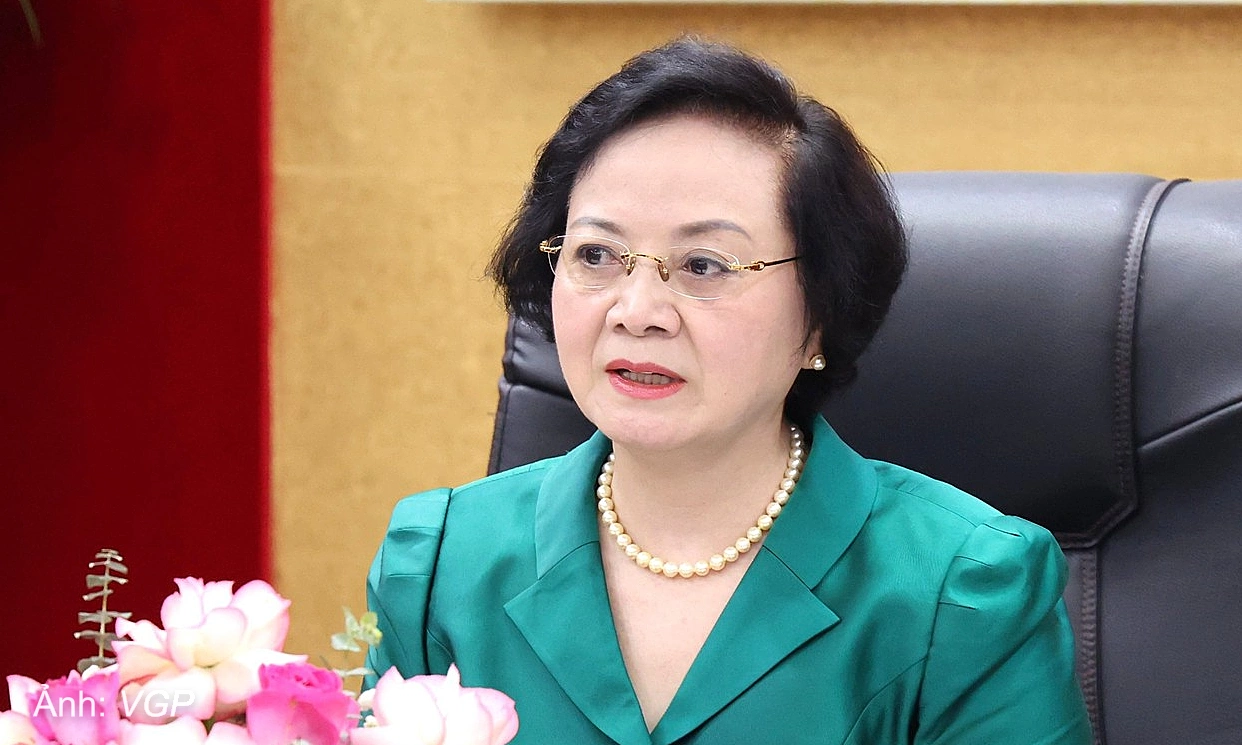 |
Deputy Prime Minister Pham Thi Thanh Tra works with the Ministry of Home Affairs on the morning of 9/9. Photo: VGP |
Deputy Prime Minister Pham Thi Thanh Tra works with the Ministry of Home Affairs on the morning of 9/9. Photo: VGP
"Cannot simply issue a project and leave localities to implement it"
During the same meeting, the Deputy Prime Minister instructed the Ministry of Home Affairs to continue refining the overall organizational model of the political system and two-level local government. She specifically requested close monitoring of commune-level operations to promptly identify and address issues.
The project to build a core commune-level administrative unit model must be completed by 15/9 for reporting to the Standing Government. The Ministry of Home Affairs is also tasked with finalizing the community self-governance model suitable for villages and residential clusters after rearrangement.
According to the Deputy Prime Minister, the workload related to local government, especially at the commune level, remains substantial. The Ministry of Home Affairs must maintain regular contact with localities to grasp the realities, advise on policies, and build a strong team of officials.
"We cannot simply issue a project and leave localities to implement it themselves," she stated, urging continuous supervision and evaluation to identify areas needing adjustment.
The Ministry of Home Affairs is concurrently assigned to develop the organizational framework for the state administrative system at the central, provincial, and commune levels, along with the personnel quota plan for the 2027-2031 period.
Vu Tuan