Speaking at the Ministry of Home Affairs' 2025 work review and 2026 task deployment conference on the afternoon of 29/12, Deputy Prime Minister Nguyen Hoa Binh urged the Ministry to promptly advise on solutions for accurately assessing the competence and qualities of officials and civil servants. He emphasized that only with precise evaluation tools can officials be appropriately assigned, noting that official evaluation has long been a weak point in the political system.
According to the Deputy Prime Minister, evaluations must ensure that those promoted earn the full conviction and acceptance of their colleagues. He highlighted the need to prevent scenarios where passive, silent officials who do nothing, contribute nothing, avoid engagement, and simply wait are promoted due to good connections, while dedicated individuals are not recognized for their contributions.
One solution he suggested is the strong application of technology in official evaluations. This approach aims to ensure objectivity and substance, thereby fostering a competent and qualified workforce that meets new demands.
The Deputy Prime Minister also requested the Ministry of Home Affairs to quickly develop solutions to identify, attract, retain, and effectively utilize talented individuals in the public sector. He cited instances where talented people were drawn into the political system but left after a short period, due to the strong appeal of the non-state sector. He warned that if the public sector lacks policies that value talent and a suitable working environment, retaining skilled individuals will be difficult.
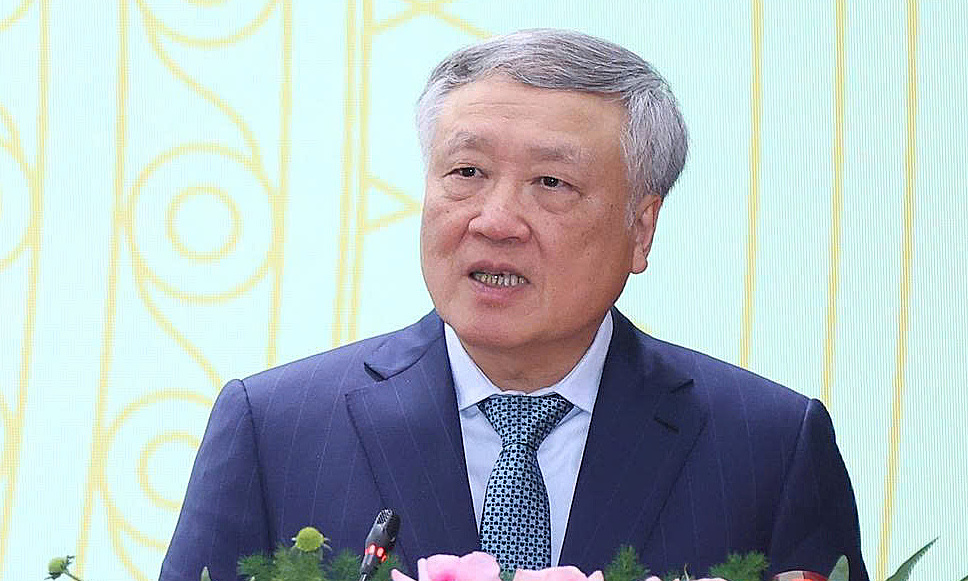 |
Deputy Prime Minister Nguyen Hoa Binh speaks on the afternoon of 29/12. *Photo: Nguyen Hoang*
He noted that Vietnamese people, both domestically and abroad, possess high capabilities, enabling them to meet demands in many fields facing global labor shortages, such as semiconductor chips and artificial intelligence. While their work in the private sector contributes to the nation, attracting this workforce into the public sector would significantly improve national administration, enhancing service efficiency for citizens and businesses.
Emphasizing that 2026 marks the beginning of the 14th Party Congress term, the Deputy Prime Minister urged the home affairs sector to maximize the capabilities of officials, civil servants, and public employees. Concurrently, it must ensure the effective operation of the two-tier local government model. He believes that the commune level now holds a different position and role, not only being close to the people but also bearing the responsibility for social governance and local socio-economic development, requiring prompt solutions to remove bottlenecks.
At the conference, Minister of Home Affairs Do Thanh Binh stated that 2025 holds special significance for the entire sector. Key achievements include advising on streamlining the apparatus, rearranging administrative units, and organizing two-tier local government. These efforts create a new appearance for the national administration, moving towards leanness and efficiency.
According to the Minister, many new policies regarding civil servants and public employees have been promulgated. The amended Law on Public Employees focuses on management by job position, serving as the basis for recruitment, placement, evaluation, planning, appointment, training, fostering, and implementing regimes and policies. Civil servants are now managed uniformly from the central to commune levels.
The Ministry of Home Affairs has also advised on caring for the material and spiritual lives of over 9.2 million people who rendered meritorious service to the revolution, including: over 1.2 million martyrs, nearly 140,000 heroic Vietnamese mothers, and over 600,000 wounded and sick soldiers.
Vu Tuan